City Council hears divided testimony on 'Respect Check' pay differential for paraprofessionals
November 14, 2025 | New York City Council, New York City, New York County, New York
This article was created by AI summarizing key points discussed. AI makes mistakes, so for full details and context, please refer to the video of the full meeting. Please report any errors so we can fix them. Report an error »
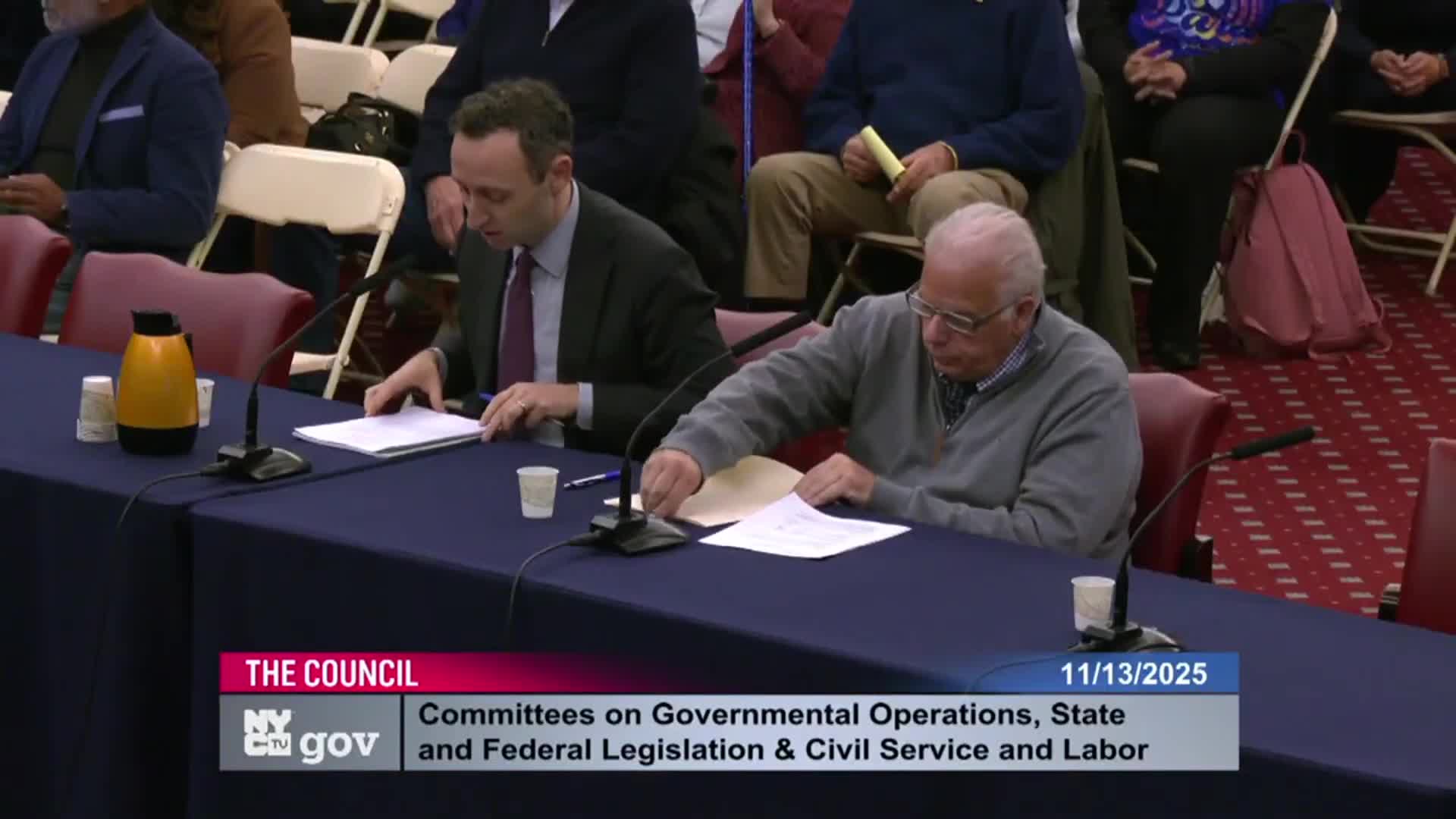
Daniel Pollock, First Deputy Commissioner of the Office of Labor Relations, told the committee that the payments proposed in Intro 12-61 "are mandatory subjects of collective bargaining under the Taylor law," and argued the city cannot impose such pay items by local law. "This means that the city and New York City public schools must negotiate these matters with its unions," he said in his opening testimony.
Lead sponsor Council Member Powers framed the bill as an urgency for classroom stability and affordability: paraprofessionals "play an incredibly important role in our city's schools," he said, noting UFT figures that starting pay is "just under 32,000" a year and calling the differential a way to "close the inequitable gap." The bill's text establishes a formula comparing paraprofessional pay to historical school-based salaries and would deliver recurring payments when the formula produces a positive differential.
Representatives from the Department of Education described current staffing and substitute deployment. Peter Ianniello, Executive Director, Division of Human Resources, said there are about "1,700 paraprofessional vacancies currently" that are budgeted, and that roughly "9,000 substitutes" work regularly to cover positions. He said many substitutes hold long-term assignments and that "632 paraprofessionals became teachers" in the last school year, a point he offered as part of retention and career-path context.
Council members pressed DOE and OLR on data and alternatives. Several members requested an exit-survey analysis that DOE said it plans to begin collecting in January and asked for a clearer tally of how substitute usage affects IEP implementation. Council Member Dinowitz said he was "concerned" by testimony that treated paraprofessionals as a stepping stone and pushed for recognizing the role as a career; he warned that substitutes cannot fully replace dedicated 1:1 support.
Union leaders and paraprofessional speakers argued the measure is legally defensible and necessary. UFT President Mulgrew and Beth Norton, UFT general counsel, said the legislation was drafted to avoid running afoul of the Taylor Law by structuring the payment as a distinct economic benefit rather than a regular salary increase. Norton summarized court tests that consider whether a payment is separate from regular wages, whether it tracks contractual increases and whether it is tied to extra work; she said the differential in Intro 12-61 "does not increase with contractual increases" and is "absolutely separate from the paraprofessionals' regular salary."
Multiple paraprofessionals and parents recounted hardship and classroom impacts, describing low starting pay and long hours and arguing a $10,000 differential would help retain staff and support students with special needs. "This is about lifting the weight that's been pressing down on every person that is here," said Treva Taylor, a D75 paraprofessional.
What happens next: the committee asked agency staff to produce follow-up analyses, including a more detailed vacancy and substitute-deployment breakdown and the fiscal implications noted in the OMB impact statement; members also solicited additional written testimony. No formal vote or action was recorded at the hearing.
Don't Miss a Word: See the Full Meeting!
Go beyond summaries. Unlock every video, transcript, and key insight with a Founder Membership.
30-day money-back guarantee
Sponsors
Proudly supported by sponsors who keep New York articles free in 2025

