EMS workers press Council for pay parity and an independent emergency medical service
November 14, 2025 | New York City Council, New York City, New York County, New York
This article was created by AI summarizing key points discussed. AI makes mistakes, so for full details and context, please refer to the video of the full meeting. Please report any errors so we can fix them. Report an error »
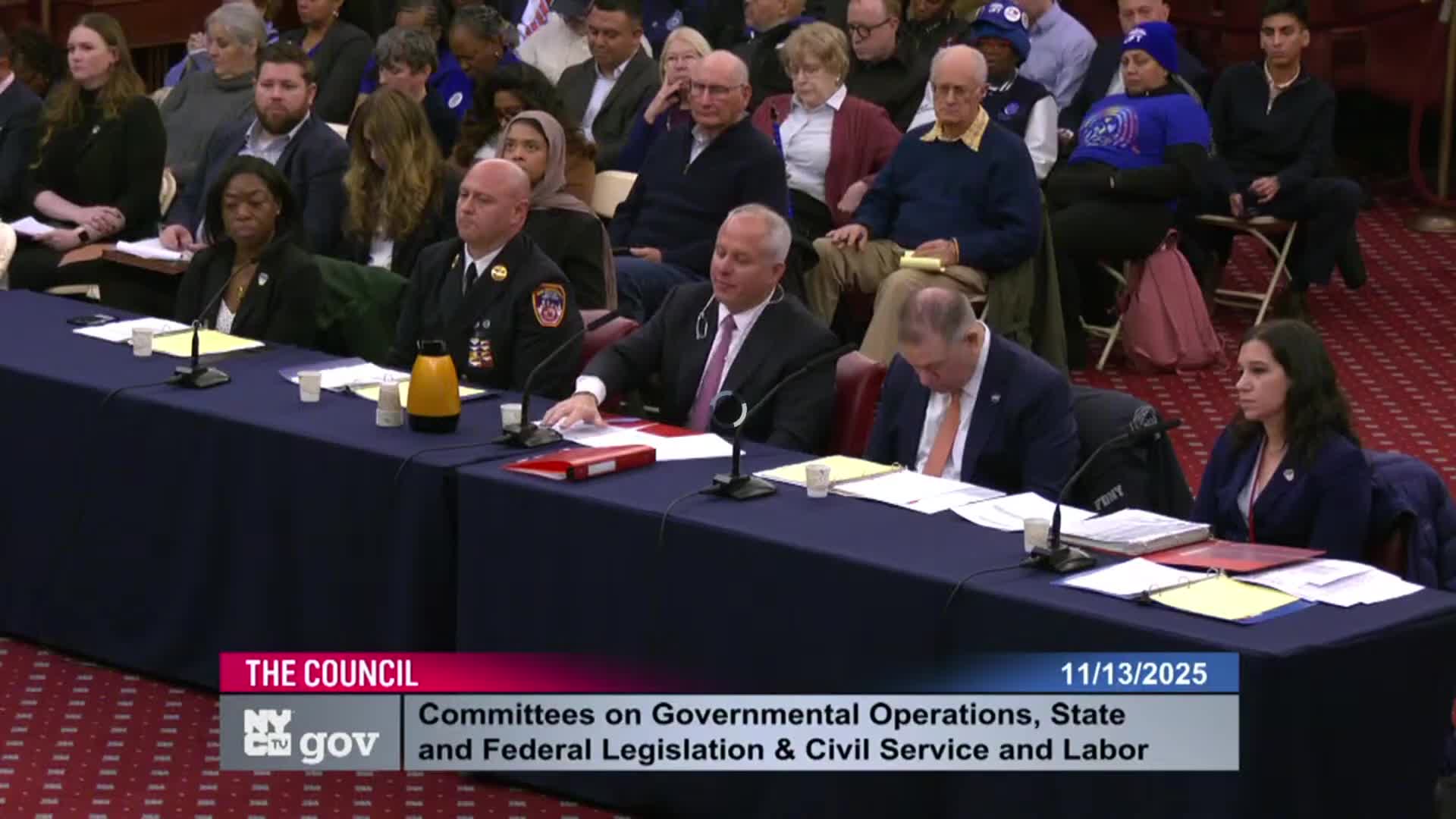
Anthony Almajera, a lieutenant paramedic and vice president of Local 36 21, summarized the unions' case: "Response times of life threatening calls are rising over 12 minutes ... EMTs and paramedics are leaving faster than we can replace them," he said, adding that the pay gap with firefighters "still exceeds 50%." He described training and recruitment costs and said paying for parity would be cheaper than repeated recruitment cycles.
Multiple EMS witnesses argued that separating EMS from FDNY into a dedicated third-service agency — or otherwise ring-fencing EMS funding — would improve accountability, recruiting and clinical focus. One witness noted that cities such as Pittsburgh, Boston and Austin operate independent EMS agencies and reported faster response times and lower turnover in those jurisdictions.
City witnesses and chairs asked practical and fiscal questions. Council members sought guarantees that a freestanding EMS would have stable funding and career pathways; some members warned that separation without budget commitments could risk service disruption. At several points members returned to the operational interplay between dispatch, incident command and joint fire/EMS response during mass-casualty or fast-moving events.
EMS leaders also raised mental-health and safety concerns. Testimony recounted high rates of burnout, suicides among members since 2020 and instances of homelessness among active EMTs; one panelist said, "If my men and women are homeless at $39,000 a year, I don't know how the paraprofessionals are doing it for $32,000 a year."
What happens next: committee chairs asked to continue follow-up with agency and budget staff and indicated they would seek more detailed attrition statistics, fiscal scenarios for third-service transitions and models used in other cities. No enactment or vote occurred at the hearing.
View the Full Meeting & All Its Details
This article offers just a summary. Unlock complete video, transcripts, and insights as a Founder Member.
30-day money-back guarantee
Sponsors
Proudly supported by sponsors who keep New York articles free in 2025

