Lake Placid workshop urges a phased utility master plan after $40 million grant designs
November 14, 2025 | Lake Placid, Highlands County, Florida
This article was created by AI summarizing key points discussed. AI makes mistakes, so for full details and context, please refer to the video of the full meeting. Please report any errors so we can fix them. Report an error »
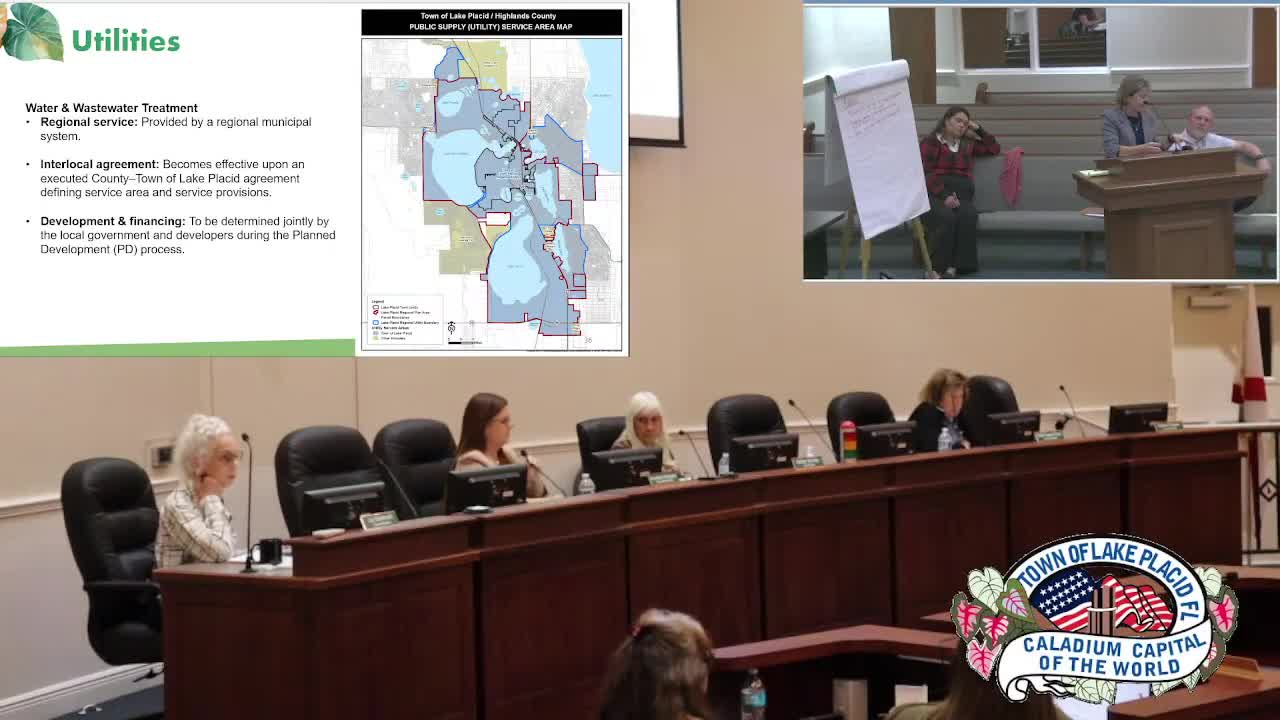
The Central Florida Regional Planning Council and town staff described the grant as having funded preliminary designs but not a final implementation plan. “With some of that $40,000,000 grant, they did some basic designs, but they’ve never really put anything for which way they want to go and how they’re going to fund it,” a staff member said. Utility staff recommended beginning work where water lines already exist — citing Late June Road as an early, lower‑cost opportunity — and then branching outward.
Town officials and residents noted three practical constraints: limited municipal budgets, aging underground infrastructure that is costly to retrofit, and uncertainty over which entity may apply for grants. “Grants are not a guarantee,” the town administrator said during the discussion, later adding that relying only on grants risks indefinite delays. Panelists discussed multiple funding paths mentioned in the meeting, including state revolving funds (SRF) and federal grants; the Florida Department of Environmental Protection (FDEP) and the county’s role were also referenced when considering applications.
Speakers repeatedly urged a master utility plan that includes a phasing schedule and cost estimates, saying that would give residents and developers clearer guidance about when sewer hookups are likely and reduce wasted private costs such as installing septic systems in advance of planned hookups. “If it’s coming next year, you might hold off on building,” a participant said, urging the town to publish a multi‑year phasing outlook so homeowners can make informed decisions.
Environmental concerns shaped prioritization suggestions. A resident cited University of Florida sampling showing relatively high nitrogen concentrations in Placid Lake and nearby canals and urged prioritizing sewer work where septic systems are closest to water bodies. Utility staff and engineers said practical sequencing typically follows existing water infrastructure and meter network because sewer metering and charge calculations are simpler when water service is already present.
No formal motion was made. Participants recommended commissioning a master utility plan with a phasing schedule and holding a follow‑up workshop to refine priorities and grant strategies. Town staff and the regional planner said they would pursue next steps to scope the master plan and explore funding options.
Next steps: attendees asked staff to scope a utility master plan and phasing study and to schedule a follow‑up meeting focused on utilities and funding.
View the Full Meeting & All Its Details
This article offers just a summary. Unlock complete video, transcripts, and insights as a Founder Member.
30-day money-back guarantee
Sponsors
Proudly supported by sponsors who keep Florida articles free in 2025

