Portland committee advances drafting of wage-theft ordinance focused on city contracts and grants
November 14, 2025 | Portland, Multnomah County, Oregon
This article was created by AI summarizing key points discussed. AI makes mistakes, so for full details and context, please refer to the video of the full meeting. Please report any errors so we can fix them. Report an error »
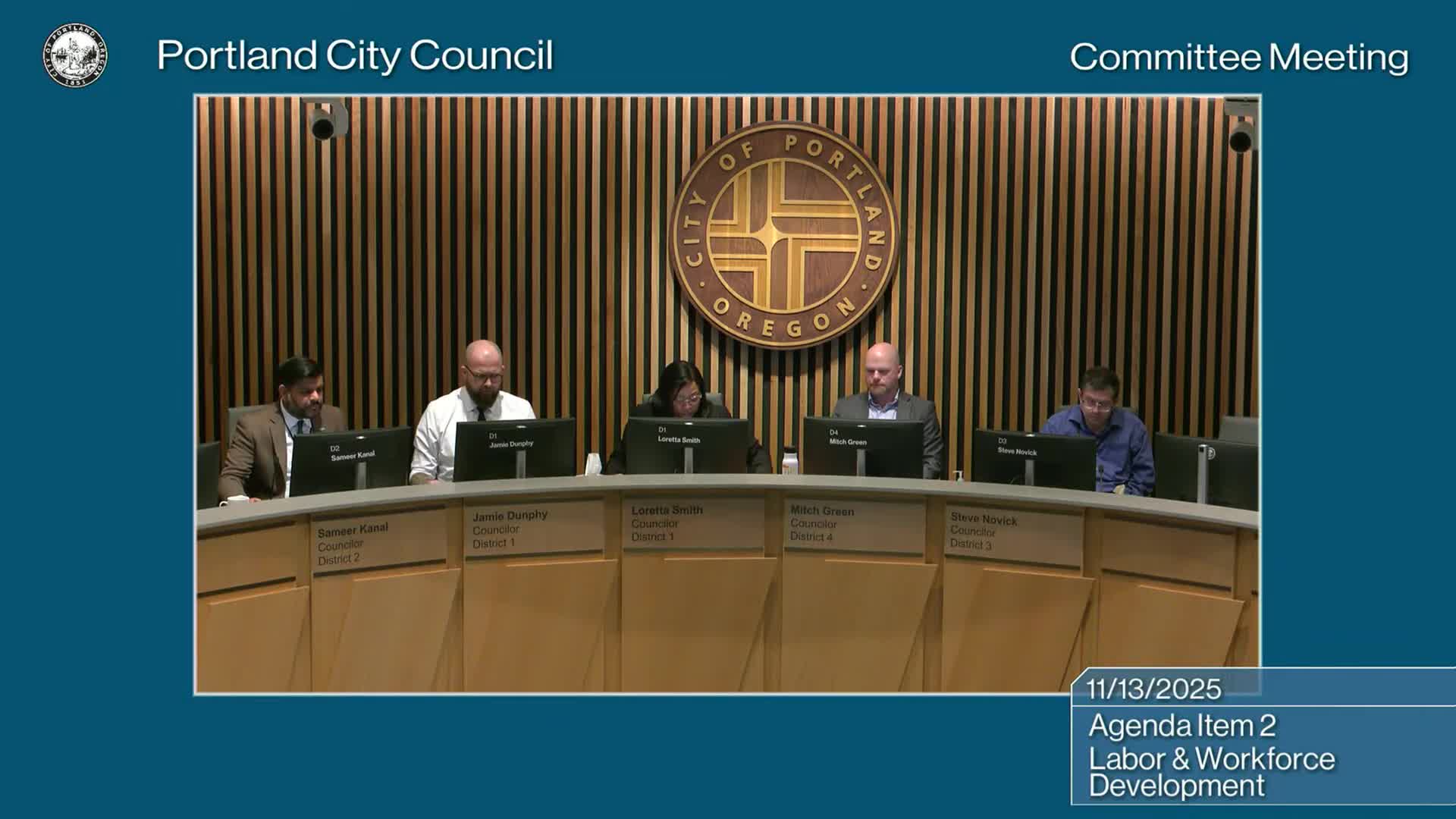
Why it matters: Witnesses and council members said wage theft reduces local economic return, harms workers and erodes trust in publicly funded projects. Labor and caregiving advocates told the committee that construction, caregiving and certain healthcare contracts are frequent sites of misclassification, unpaid overtime, fringe-benefit fraud and other wage-and-hour violations.
Labor leaders urged preemptive tools and stronger procurement standards. Travis Simmons of the Western States Regional Council of Carpenters told the committee that Portland Maps, the city’s permitting and parcel database, could be adapted to make it easier to identify responsible contractors and projects before violations occur. "By integrating permitting tools... we would give agencies, inspectors, and workers the ability to see who's responsible for what work before the problem arises, not after," Simmons said.
Lauren Bowling, speaking for Ironworkers Local 29, described industry-specific patterns such as misclassification, overtime avoidance and abuse of apprenticeship ratios. "Prevailing wage requires daily overtime," Bowling said, and the draft ordinance should include language on fringe-benefit fraud and city authority to remove bad actors and recoup incentives.
Caregiving and migrant-worker concerns. Dr. Aileen Doldelau, with the Justice Fortita Maria campaign and Migrante Portland, said wage theft in residential care and small, family-run care settings often involves migrant caregivers and recommended expanding accountability to small businesses that receive city loans or grants through entities such as Prosper Portland.
Enforcement and coordination with state agency. Witnesses noted that the Bureau of Labor and Industries (BOLI) is the existing state avenue for workers to recover wages and that recent state law (referred to in committee testimony as Senate Bill 426) provides faster remedies for some claims. Multiple speakers said BOLI remains under-resourced; the committee discussed inviting BOLI and procurement staff and consulting the city attorney to clarify what city-level enforcement (including penalties, clawbacks or debarment from city contracting) is legally permissible.
Councilor concerns and policy design choices. Council members debated whether to list specific project focuses in the ordinance text or keep them as an exhibit and whether the ordinance should cover grants and other city funding streams in addition to procurement. Councilor Green recommended directing staff to develop dashboards or reports drawn from Portland Maps data to spotlight places where wage-theft risk indicators cluster. Councilor Novick and others asked procurement to advise on state procurement law constraints and suggested training or prequalification for bidders as a preventive measure.
Public testimony: health-care staffing and predictive-scheduling complaints. Hannah Winchester of the Oregon Federation of Nurses and Health Professionals said Kaiser facilities have relied heavily on traveling nurses and reported more than $200 million in traveler spending in 2024 at local Kaiser sites, arguing the city should consider how public purchasing or plan design relate to local labor standards. Ryan Sotomayor (Labor's Local 43) and other labor speakers described predictive-scheduling, classification and unpaid-overtime examples affecting municipal and private-sector workers.
Next steps: The committee did not vote on the ordinance. Members agreed to further drafting, to consult procurement and the city attorney, to consider a December 5 site visit with labor representatives, and to continue stakeholder outreach and possible inclusion of grant recipients (including Prosper Portland grantees) in the ordinance’s scope. Chair Smith said the draft is a baseline that can be expanded.
Actions noted: The committee approved the committee minutes from Aug. 14–Sept. 25, 2025, by unanimous consent; no ordinance vote occurred.
Sources and attributions: Direct quotes and specific examples above come from testimony and discussion recorded before the committee, including testimony by Travis Simmons (Western States Regional Council of Carpenters), Lauren Bowling (Ironworkers Local 29), Dr. Aileen Doldelau (Justice Fortita Maria campaign / Migrante Portland), Hannah Winchester (Oregon Federation of Nurses and Health Professionals) and Ryan Sotomayor (Labor’s Local 43). The committee referenced coordination with the Bureau of Labor and Industries and state legislation referenced as Senate Bill 426.
What to watch: procurement staff and the city attorney’s guidance on enforceability, any added language extending requirements to grant or loan recipients (Prosper Portland), the city’s plan for an accessible Portland Maps-based report or dashboard, and whether the council will add penalties or a funding mechanism for community outreach and enforcement.
Don't Miss a Word: See the Full Meeting!
Go beyond summaries. Unlock every video, transcript, and key insight with a Founder Membership.
30-day money-back guarantee
Sponsors
Proudly supported by sponsors who keep Oregon articles free in 2025

