County presents trail feasibility studies, $80,000 grant and construction schedule for Cross Island/South Island connections
November 14, 2025 | Queen Anne's County, Maryland
This article was created by AI summarizing key points discussed. AI makes mistakes, so for full details and context, please refer to the video of the full meeting. Please report any errors so we can fix them. Report an error »
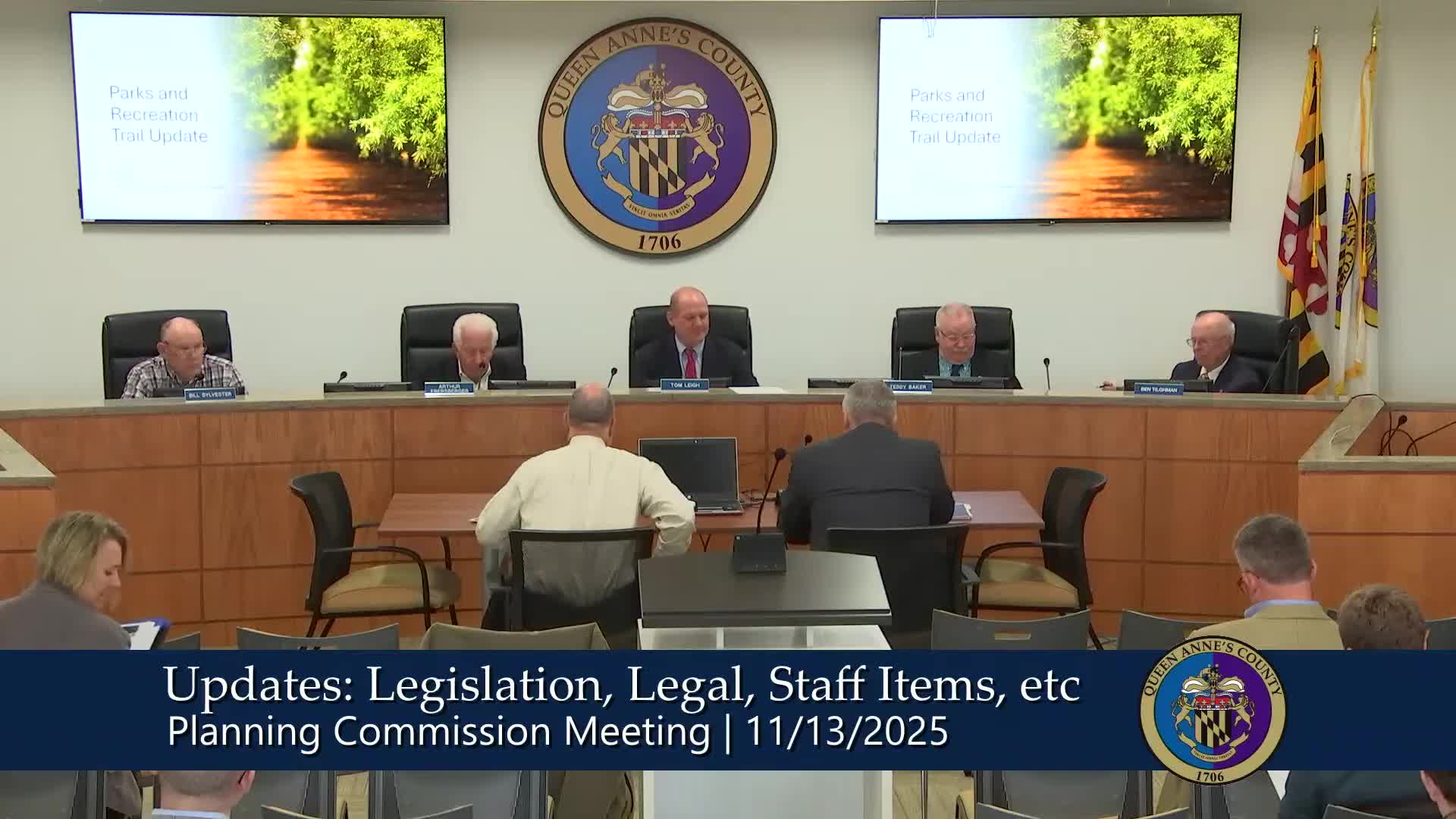
Steve Chaney, director of Parks and Recreation, described a six‑phase program to close gaps between the Cross Island Trail and the South Island Trail. Phases 1 and 2 are complete; phase 3 is under construction behind Mowbray Park, and phase 4 is in design and engineering. ‘‘Phase 3 is currently being constructed,’’ Chaney said, and the county bid for phase 3 returned about $593,000. He said construction work is limited to a seasonal window (roughly September through March) because some areas contain interior‑dwelling species that restrict work in other months.
Steve Cahoon, a public‑facilities planner in the Department of Public Works, described two feasibility studies that followed the county's bike‑and‑ped master plan. The Cross County Connector Trail study looks at routing the trail from existing segments near the Royal Farms through or along the Queenstown Links golf course property to the town of Queenstown. The second study evaluates four potential locations to provide a pedestrian crossing of US 5301; two options were eliminated and two (options 1 and 4) advanced for further analysis. ‘‘A huge part of a feasibility study in the planning process like this is getting the public comment and public outreach,’’ Cahoon said, noting an Oct. 23 public meeting.
Cahoon told commissioners the county received a grant of $80,000 from the Baltimore Regional Transportation Board to support the connector study and that cost estimates for crossing alternatives will be developed as the studies progress. He said the projects would be county capital projects requiring commissioners to allocate funds, and DPW is actively pursuing grant funding.
Parks staff also outlined maintenance and safety work, including added asphalt ramps to remove trip hazards, replacement of roughly 300 deteriorated bridge boards, and contracted invasive‑weed cutting to manage species such as the rapidly spreading ‘mile‑a‑minute’ vine. Chaney said staff has used counters and a heat‑map study to track trail use but noted that some counter data was lost because of software issues; nevertheless, he characterized the Cross Island Trail as ‘‘highly, highly used’’ and said the county hosts events and visiting bike clubs.
The commission pressed staff on outreach to property owners where trails might cross private land; DPW said property‑owner engagement will occur during feasibility studies and that right‑of‑way and state highway coordination are part of the planned public process.
Next steps include completing feasibility reports, presenting options to the commissioners with public input and cost estimates, and pursuing grant funding and capital budget approval for construction work.
View the Full Meeting & All Its Details
This article offers just a summary. Unlock complete video, transcripts, and insights as a Founder Member.
30-day money-back guarantee
Sponsors
Proudly supported by sponsors who keep Maryland articles free in 2025

