Hooper planning staff circulate new subdivision checklist amid questions on traffic studies and neighbor contact rules
November 14, 2025 | Hooper City Council, Hooper , Weber County, Utah
This article was created by AI summarizing key points discussed. AI makes mistakes, so for full details and context, please refer to the video of the full meeting. Please report any errors so we can fix them. Report an error »
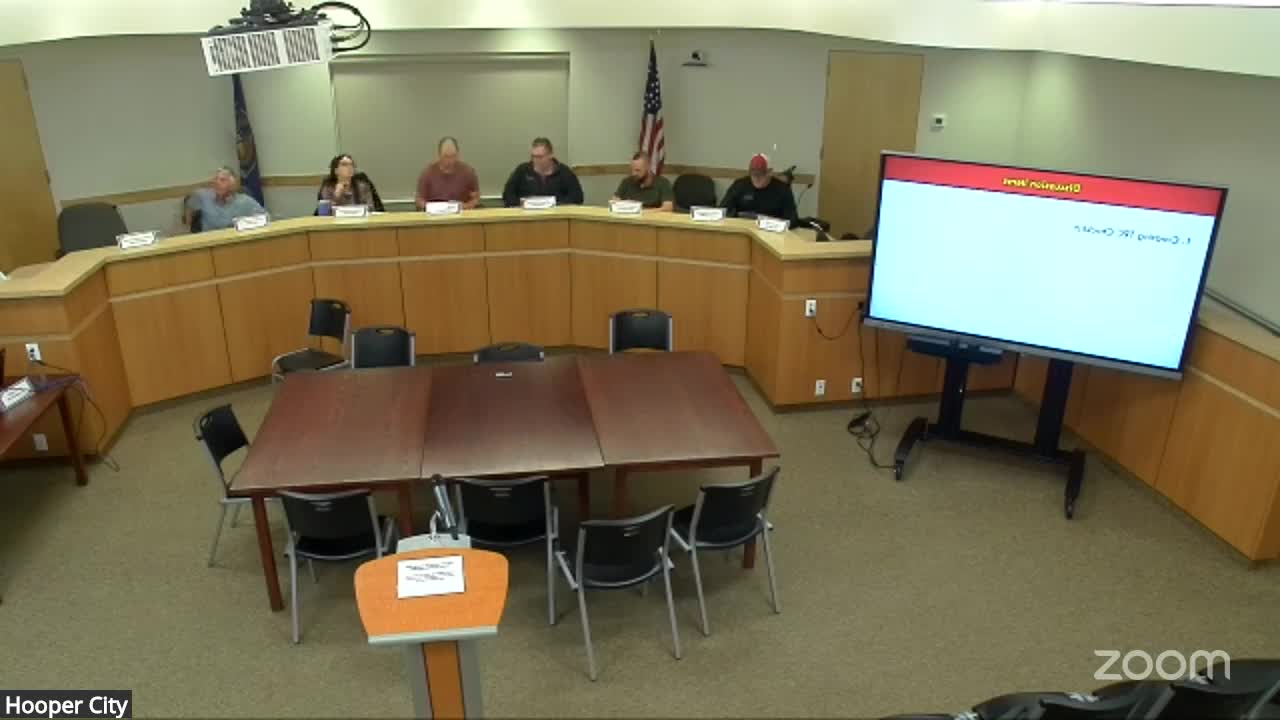
Malcolm, planning department staff, said the checklist was created to help applicants "summarize and guide them through that process" and is intended as an administrative aid, not a substitute for the full city code. He told commissioners the checklist mirrors recently adopted land-use and subdivision language and acknowledged it had become longer than intended to ensure coverage of all ordinance requirements.
The most disputed point was whether the revised ordinance unintentionally requires full traffic studies for minor subdivisions. "An unintended consequence of our last ordinance was we're requiring traffic studies for minor subdivisions," Malcolm said. Commissioner Larson asked whether such studies would still be limited to projects intersecting state routes or triggered only when the city engineer requires them; Larson noted that state review (UDOT) typically applies when a subdivision boundary touches a UDOT road. Malcolm said he would review the exact code sections and follow up with the commission.
Commissioners also pressed staff on the checklist's requirement that applicants provide the "names, addresses, and telephone numbers of all adjoining property owners." One commissioner said collecting phone numbers places an undue burden on applicants and may invade privacy: "I'm not sure that's up to us to put that onus on somebody that wants to develop to go knock on the neighbor's doors and get telephone numbers," the commissioner said. Malcolm replied that the city code contains that requirement and that city staff typically send official mailed notices to surrounding property owners; he agreed the language could be revisited.
Another operational issue discussed was the ordinance's requirement for final utility letters and other final approvals before the commission sees a subdivision. Malcolm said the ordinance's requirement for final letters (utility finals, connection fees) has been hard in practice: "We've started I guess you could call it an informal review with preliminary will-serve letters like we did in the past, but we might want to look at our ordinance for that," he said. Commissioners suggested a formal disclaimer or staff memo that indicates when a submission is an informal review so that the commission understands what has been reviewed and what remains outstanding.
Commission members asked staff to circulate the checklist and accompanying TRC (technical review committee) submission summary to commissioners before future hearings so members can see what staff reviewed and what items remain missing. Malcolm said he would email the checklist in the requested format and would follow up with Hooper Water, Hooper Irrigation and with other cities (Hansen and Associates was mentioned as a consultant used elsewhere) to better understand common practices.
Votes at a glance: The commission amended and approved the minutes for the Aug. 14, 2025 meeting (motion by Commissioner Greener; second by Commissioner Bates; unanimous "Aye" recorded). The Oct. 9, 2025 minutes were approved (motion by Commissioner Bates; second by Commissioner Prince; unanimous "Aye" recorded). The meeting was adjourned on a motion by Commissioner Greener and a recorded second.
What happens next: Staff will circulate the draft checklist and TRC submission summary to commissioners and will return with clarifications about the code language on traffic studies, the treatment of finals (utility letters), and neighbor-contact requirements. The commission agreed staff could use the checklist internally as an aid with a disclaimer that it does not replace the full code.
Sources and context: The discussion referenced Hooper city code sections (e.g., the code language cited during the meeting included references to section numbering rendered in the meeting as "10-8-93B" and "10-8-9"). Staff cited Kimball Estates as the nearest pending subdivision matter for which the checklist would be used in practice.
View the Full Meeting & All Its Details
This article offers just a summary. Unlock complete video, transcripts, and insights as a Founder Member.
30-day money-back guarantee
Sponsors
Proudly supported by sponsors who keep Utah articles free in 2025

Excel Chiropractic

