City Council reviews bus redesign progress as MTA and DOT point to ridership and speed gains
November 14, 2025 | New York City Council, New York City, New York County, New York
This article was created by AI summarizing key points discussed. AI makes mistakes, so for full details and context, please refer to the video of the full meeting. Please report any errors so we can fix them. Report an error »
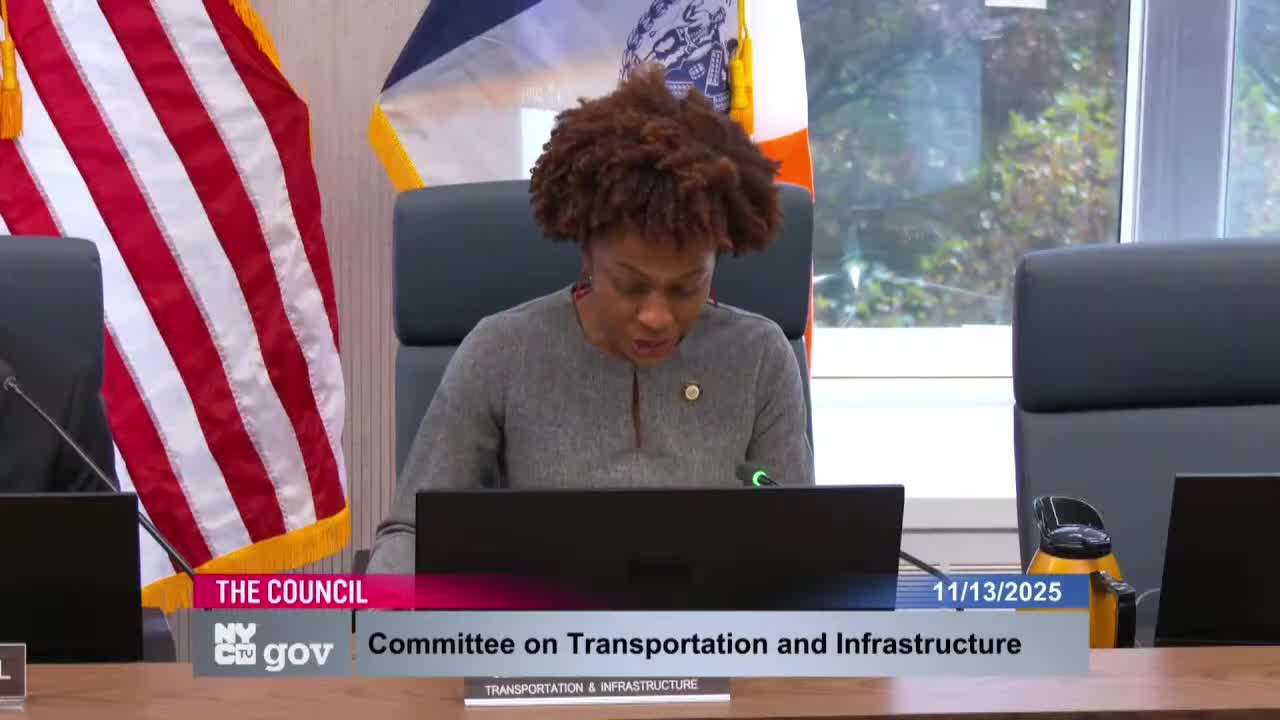
John McCarthy, the MTA’s chief of policy and external relations, told the committee the system is recovering ridership, reporting about 1,400,000 paid bus customers per weekday, up roughly 12% year over year. “Customer satisfaction is currently the highest it's been since spring 2023,” McCarthy said.
Demetrius Critchlow, president of New York City Transit, pointed to preliminary results from recent borough-based network redesigns. “We’re seeing buses moving 7% faster on average,” Critchlow said, citing greater gains on specific routes and attributing improvements to new routing and targeted ‘rush’ routes introduced in Queens. He said the redesigns depend on complementary street changes — more dedicated bus lanes, transit signal priority and enforcement — to realize full benefits.
Shanifa Riera, the MTA’s chief customer officer, described outreach and customer-service measures tied to fare and communications work, including steps to expand Fair Fares eligibility and more customer service centers. “We are on track to open another 15 customer service centers by the end of this year,” Riera said, and said agency teams were running field outreach and creative communications to help riders through the redesign transition.
City Department of Transportation Assistant Commissioner Denise Mendez told the committee DOT has advanced recent bus-priority projects citywide and said the agency delivered what she described as a high annual mileage of protected bus-lane work in 2024; she told members DOT had completed roughly 5.2 new miles and 4.6 improved miles in current projects (figures provided during testimony) and that DOT and MTA coordinate on routing, signage and street changes.
Committee members pressed MTA and DOT on several recurring problems. Council members reported constituents surprised by stop changes and concerned about impacts on seniors and riders with disabilities. On enforcement, members questioned the reach of automated-camera enforcement and whether the ACE program’s location choices account for loading, business deliveries and houses of worship. Critchlow said ACE enforces existing law and that each automated citation is subject to manual review; he invited the committee to flag specific sites for follow-up.
A major point of contention was the MTA’s decision to reassign roughly two dozen road dispatchers from field posts to a centralized Bus Command Center. Critchlow defended the change as an operational improvement: “When we centralize control of both incident management and service management … you get a better handle” on corridor-wide service, he said. Union witnesses and transit workers, however, told the council the shift risked creating a gap in frontline oversight and said the authority’s new radio system experienced drop calls and outages.
Public witnesses amplified the concerns. Jean Ryan of Disabled In Action called out driver training and accessibility problems; Charlton D’Souza of Passengers United said the Queens redesign had led to long waits and threatened litigation; Jose de Jesus, representing TWU Local 106, described the radio rollout as “a total disaster” that, together with dispatcher reassignments, jeopardized safe, timely responses to incidents.
On congestion pricing, MTA testimony emphasized systemwide gains: Critchlow said vehicle entries in the congestion zone were down 12%, or about 87,000 fewer vehicles daily, and that bus ridership had risen 13% in the same period. The agencies said they will publish a one-year report assessing congestion-pricing impacts across the city and have dashboards with ongoing metrics.
The hearing ended without votes; council members asked agencies for follow-up data on outreach, stop changes, radio reliability and dispatch staffing. The committee said it would continue oversight and requested additional written materials and specific situation reviews from MTA and DOT.
Don't Miss a Word: See the Full Meeting!
Go beyond summaries. Unlock every video, transcript, and key insight with a Founder Membership.
30-day money-back guarantee
Sponsors
Proudly supported by sponsors who keep New York articles free in 2025

