Parks Seeks ULURP/EULIP Approval to Reserve Sites for Future Parkland in Queens and Brooklyn
November 14, 2025 | New York City Council, New York City, New York County, New York
This article was created by AI summarizing key points discussed. AI makes mistakes, so for full details and context, please refer to the video of the full meeting. Please report any errors so we can fix them. Report an error »
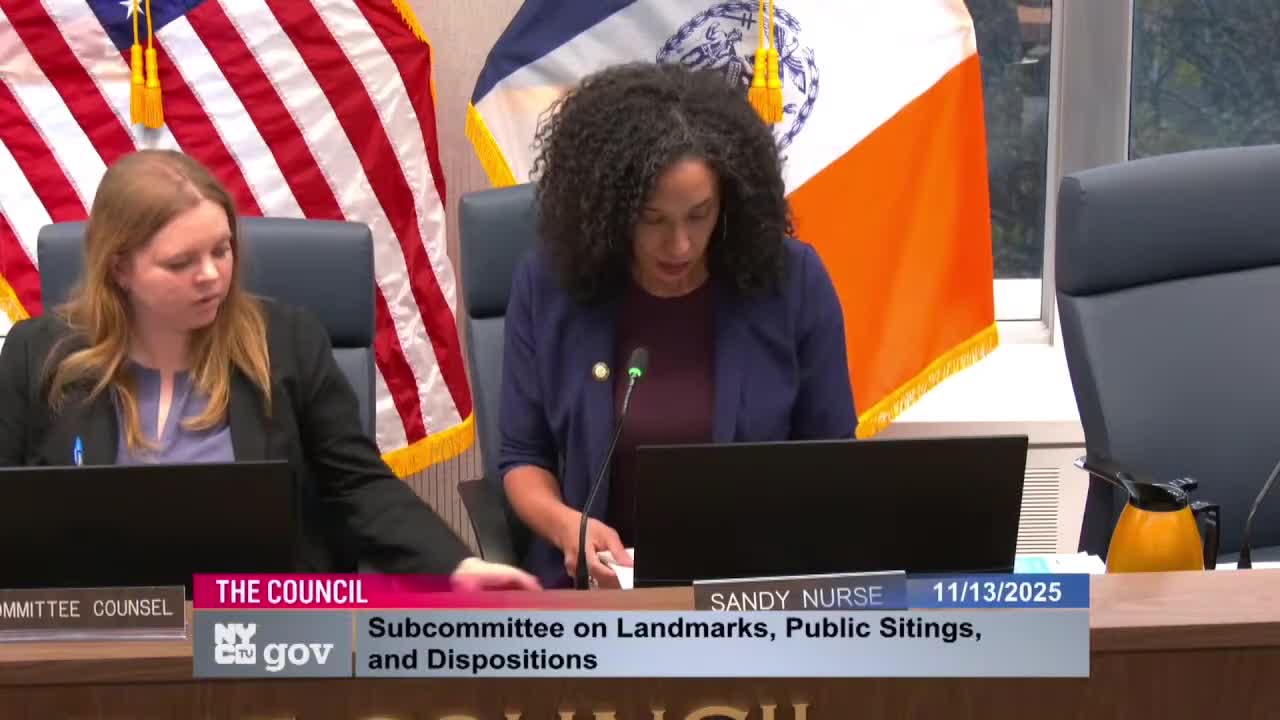
Colleen Alderson, chief of Parklands and Real Estate in NYC Parks’ Environment and Planning division, said the applications are part of a targeted effort to address park access in underserved areas. Alderson cited the citywide goal that 85% of New Yorkers live within a walk to a park by 2030 and said the city currently reaches about 84.2%, leaving roughly 1,400,000 New Yorkers in walk‑to‑park gap areas.
Project administrator Elizabeth Ernish reviewed the criteria for identifying primary sites (vacant privately owned lots of at least 5,000 sq ft or assemblages) and secondary sites (built sites at less than 50% of maximum FAR, limited to walk‑to‑park gap areas). Based on the criteria, Parks identified 7 primary sites in Brooklyn Community District 5 and 5 primary sites in Queens Community District 3; Parks said its candidate lists include 23 sites in CD5 and 20–21 sites in CD3 as options should opportunities arise.
Alderson said the EULIP approval would shorten acquisition timelines by allowing Parks to enter negotiations with willing sellers without re‑starting ULURP for each site, noting the typical EULIP acquisition process currently can take two to three years from site identification to contract closing. Parks also flagged a 10‑year sunset clause on the EULIP approval; if approved, the authorization would expire after 10 years unless Parks seeks a new application.
Committee members asked about owner outreach and whether Parks would purchase partial parcels; Parks said owners receive required letters and staff will continue outreach, and that partial acquisitions are possible for larger parcels. Members raised maintenance and enforcement concerns; Parks acknowledged the challenge and said additional resources would be required to maintain new sites.
The subcommittee closed the public hearing on LU 420 and LU 421; there were no public speakers and both items were laid over for later consideration.
Don't Miss a Word: See the Full Meeting!
Go beyond summaries. Unlock every video, transcript, and key insight with a Founder Membership.
30-day money-back guarantee
Sponsors
Proudly supported by sponsors who keep New York articles free in 2025

