Council considers bills on bus-lane tickets, signage and notices; DOT and MTA signal conditional support
November 14, 2025 | New York City Council, New York City, New York County, New York
This article was created by AI summarizing key points discussed. AI makes mistakes, so for full details and context, please refer to the video of the full meeting. Please report any errors so we can fix them. Report an error »
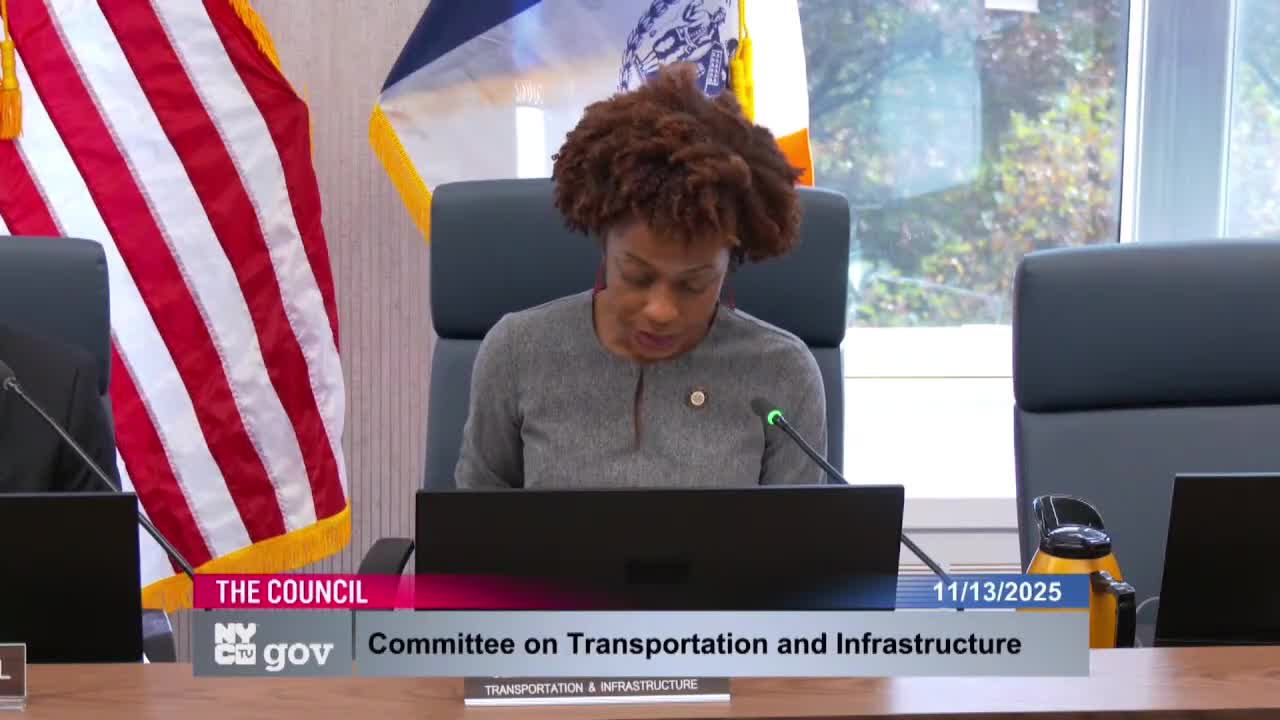
Council Member Narcisse presented Intro 3-39 to limit the issuance of multiple bus-lane violation tickets for the same continuous violation to one ticket per hour. Narcisse said the change would keep enforcement “firm but fair” to avoid inundating drivers with multiple fines captured by different cameras. DOT told the committee it already uses a back-office process to prevent duplicate tickets and said it supports the goal of the bill.
Council Member Riley described Intro 6-47, which would require DOT to post signs on each block subject to bus-lane restrictions and publish the days and hours restrictions are in effect. DOT said it already installs at least one bus-lane sign per block consistent with the Manual on Uniform Traffic Control Devices and publishes bus-lane restrictions datasets; the agency said it supports the bill’s goals.
Chair Brooks Powers introduced Intro 13-45 to require notice to homeowners and businesses when a bus stop is created or removed within 50 feet of a property. DOT said it conducts substantial outreach and publishes route and stop datasets but cautioned that the bill’s notice requirements present staff-capacity and implementation-timing challenges and would require tailored solutions to avoid delaying safety and accessibility projects.
The committee also heard several resolutions calling on state or MTA action: Reso 2-52 urging unlimited two-hour transfers for pay-per-ride riders (state action requested); Reso 4-98 asking the MTA to provide first responders with secure, real-time GPS data for buses; Reso 7-73 seeking free express-bus fares for students; Reso 7-35 directing longitudinal congestion-pricing studies; and Reso 61 calling for remediation of transit structures with high lead levels. MTA witnesses endorsed the intent of several measures — for example, Riera voiced support for expanding Fair Fares eligibility — while DOT offered to work with the council on notice and signage specifics.
Neither agency opposed the policy goals but both asked for time to work through operational details. DOT recommended tailored outreach strategies rather than a one-size-fits-all notice mandate; MTA suggested the agencies coordinate to avoid layering statutory requirements that could become outdated as implementation tools evolve.
The committee requested follow-up memos from MTA and DOT with details on outreach plans, the ACE camera review process and any data supporting claims about duplicate tickets or staffing needs for notice requirements.
Don't Miss a Word: See the Full Meeting!
Go beyond summaries. Unlock every video, transcript, and key insight with a Founder Membership.
30-day money-back guarantee
Sponsors
Proudly supported by sponsors who keep New York articles free in 2025

