Council hearing debates plan to split EMS from FDNY as sponsors call for pay parity
November 14, 2025 | New York City Council, New York City, New York County, New York
This article was created by AI summarizing key points discussed. AI makes mistakes, so for full details and context, please refer to the video of the full meeting. Please report any errors so we can fix them. Report an error »
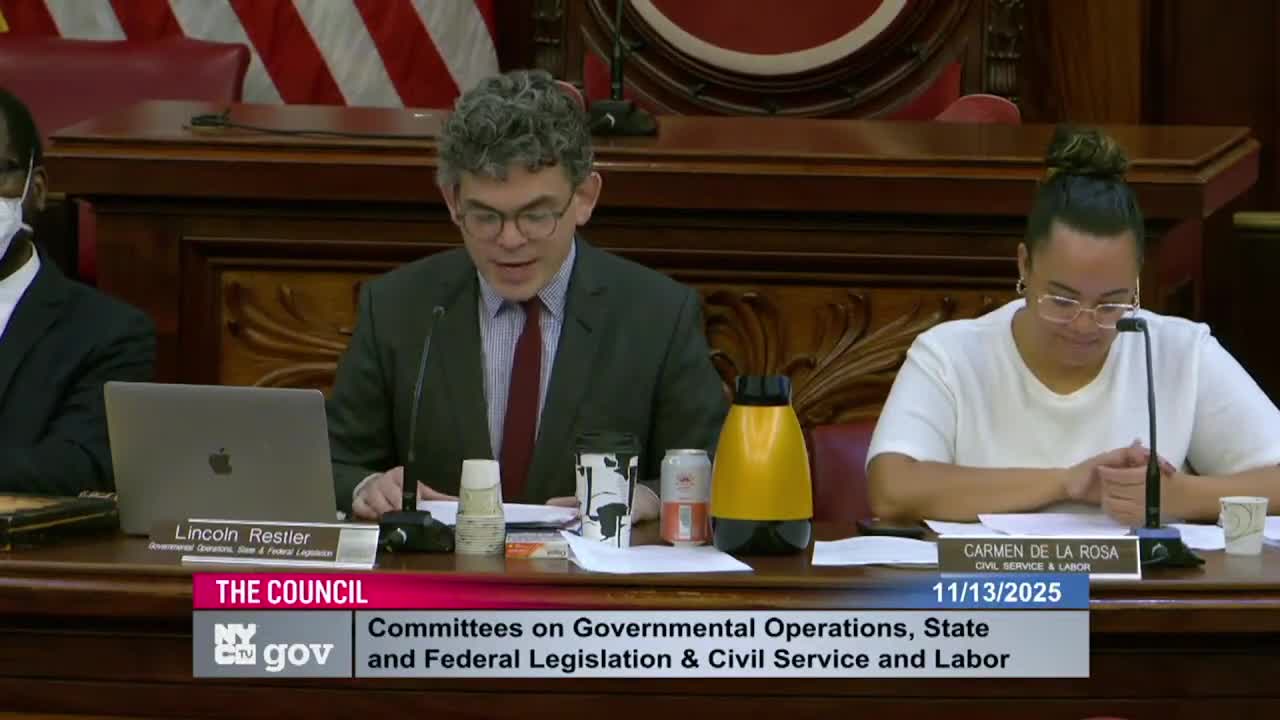
Sponsors led by Council Member Justin Brannan said the measure responds to long‑standing pay disparities and retention problems that leave EMS understaffed. "We simply cannot have second class first responders in this city," Brannan said, arguing that EMS workers — many of them women and people of color — are paid significantly less than firefighters and often need multiple jobs to make ends meet.
The bill’s lead opponents included FDNY Commissioner Robert Tucker, who told the committee he shares the sponsors’ goals but that separating EMS from FDNY would be "misguided." Tucker said a new agency would duplicate legal, human resources, procurement and other administrative functions, driving up costs and reducing operational effectiveness. "Instead of improving capabilities and enhancing the compensation of EMS members, this legislation would accomplish precisely the opposite," he said.
Tucker and FDNY staff outlined specific operational concerns. Acting Chief of EMS Paul Miano provided turnover figures, saying about 5% of EMTs have left the FDNY or city service year to date in 2025 (paramedics at 2.6%). Tucker highlighted equipment and fleet constraints — for example, supervisory vehicles taken out of service for repairs — and recommended capital investments and additional mechanics, not institutional duplication. He also warned that separating the services could impair the seamless on‑scene integration of firefighters and EMS, and complicate promotional pathways within public safety ranks.
The commissioner described a package of reforms FDNY is pursuing instead: leadership changes, paramedic response units (non‑transport vehicles that can reach critically ill patients faster), hospital liaison officers to reduce ambulance turnaround at emergency departments, and a planned EMS computer‑assisted dispatch system that FDNY proposes to build on top of the department’s existing FireCAD platform. Tucker said integrating the new EMS CAD with FireCAD would be far more cost‑effective than creating a separate dispatch system — estimating a potential increase from roughly $40 million to $80 million if duplicative systems were required.
Council members pressed the administration on pay equity and implementation. Labor Committee Chair Carmen de la Rosa asked who would calculate any pay differential in practice; Tucker deferred bargaining and parity questions to the Office of Labor Relations (OLR), which was scheduled to testify later. Sponsor Brannan said he would withdraw the bill if OLR agreed to pay parity and recognition of EMS as a uniformed service on the record. Tucker repeatedly emphasized that pay is only one part of a multi‑pronged strategy to address the crisis and that FDNY is pursuing operational fixes alongside compensation conversations.
The hearing also touched on capital needs. Commissioner Tucker said FDNY has previously requested about $1 billion in capital funding to address aging facilities and fleet issues, and he urged a holistic funding approach that targets stations, supervisory vehicles and fleet maintenance.
Next steps: the committee heard additional panels (including OLR and other stakeholders) later in the session. No formal vote on Intro 5‑21 was recorded in the portion of the hearing transcribed here.
View the Full Meeting & All Its Details
This article offers just a summary. Unlock complete video, transcripts, and insights as a Founder Member.
30-day money-back guarantee
Sponsors
Proudly supported by sponsors who keep New York articles free in 2025

