Mayor Ginther unveils $1.26 billion 2026 operating budget focused on housing, safety and crisis response
November 14, 2025 | Columbus City Council, Columbus, Franklin County, Ohio
This article was created by AI summarizing key points discussed. AI makes mistakes, so for full details and context, please refer to the video of the full meeting. Please report any errors so we can fix them. Report an error »
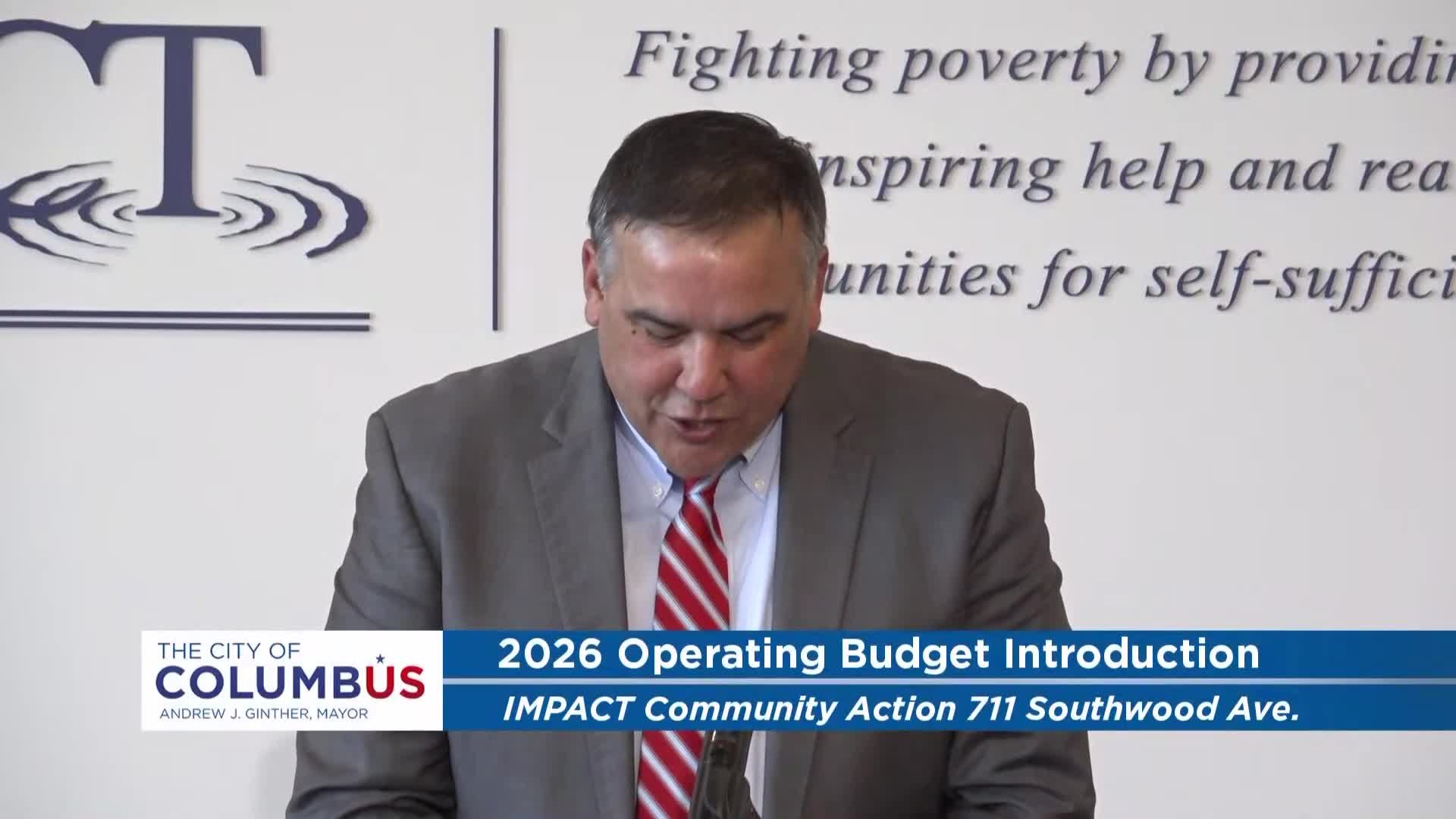
The proposal, presented at an event hosted by Impact Community Action, includes $6,500,000 in city funds for a new resilient housing initiative that the mayor described as focused on homelessness prevention rather than emergency response. “For this first time, we’re gonna use City of Columbus dollars,” Ginther said, adding the initiative will pair $5,000,000 in flexible supports for rent, utilities or unexpected costs with $1,500,000 to fund Columbus Legal Aid and a social worker in municipal court to assist people facing eviction.
Ginther framed the operating budget as a continuation budget in a time of national uncertainty and noted the city will exercise spending discipline: “Our goal isn't to do less. It is to do what matters most in an efficient and sustainable way.” He cited Auditor Megan Kilgore’s revenue estimate of $1,260,000,000 for 2026 and said the administration will be cautious on hiring and wage growth while leaving room to increase investments if revenues improve.
Public-safety remains the largest share of the plan. Ginther said the operating budget includes nearly $852,000,000 for police, firefighters, EMS workers and 911 operators, and highlighted a year-over-year decline in several crime measures: “Homicides are down 35% from last year. Felonious assault cases are down 22%. Nonfatal shootings are down 26%,” he said, adding the Columbus Division of Police’s homicide clearance rate stands at 79% for 2025.
At the same time, the mayor called attention to a troubling rise in domestic-violence‑linked homicides and proposed $3,700,000 in the budget for batterers‑intervention programs, the ACTDV advocacy crisis team and domestic‑violence and stalking services housed in the city attorney’s office.
On crisis response, the budget would add $1,000,000 for alternative-response efforts: embedding an additional clinician in the city’s Right Response 911 unit (bringing the program to 11 full- and part‑time clinicians), funding a five‑person non‑police response team to work with mobile crisis teams, and assigning a therapy dog to de‑escalation work. “That million will also cover a non police response team of 5 people who will collaborate with our mobile crisis response team,” Ginther said.
Ginther also pointed to the city’s recent capital gains at the ballot: voters approved a $1.9 billion bond package (Issues 5–9), which he said will fund parks, affordable housing, police and fire stations, safe streets and water projects. He told attendees the federal Emergency Rental Assistance program provided critical support during the pandemic, noting the city distributed about $98,000,000 to more than 33,000 households and that local funding is necessary now that federal aid has ended.
The mayor closed by thanking community partners and offering to work with Columbus City Council to move the budget forward; he also invited questions from the press and one‑on‑one follow ups. The proposal will go next to Council for review, hearings and formal consideration.
View the Full Meeting & All Its Details
This article offers just a summary. Unlock complete video, transcripts, and insights as a Founder Member.
30-day money-back guarantee
Sponsors
Proudly supported by sponsors who keep Ohio articles free in 2025

