Utility advisory board backs 2026 rate package; city presents $8.6 billion capital plan and expanded affordability measures
November 14, 2025 | Columbus City Council, Columbus, Franklin County, Ohio
This article was created by AI summarizing key points discussed. AI makes mistakes, so for full details and context, please refer to the video of the full meeting. Please report any errors so we can fix them. Report an error »
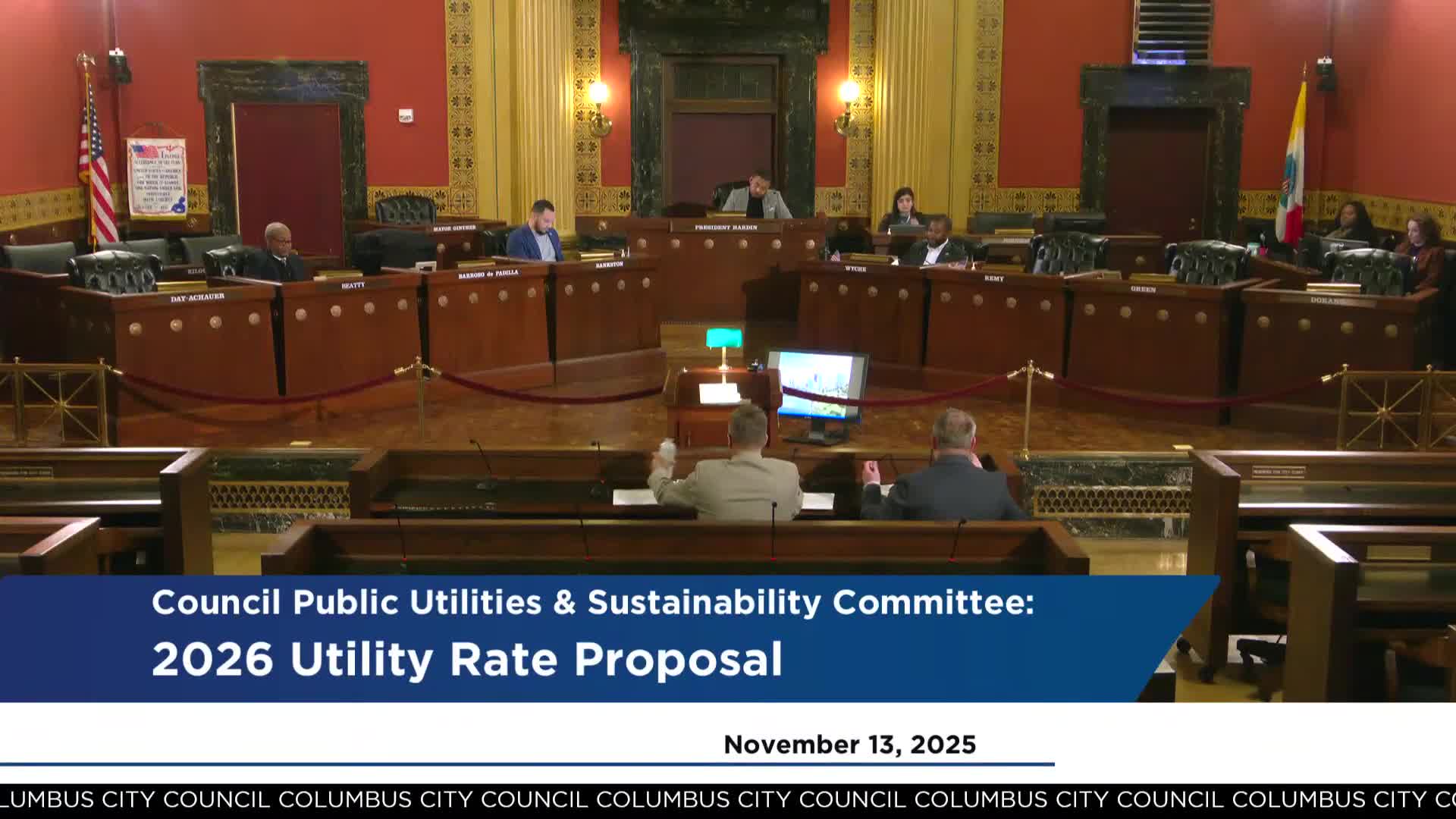
"Water, 18% increase. Sanitary sewer, 8% increase. Stormwater, 2% increase," Jason Coma, chair of the Utility Advisory Board, read to the Public Utilities and Sustainability Committee and said the combined effect would raise the average inside-city residential bill by about $10.50 per month (about $126 per year).
John (Deputy Director Lee) explained the department's capital needs and long-term projects, including the Home Road water-plant and transmission-line project, which he described as a multi-billion-dollar centerpiece that will expand treatment capacity. The department presented an $8.6 billion capital plan for 2026–2031 and said the Home Road project represents roughly $2.0–2.3 billion of that cost, with construction beginning in 2026 and estimated completion in the early 2030s.
The department said the proposed rate package is rooted in a cost-of-service analysis and cited drivers including debt service for new plants, a first update to capacity/tap fees since 2006 and a new uniform commercial rate to better match system demand. The department proposed transition steps to an inclining block structure beginning in 2027 to encourage efficient use and shift more costs to very large users.
To reduce impacts on vulnerable customers, the department and advisory board recommended expanding low-income and senior discounts, increasing the low-income discount from 25% to 30% in 2026 with a goal of 40% by 2028, and launching multilingual outreach, easier applications, monthly billing, expanded leak adjustments and extended payment plans. The department also described new programs such as the Columbus Care donation round-up fund and assistance loans for lead service-line replacement or septic abandonment.
Public commenters urged the council to prioritize affordability and to ensure bond proceeds and loan structures minimize borrowing costs. Community advocates warned that the timing of rate increases so soon after a bond vote raises concerns about asking residents to carry near-term costs for long-term projects.
Ending note: The UAB recommendation and the department's proposed ordinances will be considered by council on first and second readings; council members signaled more questions and follow-up on affordability enrollment, bond usage and commercial rate transitions.
View the Full Meeting & All Its Details
This article offers just a summary. Unlock complete video, transcripts, and insights as a Founder Member.
30-day money-back guarantee
Sponsors
Proudly supported by sponsors who keep Ohio articles free in 2025

