Planning commission recommends denial of proposed short-term rental rules after heated public comment
November 14, 2025 | Columbia City, Richland County, South Carolina
This article was created by AI summarizing key points discussed. AI makes mistakes, so for full details and context, please refer to the video of the full meeting. Please report any errors so we can fix them. Report an error »
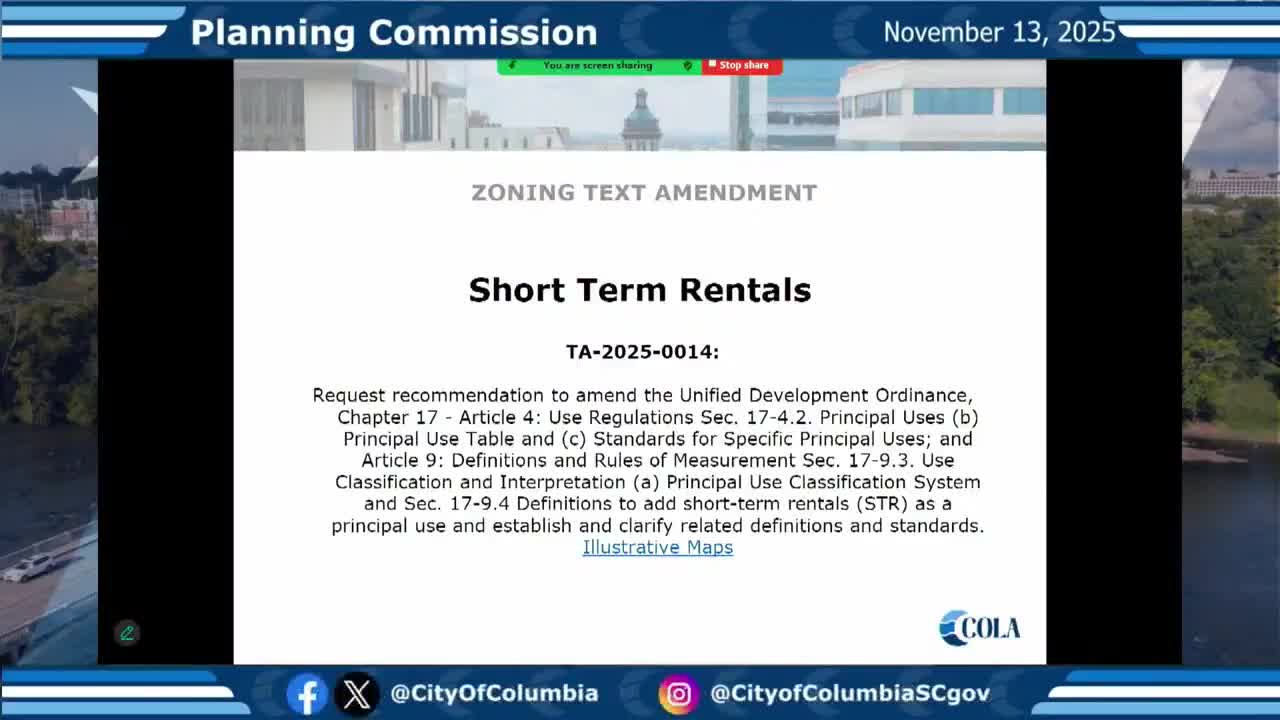
The Columbia Planning Commission on Nov. 13 recommended denial of a proposed amendment to Chapter 17, Article 4 of the unified development ordinance that would add short‑term rentals as a regulated use and sharply limit where they are permitted in residential neighborhoods.
Staff told the commission the amendment would list short‑term rentals as a permitted use in mixed‑use and corridor districts and as a conditional use in residential zones only when the parcel fronts a collector or arterial with four through‑lanes. Staff also said existing lawful short‑term rentals would be treated as nonconforming uses and could continue so long as they were not discontinued.
Short‑term rental operators and managers urged the planning commission to defer action and engage stakeholders. David Bergman, who operates a property‑management company and said his firm holds about 90 permits in the city, told commissioners the proposed map and standards had been released to the public with almost no notice and would effectively ban most city STRs. “This policy impacts all of these people…We employ about 25 people,” Bergman said, and asked the commission to delay the item so staff could further engage operators and homeowners.
Neighborhood representatives countered that the change is about zoning and protecting residential character. John Wilkinson, president of the Elmwood Park Neighborhood Association, told the commission his neighborhood supports the amendment and cited safety, parking and noise complaints. “We’re talking about putting hotels in the middle of our neighborhoods,” Wilkinson said.
Staff clarified enforcement is by code enforcement and that the city already operates a registration program with occupancy, parking and quiet‑hours standards. Joe Cuido, a homeowner and landlord, described the existing point‑based enforcement regime and urged enforcement rather than a ban.
After a prolonged public comment period and internal discussion about whether to hold a workshop or defer before City Council’s Dec. 16 public hearing, Commissioner (speaker 10) moved to recommend denial of the amendment. The motion was seconded and recorded with a roll‑call result the commission reported as 4–3 in favor of recommending denial.
The planning commission’s recommendation will be transmitted to City Council, which will hold the formal public hearing and may adopt, amend or reject the proposal.
What happens next: council is scheduled for a public hearing in mid‑December; if the council pursues changes, further public engagement and text edits are possible before any adoption.
Staff told the commission the amendment would list short‑term rentals as a permitted use in mixed‑use and corridor districts and as a conditional use in residential zones only when the parcel fronts a collector or arterial with four through‑lanes. Staff also said existing lawful short‑term rentals would be treated as nonconforming uses and could continue so long as they were not discontinued.
Short‑term rental operators and managers urged the planning commission to defer action and engage stakeholders. David Bergman, who operates a property‑management company and said his firm holds about 90 permits in the city, told commissioners the proposed map and standards had been released to the public with almost no notice and would effectively ban most city STRs. “This policy impacts all of these people…We employ about 25 people,” Bergman said, and asked the commission to delay the item so staff could further engage operators and homeowners.
Neighborhood representatives countered that the change is about zoning and protecting residential character. John Wilkinson, president of the Elmwood Park Neighborhood Association, told the commission his neighborhood supports the amendment and cited safety, parking and noise complaints. “We’re talking about putting hotels in the middle of our neighborhoods,” Wilkinson said.
Staff clarified enforcement is by code enforcement and that the city already operates a registration program with occupancy, parking and quiet‑hours standards. Joe Cuido, a homeowner and landlord, described the existing point‑based enforcement regime and urged enforcement rather than a ban.
After a prolonged public comment period and internal discussion about whether to hold a workshop or defer before City Council’s Dec. 16 public hearing, Commissioner (speaker 10) moved to recommend denial of the amendment. The motion was seconded and recorded with a roll‑call result the commission reported as 4–3 in favor of recommending denial.
The planning commission’s recommendation will be transmitted to City Council, which will hold the formal public hearing and may adopt, amend or reject the proposal.
What happens next: council is scheduled for a public hearing in mid‑December; if the council pursues changes, further public engagement and text edits are possible before any adoption.
View the Full Meeting & All Its Details
This article offers just a summary. Unlock complete video, transcripts, and insights as a Founder Member.
✓
Watch full, unedited meeting videos
✓
Search every word spoken in unlimited transcripts
✓
AI summaries & real-time alerts (all government levels)
✓
Permanent access to expanding government content
30-day money-back guarantee
