Michigan Apple Committee tells House Ag panel labor costs, falling consumption and research gaps threaten growers
November 14, 2025 | 2025 House Legislature MI, Michigan
This article was created by AI summarizing key points discussed. AI makes mistakes, so for full details and context, please refer to the video of the full meeting. Please report any errors so we can fix them. Report an error »
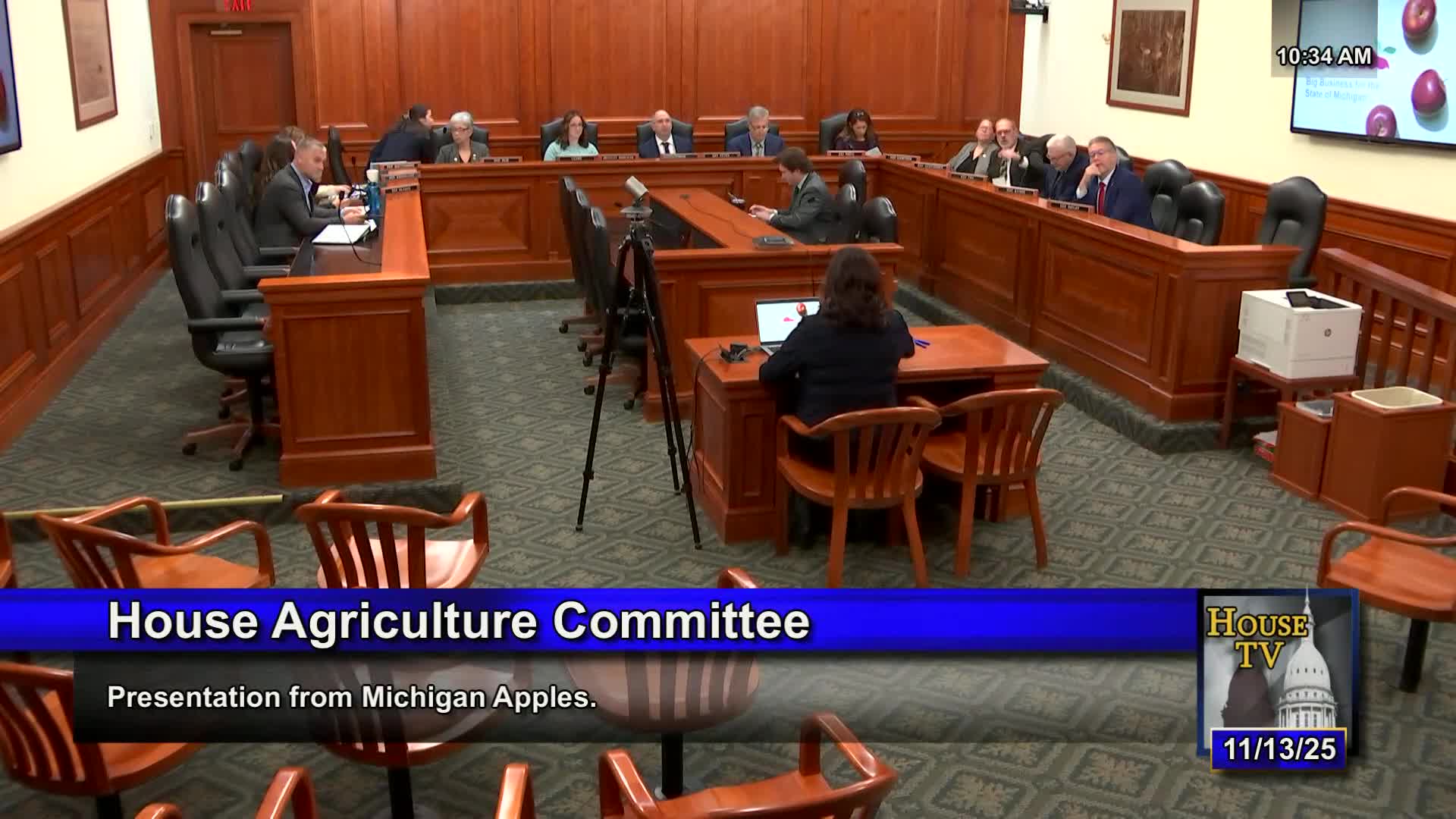
Diane, a representative of the Michigan Apple Committee, briefed the panel, saying the industry supports growers through marketing, education and research and that Michigan remains the nation's second-largest apple producer. "We represent the growers in the state," she said, outlining production numbers and the industry's role in rural economies.
Why it matters: apples account for a large share of Michigan's fruit cash receipts and are produced in most counties; changes that reduce grower returns or research capacity can ripple through rural labor and service sectors.
Diane gave several figures to illustrate the margins facing growers: she said Michigan produced about 1,280,000,000 pounds of apples and cited an example in which a $2.99, three‑pound bag returns about $0.19 to the grower after retailer and handling costs. She said labor represents roughly 56% of per‑acre expenses and noted the Department of Labor's Agricultural Wage Evaluation Rate (AWER) for harvest is currently $18.15 per hour.
Committee members focused on federal labor and immigration programs. Rep. Leitner asked how many growers use H‑2A and whether they also run employees through E‑Verify; Diane said most large producers use H‑2A year‑round for pruning and harvest and pledged to follow up with specifics on when both systems have been used together. "I do have some domestic workers; I don't know the stat on how many people are using E‑Verify in that respect," she said.
Rep. Skaggs pressed Diane on new AWER methodology and whether the allowance for housing will reduce hourly pay. Diane acknowledged that housing allowances will lower the hourly wage on paper and estimated the allowance for Michigan could be about $1.30, noting that even an extreme change would only reduce growers' labor cost by roughly 1–2% of the per‑acre labor share. "They're gonna get a lower wage," she said when asked whether workers would be worse off.
Trade and research were other focal points. Diane said exports fell about 31% in 2024, mainly because of smaller crop size and pricing, and underscored Michigan's participation in national export efforts through the U.S. Apple Export Council. On research, she said Michigan Apples contributes $250,000–$350,000 annually to production research and warned that federal cuts to USDA research funding have reduced graduate and postdoctoral positions, weakening the pipeline for extension and research hires at Michigan State University.
On promoting consumption, Diane highlighted agritourism and past partnerships with Pure Michigan and recommended more state marketing support to boost local purchases of specialty crops. She described school tasting programs run with Blue Cross Blue Shield and universities to get students to try higher‑quality varieties.
The committee thanked Diane for the briefing and asked staff to follow up on specific requests, including details about growers that have used both H‑2A and E‑Verify.
Don't Miss a Word: See the Full Meeting!
Go beyond summaries. Unlock every video, transcript, and key insight with a Founder Membership.
30-day money-back guarantee
Sponsors
Proudly supported by sponsors who keep Michigan articles free in 2025

