Draft UDC consolidates use tables, removes 25% home‑occupation interior cap and adds limited administrative variance
November 14, 2025 | Cobb County, Georgia
This article was created by AI summarizing key points discussed. AI makes mistakes, so for full details and context, please refer to the video of the full meeting. Please report any errors so we can fix them. Report an error »
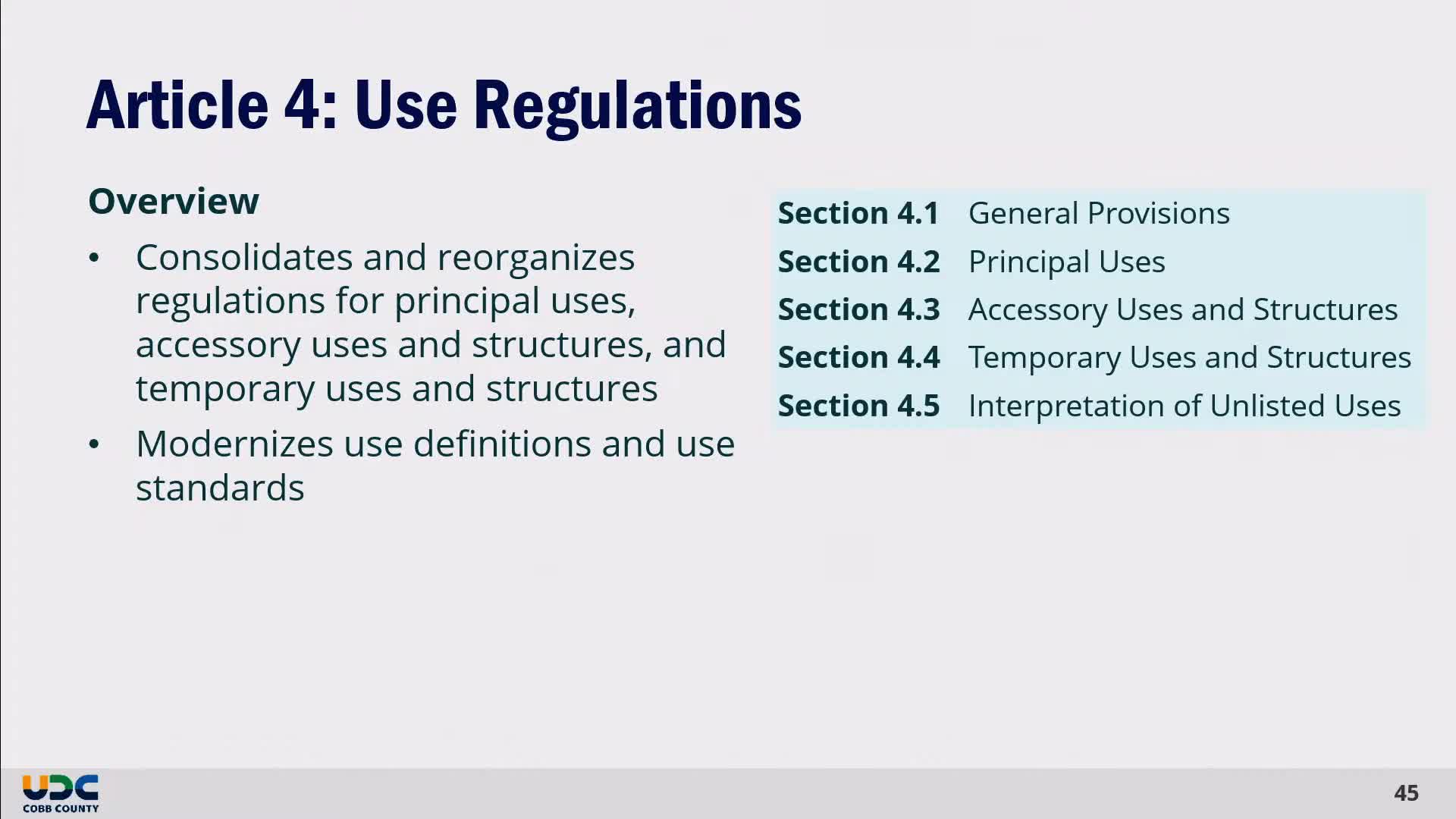
Green said each use will have a clear permission code (P for permitted, S for special exception, L for special land use permit, and A for allowed in a planned development), with direct links to use‑specific standards. He highlighted that commonly repeated accessory standards — such as the customary home occupation rules — have been consolidated; the draft places the definition in Article 9 and lists standards once in Article 4.
The consultants removed a current ordinance restriction that limited home occupations to using no more than 25% of a dwelling’s floor area because enforcement was impractical. "That is very hard to enforce," Green said, noting the zoning office cannot reliably inspect private interior use.
On administration, Article 2 retains most current procedures but adds a new administrative variance allowing staff to authorize limited adjustments (for example, up to 10% to some dimensional standards) in appropriate site circumstances, reducing the need for a Board of Zoning Appeals variance in small cases. Green said development standards such as parking will be provided in Installment 3 and that staff‑level flexibility for parking requirements is being considered.
Don't Miss a Word: See the Full Meeting!
Go beyond summaries. Unlock every video, transcript, and key insight with a Founder Membership.
30-day money-back guarantee
Sponsors
Proudly supported by sponsors who keep Georgia articles free in 2025

