Compass director warns Meridian‑area growth will outpace current transportation funding
November 13, 2025 | Meridian, Ada County, Idaho
This article was created by AI summarizing key points discussed. AI makes mistakes, so for full details and context, please refer to the video of the full meeting. Please report any errors so we can fix them. Report an error »
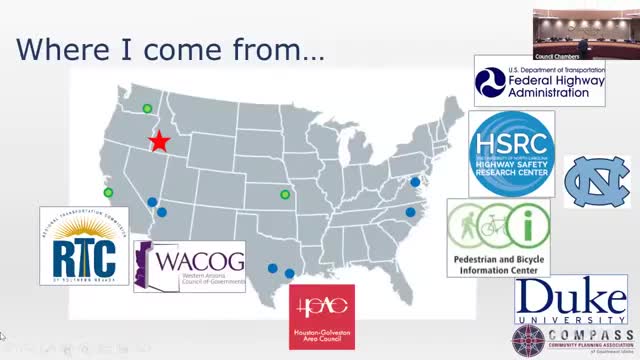
Craig Rayborn, executive director of the regional planning organization Compass, told the Meridian City Council on Nov. 12 that rapid growth across Southwest Idaho is shifting where people live and work and increasing pressure on the local transportation system. "We're averaging about 15 new households a day and about 16 new jobs a day," Rayborn said, and he projected the region’s population would surpass 1 million by 2050 and reach about 1.3 million by 2055.
Rayborn presented heat‑maps of recent development and warned that traditional separations between Meridian and neighboring cities such as Kuna, Nampa and Star are “basically gone,” increasing cross‑jurisdiction travel through Meridian. He said the geographic shift of jobs and housing — roughly a 3‑mile average separation in some corridors and as many as 300,000–350,000 jobs concentrated away from housing — adds about a million vehicle miles traveled per day across the region.
The Compass executive said the organization maintains a long‑range plan, Communities in Motion 2050, and models the effect of projects the region expects to fund. Rayborn told the council the region can reasonably anticipate roughly $11 billion in funded projects over the next two to three decades, but that total identified project needs sum to about $16.5 billion, leaving an estimated $5.5 billion unfunded shortfall (about $193 million per year). "We can model what they look like when we do them," he said, but the modeled improvements do not fully restore today’s congestion levels without additional resources.
Rayborn described Compass’s role in facilitating regional coordination, distributing federal transportation dollars, and providing technical assistance to member agencies. He encouraged Meridian staff to apply to Compass’s resource development program — the current application window, he said, closes next Wednesday — and said smaller local projects and larger, long‑lead investments (he cited State Highway 16 as an item that appeared in Compass plans as early as 2006) move forward on varied timelines.
Council members praised the regional perspective. Councilman Overton said Meridian frequently functions as a regional traffic “dartboard” with many trips passing through the city, and urged continuing collaboration with Compass. Councilman Taylor asked about the potential local financial commitment required for a high‑capacity rail corridor; Rayborn replied it was too early to quantify local agency shares and said the project would likely require new funding sources and substantial external support.
What happens next: Rayborn said Compass adopted state legislative priorities for 2026 focused on revenue, growth‑pay strategies, and linking housing to transportation; he also signaled active federal engagement ahead of the next federal surface‑transportation reauthorization, which is due in 2026. He offered to follow up with detailed materials and encouraged Meridian staff to submit projects into Compass’s resource queue.
Rayborn presented heat‑maps of recent development and warned that traditional separations between Meridian and neighboring cities such as Kuna, Nampa and Star are “basically gone,” increasing cross‑jurisdiction travel through Meridian. He said the geographic shift of jobs and housing — roughly a 3‑mile average separation in some corridors and as many as 300,000–350,000 jobs concentrated away from housing — adds about a million vehicle miles traveled per day across the region.
The Compass executive said the organization maintains a long‑range plan, Communities in Motion 2050, and models the effect of projects the region expects to fund. Rayborn told the council the region can reasonably anticipate roughly $11 billion in funded projects over the next two to three decades, but that total identified project needs sum to about $16.5 billion, leaving an estimated $5.5 billion unfunded shortfall (about $193 million per year). "We can model what they look like when we do them," he said, but the modeled improvements do not fully restore today’s congestion levels without additional resources.
Rayborn described Compass’s role in facilitating regional coordination, distributing federal transportation dollars, and providing technical assistance to member agencies. He encouraged Meridian staff to apply to Compass’s resource development program — the current application window, he said, closes next Wednesday — and said smaller local projects and larger, long‑lead investments (he cited State Highway 16 as an item that appeared in Compass plans as early as 2006) move forward on varied timelines.
Council members praised the regional perspective. Councilman Overton said Meridian frequently functions as a regional traffic “dartboard” with many trips passing through the city, and urged continuing collaboration with Compass. Councilman Taylor asked about the potential local financial commitment required for a high‑capacity rail corridor; Rayborn replied it was too early to quantify local agency shares and said the project would likely require new funding sources and substantial external support.
What happens next: Rayborn said Compass adopted state legislative priorities for 2026 focused on revenue, growth‑pay strategies, and linking housing to transportation; he also signaled active federal engagement ahead of the next federal surface‑transportation reauthorization, which is due in 2026. He offered to follow up with detailed materials and encouraged Meridian staff to submit projects into Compass’s resource queue.
View the Full Meeting & All Its Details
This article offers just a summary. Unlock complete video, transcripts, and insights as a Founder Member.
✓
Watch full, unedited meeting videos
✓
Search every word spoken in unlimited transcripts
✓
AI summaries & real-time alerts (all government levels)
✓
Permanent access to expanding government content
30-day money-back guarantee
