Education officials roll out new cell‑phone rules; teachers, parents and students press for clearer rollout and consistent enforcement
November 13, 2025 | 2025 Legislature, Virgin Islands
This article was created by AI summarizing key points discussed. AI makes mistakes, so for full details and context, please refer to the video of the full meeting. Please report any errors so we can fix them. Report an error »
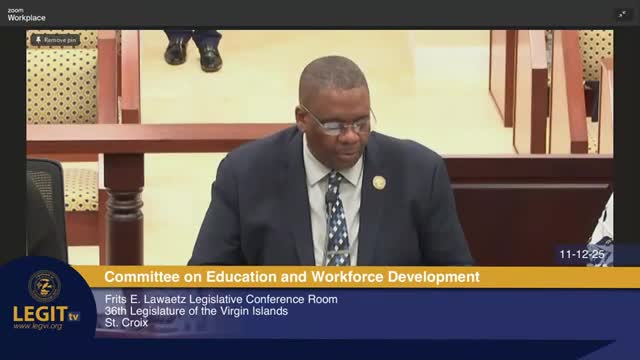
The Virgin Islands Department of Education and the Virgin Islands Board of Education presented a new personal electronic communication device (PECD) policy at a Senate hearing Nov. 12 that restricts student use of phones during instructional time and prescribes tiered discipline: verbal warning, written reprimand, confiscation with parent conference and, for repeat or severe cases, Level‑4 disciplinary referral.
Assistant Commissioner Victor Somme III said the policy (effective June 13, 2025) was disseminated to district leaders and posted to DOE channels but acknowledged the department’s rollout came after many school orientations and that not all students or parents have seen the signed acknowledgement form. “The policy was disseminated after many schools had already had their orientations,” Somme told the committee.
Board secretary Eros C. Lockhart and others cited research (London School of Economics, RAND) showing device restrictions correlate with improved attention and reduced cheating, while student representatives and parents urged careful implementation that does not prevent emergency contact or deny teachers the ability to use phones for instruction when laptops or classroom devices are unavailable. Student Ace Poya said the policy “strikes a healthy balance” but he and other students reported uneven awareness and inconsistent classroom practice.
Several senators asked whether schools have backup communications when VOIP phone lines or Internet services are down; DOE acknowledged VOIP outages can disable school phones and said generator and electrical upgrades and alternative communications are part of BSCM’s facilities work. Parents and the teacher union pressed for public assemblies, clear signage, training in digital citizenship, and a consistent enforcement plan; the Board urged promulgation and ongoing monitoring.
The committee asked the department to deliver a distribution log showing which students and parents signed the acceptable‑use agreement, to confirm protocols for extenuating‑circumstance emergency use, and to provide a schedule for additional training and a clear enforcement checklist for administrators.
Next steps: Department to provide signed acknowledgement coverage data, an emergency communications checklist, and a timeline for school‑level orientation and training.
Assistant Commissioner Victor Somme III said the policy (effective June 13, 2025) was disseminated to district leaders and posted to DOE channels but acknowledged the department’s rollout came after many school orientations and that not all students or parents have seen the signed acknowledgement form. “The policy was disseminated after many schools had already had their orientations,” Somme told the committee.
Board secretary Eros C. Lockhart and others cited research (London School of Economics, RAND) showing device restrictions correlate with improved attention and reduced cheating, while student representatives and parents urged careful implementation that does not prevent emergency contact or deny teachers the ability to use phones for instruction when laptops or classroom devices are unavailable. Student Ace Poya said the policy “strikes a healthy balance” but he and other students reported uneven awareness and inconsistent classroom practice.
Several senators asked whether schools have backup communications when VOIP phone lines or Internet services are down; DOE acknowledged VOIP outages can disable school phones and said generator and electrical upgrades and alternative communications are part of BSCM’s facilities work. Parents and the teacher union pressed for public assemblies, clear signage, training in digital citizenship, and a consistent enforcement plan; the Board urged promulgation and ongoing monitoring.
The committee asked the department to deliver a distribution log showing which students and parents signed the acceptable‑use agreement, to confirm protocols for extenuating‑circumstance emergency use, and to provide a schedule for additional training and a clear enforcement checklist for administrators.
Next steps: Department to provide signed acknowledgement coverage data, an emergency communications checklist, and a timeline for school‑level orientation and training.
View the Full Meeting & All Its Details
This article offers just a summary. Unlock complete video, transcripts, and insights as a Founder Member.
✓
Watch full, unedited meeting videos
✓
Search every word spoken in unlimited transcripts
✓
AI summaries & real-time alerts (all government levels)
✓
Permanent access to expanding government content
30-day money-back guarantee
