Parlier staff says SB 9 and ADU laws allow four‑unit project at 479 Merced Street; residents raise parking, transit and capacity concerns
November 13, 2025 | Parlier City, Fresno County, California
This article was created by AI summarizing key points discussed. AI makes mistakes, so for full details and context, please refer to the video of the full meeting. Please report any errors so we can fix them. Report an error »
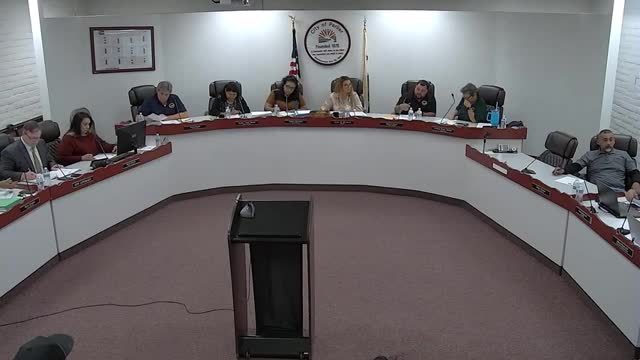
O'Neal said the lot is roughly 50 by 150 feet and has been vacant since mid‑2018. The approved plan shows two buildings with two 1,000‑square‑foot dwellings each, a 20‑by‑16 paved parking area suitable for two cars at the front, and setbacks that are larger than what SB 9 would require. "The city is required to approve the front duplex without discretionary action or hearing, ministerially," O'Neal said, explaining that ministerial SB 9 approvals preclude local conditional permit requirements that once applied to second dwellings.
Why it matters: SB 9 and ADU law are designed to speed housing production; for small cities that have older local rules the statutes can preempt longstanding local parking, setback and public‑hearing requirements. That tension helps explain the volume of public comment the council heard.
Residents at the meeting raised several specific problems. Jenny Cloprick, a resident, argued the project's site plan does not label the development as an SB 9 application and cited CEQA‑related definitions of a "major transit stop," saying the city's transit service does not meet that standard. "Based on these definitions, Parlier does not currently have the level of public transportation service required," Cloprick said, arguing that absence would affect which parking or CEQA exemptions apply. O'Neal responded that the ADU statute uses a different transit standard than SB 9 and that staff is applying the distinct provisions to the separate components of the proposal.
Neighbors also said construction activity has created noise and public‑safety concerns. Lionel Lopez described early‑morning concrete trucks outside his bedroom window and said local streets and infrastructure were designed for single‑family lots. "What is it exactly that we're doing?" he asked the council, noting complaints about water and sewer capacity.
On technical compliance, O'Neal said staff conducted a Nov. 11 site visit and found the buildings sit as shown on the plot plan within acceptable tolerances except possibly in the rear due to difficulty locating the alley right‑of‑way in the field. He said staff has directed the applicant to revise the plot plan to (1) identify the SB 9/ADU status on the plan, (2) mark any discrepancies between the approved plan and field measurements, and (3) relabel the northern building as two detached ADUs rather than calling it a duplex for clarity.
O'Neal also said staff has submitted a detailed explanation of the project's status to the California Department of Housing and Community Development's housing accountability unit and is awaiting their response. David Santos of Senator Anna Caballero's office offered to follow up with the planner and legislative staff to assist with that HCD inquiry.
What remains unresolved: residents asked for further documentation about whether the site meets certain CEQA transit definitions and for confirmation of sewer/wastewater capacity. City engineering staff said the treatment plant has an expansion in a funding round that would address longer‑term capacity and that the city is currently not at capacity for this development, but they recommended a comprehensive sewer master study to evaluate broader ADU saturation scenarios.
Next step: the applicant will submit a revised plot plan reflecting SB 9 and ADU status and noting field discrepancies; the HCD housing accountability unit response is pending. The council did not take a final approval vote on the development at this meeting.
View the Full Meeting & All Its Details
This article offers just a summary. Unlock complete video, transcripts, and insights as a Founder Member.
30-day money-back guarantee
Sponsors
Proudly supported by sponsors who keep California articles free in 2025

