Evanston’s updated tenant law expands protections for students moving off campus
November 13, 2025 | Evanston, Cook County, Illinois
This article was created by AI summarizing key points discussed. AI makes mistakes, so for full details and context, please refer to the video of the full meeting. Please report any errors so we can fix them. Report an error »
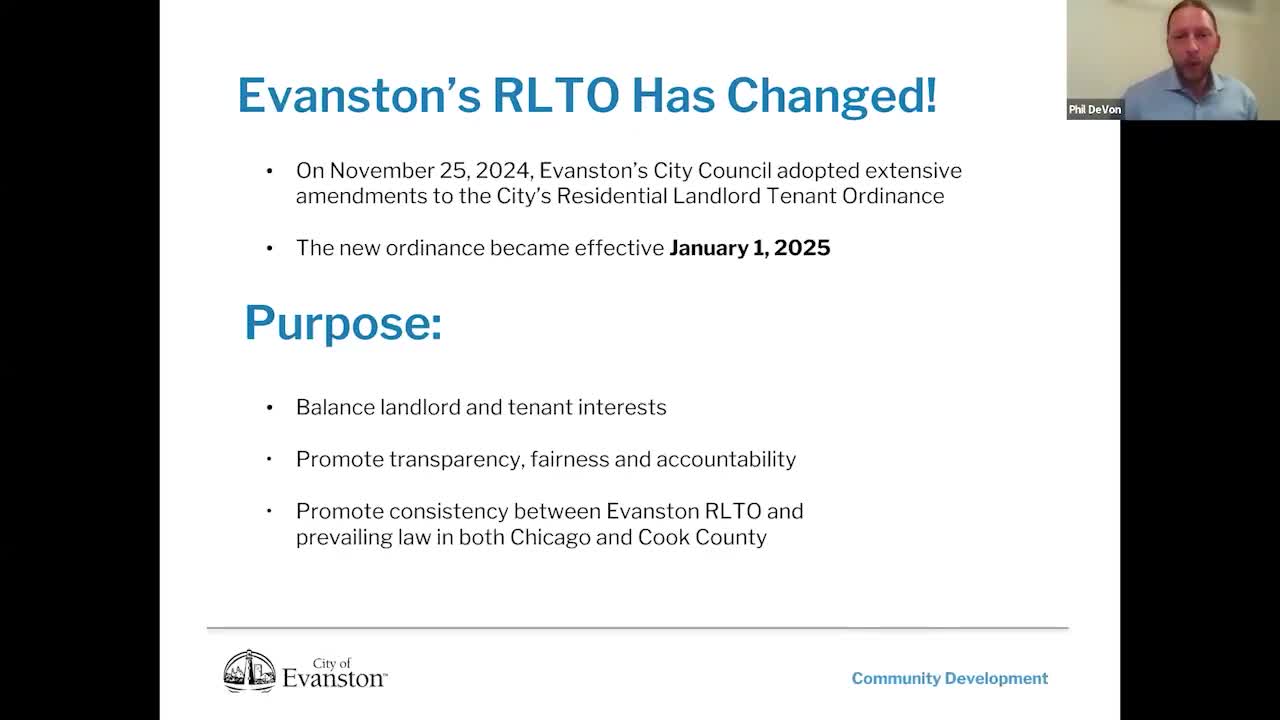
"The RLTO was updated on 01/01/2025," Philip Devon, staff attorney at the Metropolitan Tenants Organization, said during the presentation. Devon described the ordinance as "essentially the tenant's bill of rights in Evanston" and said the changes align the city with recent Cook County and Chicago updates while adding locally tailored protections.
The most concrete changes students should note concern fees and deposits. Devon explained that late fees are capped: landlords may charge up to $25 for the first $1,600 in monthly rent and 5% of any amount above that. "So, for example, if the rent is $2,000 a month, they can charge $25 plus 5% of $400, which is $20, for a total of $45," he said. Landlords must provide itemized lists for any move-in fee and may not charge for routine maintenance. Security deposits are capped at 1.5 times monthly rent, must be held in a separate federally insured Illinois bank account, and must be returned within 21 days after move-out, or the tenant may pursue legal remedies.
Devon also outlined when and how tenants can compel repairs. After giving a written 10-day notice, a tenant may hire someone to fix a cited code violation and deduct the cost from rent (the repair-and-deduct limit is $500 or half a month's rent, whichever is greater). For larger problems, rent withholding is possible only after the city has cited the issue as a code violation, he said. "You have to write a letter first. It has to give them 10 days to fix the problem," Devon said.
The update expands anti-retaliation and anti-lockout protections. Retaliation — for example, not renewing a lease or removing amenities after a tenant reports code violations or contacts community groups — is explicitly prohibited. Devon said the ordinance now treats cutting off Internet or removing/disablement of appliances as a lockout, which is illegal across Illinois. He advised tenants to call police and contact MTO immediately in such cases.
Landlord entry rules and disclosure obligations also changed. Landlords must give 48 hours' notice before entering a unit except in emergencies, may show the unit to prospective renters within 90 days of lease end, and must disclose who pays utilities and utility costs for the prior 12 months, recent building-code violations, threats of service cutoffs, known lead hazards, and pending foreclosures. Devon emphasized documenting all communications and agreements in writing: "Documenting what is going on is one of the best ways that renters can protect themselves," he said.
Devon encouraged students to consult MTO and campus resources. The Evanston text-for-helpline ((205) 736-0293) connects residents to MTO counselors; the organization provides sample letters and guidance. He also pointed to a model lease on the City of Evanston website, Northwestern's Office of Student Affairs (Off-Campus Life), and undergraduate financial aid offices for documentation that can help renters show ability to pay. MTO offers walk-in hours at the Evanston Public Library (Nov. 19 and Dec. 10, 4–7 p.m.).
What follows from here: students moving into private off-campus housing should read leases carefully, confirm required disclosures are provided before signing, take date-stamped photos at move-in and move-out, keep written records of all communications, and contact MTO or city offices if a landlord appears to violate the RLTO. No formal city action or vote was taken during the webinar; the session was informational and concluded with an invitation to submit questions via chat or the helpline.
Don't Miss a Word: See the Full Meeting!
Go beyond summaries. Unlock every video, transcript, and key insight with a Founder Membership.
30-day money-back guarantee
Sponsors
Proudly supported by sponsors who keep Illinois articles free in 2025

