Pitkin County starts short-term rental impact study after EPS finds 73 licensed STRs and average 30% occupancy
November 13, 2025 | Pitkin County, Colorado
This article was created by AI summarizing key points discussed. AI makes mistakes, so for full details and context, please refer to the video of the full meeting. Please report any errors so we can fix them. Report an error »
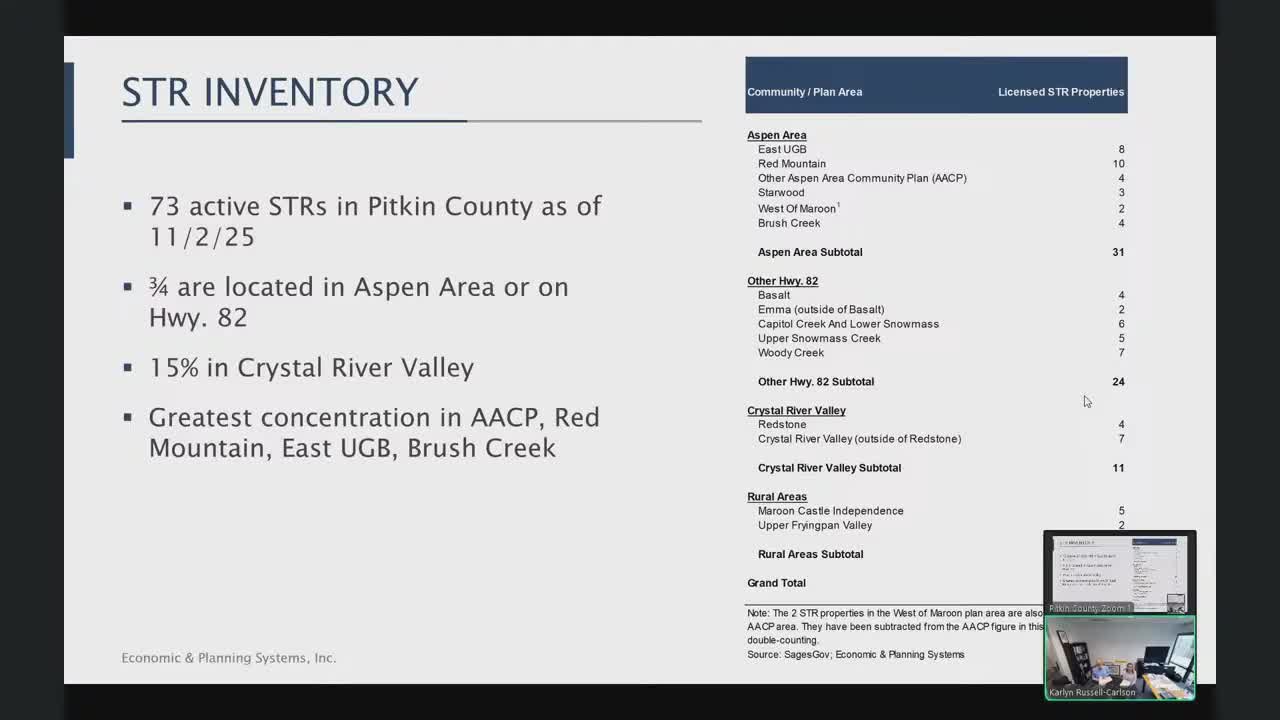
"As of early November, there were 73 active short term rentals in Pitkin County," Knudson said, and he noted concentrations in the Aspen Community Plan area and along Highway 82. EPS27 pricing queries across platforms found a broad range: about half the inventory sampled listed under roughly $2,000 per night for peak-week examples, with a lower proportion clustered in the $2,000–$7,000 range and a distinct luxury segment; EPS said some luxury listings appeared above $10,000 per night and that luxury-specialist platforms showed similar distributions.
EPS reported county STRs average roughly 30% occupancy (2018202013 through 2023 baseline presented), which the consultants characterized as comparatively low utilization relative to larger resort counties. EPS outlined policy levers to address impacts: different license categories (local vs. nonlocal), geographic caps or neighborhood overlays, limits on nights and guest counts, license conditions to address noise/trash/parking, and fee approaches tied to mitigation (administrative licensing fees, regulatory fees and, where municipalities allow, excise taxes).
Commissioners raised three consistent themes: whether the five-year rental-history requirement (201720to 2022) should be retained or opened with a cap on total licenses; whether caps should target specific high-intensity neighborhoods; and how to quantify any STR-linked effects on labor demand and housing. Staff said focus groups and broker outreach will continue in early December and that the study team will return with mitigation scenarios and more disaggregated data (owner type, resident versus nonresident ownership, special-events use and service/concierge intensity).
Commissioners asked staff to explore options including opening eligibility for local residents who lack the historical rental record but pairing any change with an overall cap and clear owner-occupancy or tenure criteria. EPS will probe how many new applications the board might expect and will test policy scenarios against housing-impact metrics and license-cap models.
The board did not take a final policy vote; commissioners directed staff and EPS to continue outreach and to present mitigation scenarios in the final impact study due this winter.
Don't Miss a Word: See the Full Meeting!
Go beyond summaries. Unlock every video, transcript, and key insight with a Founder Membership.
30-day money-back guarantee
Sponsors
Proudly supported by sponsors who keep Colorado articles free in 2025

