William Penn SD posts mixed 2023-24 results, highlights growth and readies students for digital testing
November 13, 2025 | William Penn SD, School Districts, Pennsylvania
This article was created by AI summarizing key points discussed. AI makes mistakes, so for full details and context, please refer to the video of the full meeting. Please report any errors so we can fix them. Report an error »
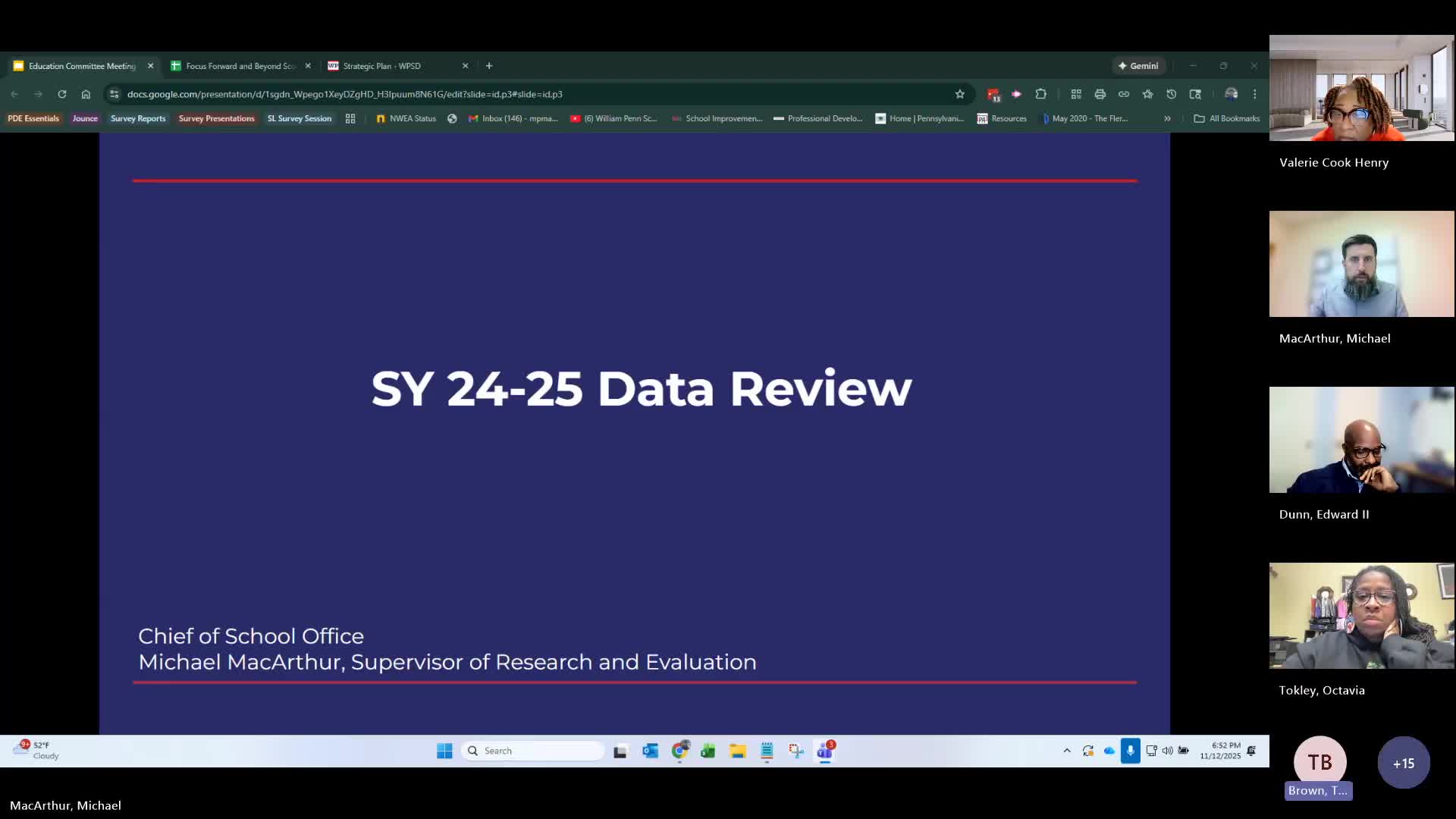
Mr. McArthur, the district's supervisor of research and evaluation, presented the William Penn School District's final academic results for the 2023-24 school year at the Education Committee meeting on Nov. 12.
He said districtwide measures showed meaningful growth on the Keystone exams and that first-time proficiency rates improved in Algebra I and Biology. McArthur noted that third-through-eighth-grade growth as measured by state growth indicators met or exceeded state targets in most grades and subgroups, including special education and English-language learners in many cases.
District attendance improved (regular attendance rose about three percentage points year over year) and the district recorded 47 fewer behavior incidents than the prior year, which McArthur framed as evidence of stronger learning environments. At the same time, several schools had mixed results: Alden posted gains in ELA and math but still missed district 2025 targets; Ardmore had a drop in ELA and gains in math; Park Lane showed declines in both ELA and math and was below the state growth standard in math.
At the secondary level, the ninth grade academy was a bright spot (a 5-point increase in first-time proficiency and well above on growth); Penwood High School showed a drop in first-time literature proficiency but strong growth overall and a notable increase in biology proficiency. Penwood Middle School saw small drops and remained below growth standards in several areas, though algebra for advanced middle-school students improved.
McArthur also described assessment and baseline work for the 2024-25 year: NWEA MAP linking study adjustments affected proficiency projections in January; the district piloted Firefly (a state-provided benchmark for science) and will continue to test its usefulness; and the state is shifting to digital administration of statewide tests (the district has been administering digital common assessments and building teacher and student readiness). He said MAP is roughly 85% predictive of PSSA proficiency and is more predictive for math than ELA; district leaders said they plan MAP administration in January with PSSA predictions likely discussed in a February meeting and Keystone predictions later in the spring.
Committee members asked about ELL testing rules, subgroup slides and whether students are being prepared for digital exams; McArthur and other administrators said subgroup and growth reports are available online and described digital practice and common assessments to prepare students.
The Education Committee received the update; no votes were recorded. McArthur and colleagues indicated communications efforts are planned to make the results more accessible to families and the community.
He said districtwide measures showed meaningful growth on the Keystone exams and that first-time proficiency rates improved in Algebra I and Biology. McArthur noted that third-through-eighth-grade growth as measured by state growth indicators met or exceeded state targets in most grades and subgroups, including special education and English-language learners in many cases.
District attendance improved (regular attendance rose about three percentage points year over year) and the district recorded 47 fewer behavior incidents than the prior year, which McArthur framed as evidence of stronger learning environments. At the same time, several schools had mixed results: Alden posted gains in ELA and math but still missed district 2025 targets; Ardmore had a drop in ELA and gains in math; Park Lane showed declines in both ELA and math and was below the state growth standard in math.
At the secondary level, the ninth grade academy was a bright spot (a 5-point increase in first-time proficiency and well above on growth); Penwood High School showed a drop in first-time literature proficiency but strong growth overall and a notable increase in biology proficiency. Penwood Middle School saw small drops and remained below growth standards in several areas, though algebra for advanced middle-school students improved.
McArthur also described assessment and baseline work for the 2024-25 year: NWEA MAP linking study adjustments affected proficiency projections in January; the district piloted Firefly (a state-provided benchmark for science) and will continue to test its usefulness; and the state is shifting to digital administration of statewide tests (the district has been administering digital common assessments and building teacher and student readiness). He said MAP is roughly 85% predictive of PSSA proficiency and is more predictive for math than ELA; district leaders said they plan MAP administration in January with PSSA predictions likely discussed in a February meeting and Keystone predictions later in the spring.
Committee members asked about ELL testing rules, subgroup slides and whether students are being prepared for digital exams; McArthur and other administrators said subgroup and growth reports are available online and described digital practice and common assessments to prepare students.
The Education Committee received the update; no votes were recorded. McArthur and colleagues indicated communications efforts are planned to make the results more accessible to families and the community.
View the Full Meeting & All Its Details
This article offers just a summary. Unlock complete video, transcripts, and insights as a Founder Member.
✓
Watch full, unedited meeting videos
✓
Search every word spoken in unlimited transcripts
✓
AI summaries & real-time alerts (all government levels)
✓
Permanent access to expanding government content
30-day money-back guarantee
