Philadelphia council grills administration on $800M HOME plan, debates who gets priority
November 13, 2025 | Philadelphia City, Pennsylvania
This article was created by AI summarizing key points discussed. AI makes mistakes, so for full details and context, please refer to the video of the full meeting. Please report any errors so we can fix them. Report an error »
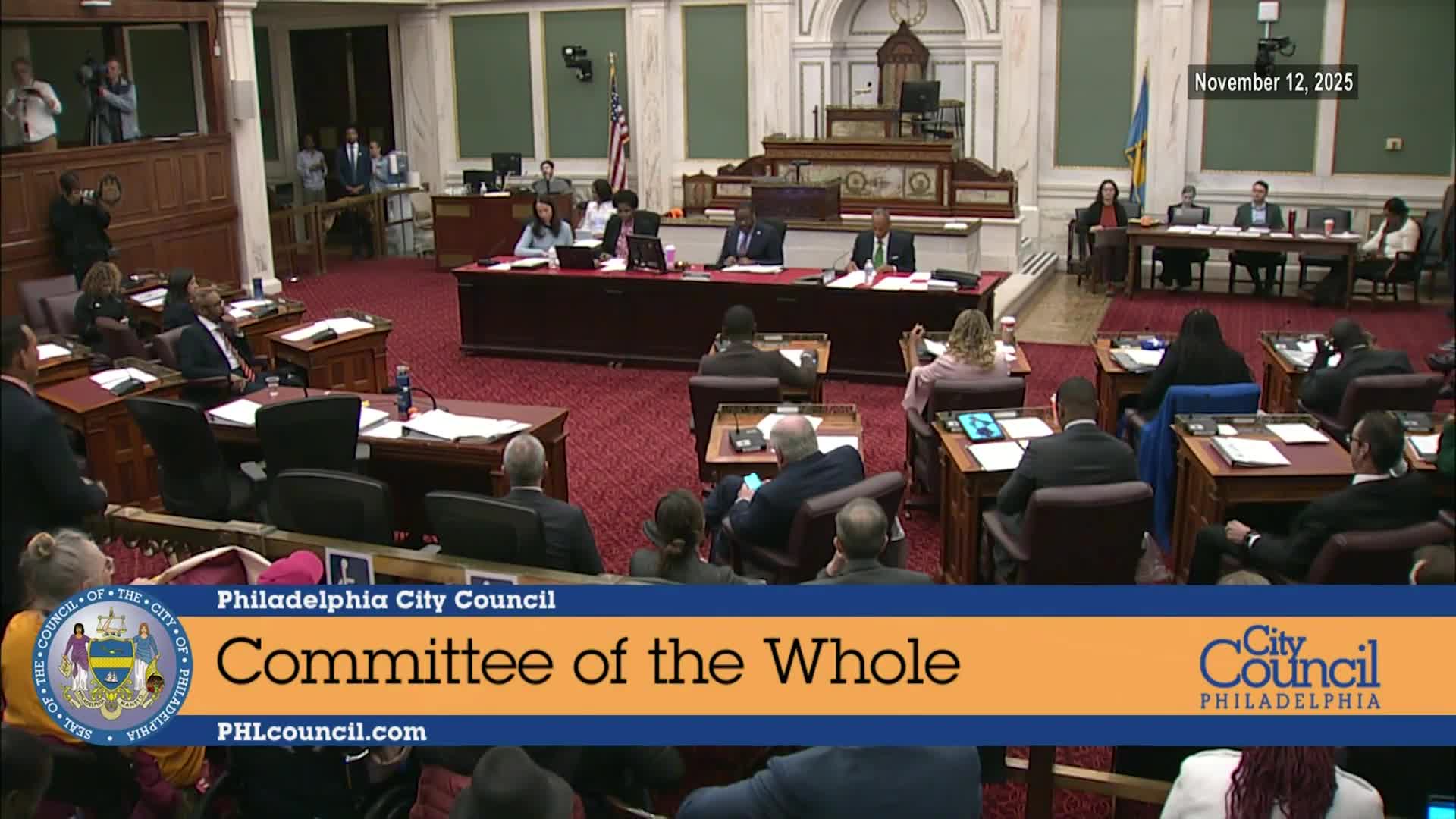
Philadelphia City Council's Committee of the Whole spent an extended hearing on Nov. 12 pressing the Parker administration for details about its proposed $800 million HOME housing bond, the Year 1 program statement and how the city will prioritize the people most at risk of losing housing.
Tiffany Thurman, chief of staff to Mayor Sherrell Parker, told council members the administration's plan is an "ambitious and historic" effort and reiterated the urgency: "The $800,000,000 that we propose to borrow for this very ambitious and historic plan is a serious investment," and officials must move swiftly to access the bond market this calendar year to avoid service interruptions.
Angela Brooks, chief housing and urban development officer, outlined Year 1 allocations and changes since July. Brooks said the first-year program statement totals approximately $238,000,000 and reallocates money toward preservation and repair: "We increased Basic Systems Repair and added to resources for home repairs," she said, and confirmed a $25,000,000 upfront investment for the One Philly mortgage program to expand homeownership supports.
Council members repeatedly pressed administration staff on who the plan will serve. Council President Kenyatta Johnson led early questioning about the Turn the Key pipeline and unit projections; city staff said Turn the Key's Year 1 request was raised to about $43.4 million because the bond's budget year shifted from a truncated fiscal-year window to a full calendar year. Jesse Lawrence, director of planning and development, and pipeline staff said the city projects 2,408 new-construction units across all sources over the plan's first year window, with at least 656 Turn the Key closings expected in calendar 2026 and roughly 765 properties counted between two funding sources.
A central, recurring dispute concerned income targeting. The administration repeatedly argued AMI bands are only one of several factors used to identify need and said its projections show substantial deep affordability: staff cited projections that roughly 68% of beneficiaries will earn 0'50% of area median income (AMI) and that production and preservation would deliver about 17,870 units for 0'30% AMI over four years. Several council members pushed to codify priority AMI ranges into the legislation so the lowest-income households are not deprioritized if eligibility bands are expanded. "If it's not in writing, it ain't real," one council member said, and others said projections are not a substitute for legal requirements.
Preservation of existing subsidized housing was another focal point. Councilmember Nicholas O'Rourke and outside experts warned the city faces the potential loss of thousands of deeply affordable units as federal contracts expire. Administration staff said the city is building an online affordable-housing directory and mapping tool that will identify expiring properties and their risk; officials said a soft launch is planned before the end of the year with a formal launch early next year.
Council members also probed programmatic capacity: PHDC inspection staffing (about 19 inspectors now, staff reported), backlog timelines (average turnaround of roughly six to nine months in current testimony), housing counseling expansion (staff said an additional $85,000,000 is allocated for counseling services in Year 1) and Land Bank operations. The Land Bank presented a recent Guidehouse assessment and pledged quick wins, new hires and website upgrades to clear acquisition and disposition bottlenecks.
Minority developer participation and contractor access were raised repeatedly. PHDC and accelerator fund representatives said roughly 330 Turn the Key units have gone to minority developers so far and that the Accelerator Fund has closed $14.2 million in loans, 26 of 29 to Black- or brown-owned firms; agency staff said the program and technical assistance cohorts aim to increase that participation but acknowledged more work remains.
Finance questions were also detailed. City Finance Director Rob DeBeau said if the resolution passes next week the city can take the bonds to market in December; Treasurer Jackie Dunn named the financing team and said the underwriting syndicate includes diverse firms (Siebert Williams Schenck is a co-senior manager and is Black- and woman-owned; Phoenix Capital and Ahmad Zafri serve roles in the advisory/co-counsel structure).
Public commenters, including housing academics and community advocates, urged stronger prioritization for the lowest-income households and warned that the City faces a 65,000-unit shortage in deeply affordable housing. "Housing is an emergency," Reverend Gregory Holstein said in public comment, calling the shortage a crisis that requires bolder public investment and proposals like social housing.
No final vote was taken at the hearing. Council President Johnson recessed the Committee to reconvene on Nov. 17 at 10 a.m. in City Hall, Room 400, so members and the administration can continue line-by-line discussions and staff can provide requested spreadsheet reconciliations, contract end dates and other clarifying information.
What happened next: the Committee recessed with follow-up items requested from the administration, including reconciled funding spreadsheets for tangled-title allocations; a list of MPI/NPI contract end dates and renewal opportunities; staffing and inspector-count details for PHDC; and a soft-launch timeline for the affordable-housing directory and Land Bank action items.
Why it matters: The HOME plan would be the city's largest single municipal housing investment in recent years and is meant to produce and preserve tens of thousands of units while expanding homeownership programs. Council members and community groups agree the investment is historic, but they differ on the degree to which the plan should legally prioritize the lowest-income households and on how quickly the city can deliver services without additional administrative infrastructure.
Tiffany Thurman, chief of staff to Mayor Sherrell Parker, told council members the administration's plan is an "ambitious and historic" effort and reiterated the urgency: "The $800,000,000 that we propose to borrow for this very ambitious and historic plan is a serious investment," and officials must move swiftly to access the bond market this calendar year to avoid service interruptions.
Angela Brooks, chief housing and urban development officer, outlined Year 1 allocations and changes since July. Brooks said the first-year program statement totals approximately $238,000,000 and reallocates money toward preservation and repair: "We increased Basic Systems Repair and added to resources for home repairs," she said, and confirmed a $25,000,000 upfront investment for the One Philly mortgage program to expand homeownership supports.
Council members repeatedly pressed administration staff on who the plan will serve. Council President Kenyatta Johnson led early questioning about the Turn the Key pipeline and unit projections; city staff said Turn the Key's Year 1 request was raised to about $43.4 million because the bond's budget year shifted from a truncated fiscal-year window to a full calendar year. Jesse Lawrence, director of planning and development, and pipeline staff said the city projects 2,408 new-construction units across all sources over the plan's first year window, with at least 656 Turn the Key closings expected in calendar 2026 and roughly 765 properties counted between two funding sources.
A central, recurring dispute concerned income targeting. The administration repeatedly argued AMI bands are only one of several factors used to identify need and said its projections show substantial deep affordability: staff cited projections that roughly 68% of beneficiaries will earn 0'50% of area median income (AMI) and that production and preservation would deliver about 17,870 units for 0'30% AMI over four years. Several council members pushed to codify priority AMI ranges into the legislation so the lowest-income households are not deprioritized if eligibility bands are expanded. "If it's not in writing, it ain't real," one council member said, and others said projections are not a substitute for legal requirements.
Preservation of existing subsidized housing was another focal point. Councilmember Nicholas O'Rourke and outside experts warned the city faces the potential loss of thousands of deeply affordable units as federal contracts expire. Administration staff said the city is building an online affordable-housing directory and mapping tool that will identify expiring properties and their risk; officials said a soft launch is planned before the end of the year with a formal launch early next year.
Council members also probed programmatic capacity: PHDC inspection staffing (about 19 inspectors now, staff reported), backlog timelines (average turnaround of roughly six to nine months in current testimony), housing counseling expansion (staff said an additional $85,000,000 is allocated for counseling services in Year 1) and Land Bank operations. The Land Bank presented a recent Guidehouse assessment and pledged quick wins, new hires and website upgrades to clear acquisition and disposition bottlenecks.
Minority developer participation and contractor access were raised repeatedly. PHDC and accelerator fund representatives said roughly 330 Turn the Key units have gone to minority developers so far and that the Accelerator Fund has closed $14.2 million in loans, 26 of 29 to Black- or brown-owned firms; agency staff said the program and technical assistance cohorts aim to increase that participation but acknowledged more work remains.
Finance questions were also detailed. City Finance Director Rob DeBeau said if the resolution passes next week the city can take the bonds to market in December; Treasurer Jackie Dunn named the financing team and said the underwriting syndicate includes diverse firms (Siebert Williams Schenck is a co-senior manager and is Black- and woman-owned; Phoenix Capital and Ahmad Zafri serve roles in the advisory/co-counsel structure).
Public commenters, including housing academics and community advocates, urged stronger prioritization for the lowest-income households and warned that the City faces a 65,000-unit shortage in deeply affordable housing. "Housing is an emergency," Reverend Gregory Holstein said in public comment, calling the shortage a crisis that requires bolder public investment and proposals like social housing.
No final vote was taken at the hearing. Council President Johnson recessed the Committee to reconvene on Nov. 17 at 10 a.m. in City Hall, Room 400, so members and the administration can continue line-by-line discussions and staff can provide requested spreadsheet reconciliations, contract end dates and other clarifying information.
What happened next: the Committee recessed with follow-up items requested from the administration, including reconciled funding spreadsheets for tangled-title allocations; a list of MPI/NPI contract end dates and renewal opportunities; staffing and inspector-count details for PHDC; and a soft-launch timeline for the affordable-housing directory and Land Bank action items.
Why it matters: The HOME plan would be the city's largest single municipal housing investment in recent years and is meant to produce and preserve tens of thousands of units while expanding homeownership programs. Council members and community groups agree the investment is historic, but they differ on the degree to which the plan should legally prioritize the lowest-income households and on how quickly the city can deliver services without additional administrative infrastructure.
Don't Miss a Word: See the Full Meeting!
Go beyond summaries. Unlock every video, transcript, and key insight with a Founder Membership.
✓
Get instant access to full meeting videos
✓
Search and clip any phrase from complete transcripts
✓
Receive AI-powered summaries & custom alerts
✓
Enjoy lifetime, unrestricted access to government data
30-day money-back guarantee
