Evanston committee advances seven-year Axon contract to council amid cost and data-control questions
November 13, 2025 | Evanston, Cook County, Illinois
This article was created by AI summarizing key points discussed. AI makes mistakes, so for full details and context, please refer to the video of the full meeting. Please report any errors so we can fix them. Report an error »
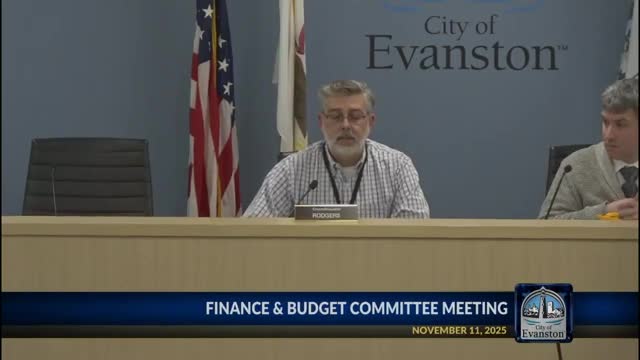
Deputy Chief Jody Wright and Louis Gurrieth, the police department’s manager of budget and finance, told the committee the renewal would begin in 2026 and was quoted at roughly $5.8–$5.9 million over seven years. Staff said the proposal raises the department’s average annual cost to about $850,000 from about $500,000 under the current arrangement, and that the 2026 payment would be budget-neutral because that year’s funding had already been accounted for.
Why it matters: the contract covers technology and services that the department and state law increasingly expect — including body-worn cameras — but the proposed term and price drew sustained questions over vendor lock-in, the pace of technological change, and how the city controls access to stored evidence.
Wright described the department’s history with Axon, saying the city began piloting body-worn cameras in 2017 and completed full implementation in 2018. He told the committee the Axon suite includes body-worn and fleet cameras, interview-room systems, Evidence.com (the vendor’s evidence-management service), an automated redaction tool and other software such as Axon Standards and Axon Fuses. "We were the first in this area to implement body-worn cameras," Wright said, and the department has integrated Axon tools into investigations and subpoena responses.
Finance manager Louis Gurrieth said the city negotiated early to avoid a weaker position next year and to lock in pricing before anticipated annual vendor increases. "Renewing a little bit early, a year early would provide us with a stronger negotiating position," Gurrieth said, adding that some initial quotes were "even more shocking" before negotiation.
Committee members pressed staff for specifics. One member characterized the difference between the prior average cost and the proposed average as about a 70% increase; another noted a roughly 35% year‑to‑year jump between 2026 and 2027. Staff said much of the change reflects market-rate increases and that the renewal bundles additional services the department did not previously license (including Taser 10 and community engagement tools). Staff also said Axon offers equipment refreshes mid-contract — typically about halfway through a multi-year term — and that the first year of the renewal is intended to be budget-neutral.
On procurement options, members asked whether the city should run a new competitive solicitation. Staff said it is technically possible to "piecemeal" services from multiple vendors but warned that doing so would increase internal staffing and integration costs and could disrupt operations. Gurrieth estimated the internal cost of managing multiple vendors could amount to roughly one full-time employee ($100,000) per major function and said those internal costs reduce the apparent savings of a la carte purchasing.
Public comment raised privacy and surveillance concerns. A caller, Mr. Sutherland, urged the committee to "slow down" and cited the recent termination of a Flock Safety ALPR contract as a cautionary example, alleging that third‑party systems can share data with federal agencies and warning against expanding mobile ALPRs and new sensor platforms. "This is a social issue," Sutherland said, urging more community review before committing to the contract.
Staff responded to access concerns by saying evidence stored in Evidence.com remains under city control and that the department must expressly share materials for another agency or external party to obtain them. Deputy Chief Wright said there is no open system that would allow other agencies to search the city’s evidence without permission.
Timing and next steps: staff said Axon’s list prices typically increase on Jan. 1, and that renewing before the end of the year would lock the quoted pricing. Committee members noted the compressed calendar — Council’s last meeting of the year is Dec. 8 — and some urged more time for comparative analysis; staff said a full, reliable a la‑carte cost comparison could not be completed in the weeks available without jeopardizing the current price.
The committee’s recommendation to advance the matter to the City Council with a neutral recommendation passed on a roll-call vote with seven ayes and no votes against. The council will consider the item during its regular proceedings.
What was not decided: the committee did not adopt a final contract at this meeting and did not supply additional procurement terms such as formal contractual off-ramps or termination milestones beyond what staff described. Council debate and any recommended contract terms will be addressed at the full City Council meeting.
Don't Miss a Word: See the Full Meeting!
Go beyond summaries. Unlock every video, transcript, and key insight with a Founder Membership.
30-day money-back guarantee
Sponsors
Proudly supported by sponsors who keep Illinois articles free in 2025

