Santa Fe completes $20 million rehabilitation of Nichols Dam, cites safety and operational upgrades
This article was created by AI summarizing key points discussed. AI makes mistakes, so for full details and context, please refer to the video of the full meeting. Please report any errors so we can fix them. Report an error »
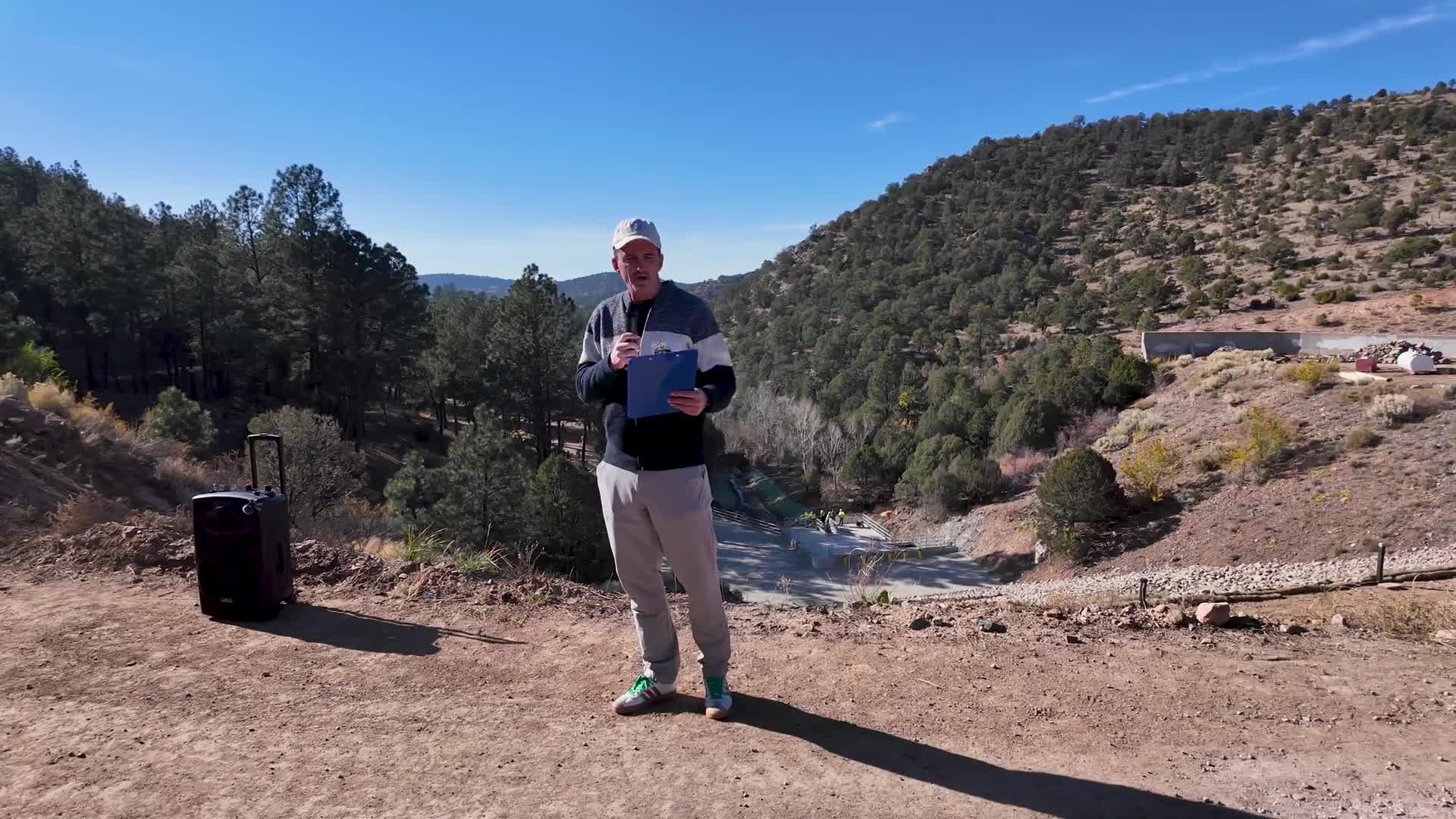
City of Santa Fe officials and state water regulators on Thursday celebrated completion of a nearly 18-month, $20 million rehabilitation of Nichols Dam, a municipal reservoir that holds roughly 20% of the city's Santa Fe River storage.
"This is a key piece of the city's water infrastructure, and we've been storing water here for municipal use for more than 80 years," said Jesse Roach, interim public utilities department director for the City of Santa Fe, at the ceremony. Roach said the work addresses safety deficiencies identified in 2017–18 inspections and returns the dam to modern standards.
The Office of the State Engineer's dam safety bureau chief, Sashil Chaudhary, who led the inspection that downgraded Nichols from "good" to "poor," described his office's role in regulation, design support and on-site monitoring. "So if you are looking for the guy who rated this dam from good to poor, that would be me," Chaudhary said, adding that the office also assisted financially in the design phase when contract limits were reached.
Officials said the work moved about 25,000 cubic yards of earth, required a temporary upstream cofferdam to keep the site dry, and involved pumping roughly one billion gallons of water around the dam during construction. The dam shifted about a quarter-inch upstream when drained and is now returning to its original position, Roach said.
Funding for the project was a mix of state sources. Roach said the Water Trust Board provided $3.3 million in grant funding and $2.2 million as a low-interest loan; the remainder was financed through a Clean Water State Revolving Fund loan administered by the New Mexico Environment Department (NMED). Jonas Armstrong of NMED praised the city's ability to "stack those funding sources" and called the project a model for other communities.
The rehabilitation included replacement of the outlet conduit. According to city staff, the original 5-foot, hand-poured concrete conduit was relined by inserting a continuous HDPE pipe through the old conduit, grouting the annular space and creating a fully pressurized, winter-proof pipeline to the Canyon Road Water Treatment Plant. "And so now we have a new conduit that's fully pressurized all the way through the dam and all the way down to Canyon Road Water Treatment Plant," said Jonathan Antoya, the city's water division director.
Antoya said the upgrades restore a natural river channel by removing an old metal pipe, install automated valves and meters that will allow the city to measure deliveries to acequias, the river and the treatment plant, and create operational flexibility to shift seasonal treatment processes. He also said the city expects the new pressurized conduit to provide head for hydroelectric generation once the city purchases a turbine: "We haven't bought that turbine yet, but once we invest in the turbine, we'll be able to start making electricity."
City leaders highlighted water-quality benefits from the rehabilitation. Antoya said the city will begin bubbling oxygen-rich air through the reservoir to improve water quality and reduce the need to add manganese during treatment. Mayor Allen Webber called the improvements "a massive upgrade" and said the project was completed "on budget and on schedule." "Water is life," Webber added.
AECOM provided design and construction oversight and installed an inclinometer to monitor movement; CF Padilla, a New Mexico contractor, completed construction and did not submit any change orders, city officials said. City staff and state partners emphasized ongoing monitoring and the role of interagency cooperation in completing the project.
Next steps described at the event included continued monitoring of the dam's movement, completing procurement for a potential turbine if the city decides to pursue hydroelectric generation, and operational integration of the new controls and metering systems.
"This is a key piece of the city's water infrastructure, and we've been storing water here for municipal use for more than 80 years," said Jesse Roach, interim public utilities department director for the City of Santa Fe, at the ceremony. Roach said the work addresses safety deficiencies identified in 2017–18 inspections and returns the dam to modern standards.
The Office of the State Engineer's dam safety bureau chief, Sashil Chaudhary, who led the inspection that downgraded Nichols from "good" to "poor," described his office's role in regulation, design support and on-site monitoring. "So if you are looking for the guy who rated this dam from good to poor, that would be me," Chaudhary said, adding that the office also assisted financially in the design phase when contract limits were reached.
Officials said the work moved about 25,000 cubic yards of earth, required a temporary upstream cofferdam to keep the site dry, and involved pumping roughly one billion gallons of water around the dam during construction. The dam shifted about a quarter-inch upstream when drained and is now returning to its original position, Roach said.
Funding for the project was a mix of state sources. Roach said the Water Trust Board provided $3.3 million in grant funding and $2.2 million as a low-interest loan; the remainder was financed through a Clean Water State Revolving Fund loan administered by the New Mexico Environment Department (NMED). Jonas Armstrong of NMED praised the city's ability to "stack those funding sources" and called the project a model for other communities.
The rehabilitation included replacement of the outlet conduit. According to city staff, the original 5-foot, hand-poured concrete conduit was relined by inserting a continuous HDPE pipe through the old conduit, grouting the annular space and creating a fully pressurized, winter-proof pipeline to the Canyon Road Water Treatment Plant. "And so now we have a new conduit that's fully pressurized all the way through the dam and all the way down to Canyon Road Water Treatment Plant," said Jonathan Antoya, the city's water division director.
Antoya said the upgrades restore a natural river channel by removing an old metal pipe, install automated valves and meters that will allow the city to measure deliveries to acequias, the river and the treatment plant, and create operational flexibility to shift seasonal treatment processes. He also said the city expects the new pressurized conduit to provide head for hydroelectric generation once the city purchases a turbine: "We haven't bought that turbine yet, but once we invest in the turbine, we'll be able to start making electricity."
City leaders highlighted water-quality benefits from the rehabilitation. Antoya said the city will begin bubbling oxygen-rich air through the reservoir to improve water quality and reduce the need to add manganese during treatment. Mayor Allen Webber called the improvements "a massive upgrade" and said the project was completed "on budget and on schedule." "Water is life," Webber added.
AECOM provided design and construction oversight and installed an inclinometer to monitor movement; CF Padilla, a New Mexico contractor, completed construction and did not submit any change orders, city officials said. City staff and state partners emphasized ongoing monitoring and the role of interagency cooperation in completing the project.
Next steps described at the event included continued monitoring of the dam's movement, completing procurement for a potential turbine if the city decides to pursue hydroelectric generation, and operational integration of the new controls and metering systems.
Don't Miss a Word: See the Full Meeting!
Go beyond summaries. Unlock every video, transcript, and key insight with a Founder Membership.
✓
Get instant access to full meeting videos
✓
Search and clip any phrase from complete transcripts
✓
Receive AI-powered summaries & custom alerts
✓
Enjoy lifetime, unrestricted access to government data
30-day money-back guarantee
