Palo Alto Council approves 660 University Avenue planned-community rezoning after heated hearing, with tree protections and parking conditions
November 11, 2025 | Palo Alto, Santa Clara County, California
This article was created by AI summarizing key points discussed. AI makes mistakes, so for full details and context, please refer to the video of the full meeting. Please report any errors so we can fix them. Report an error »
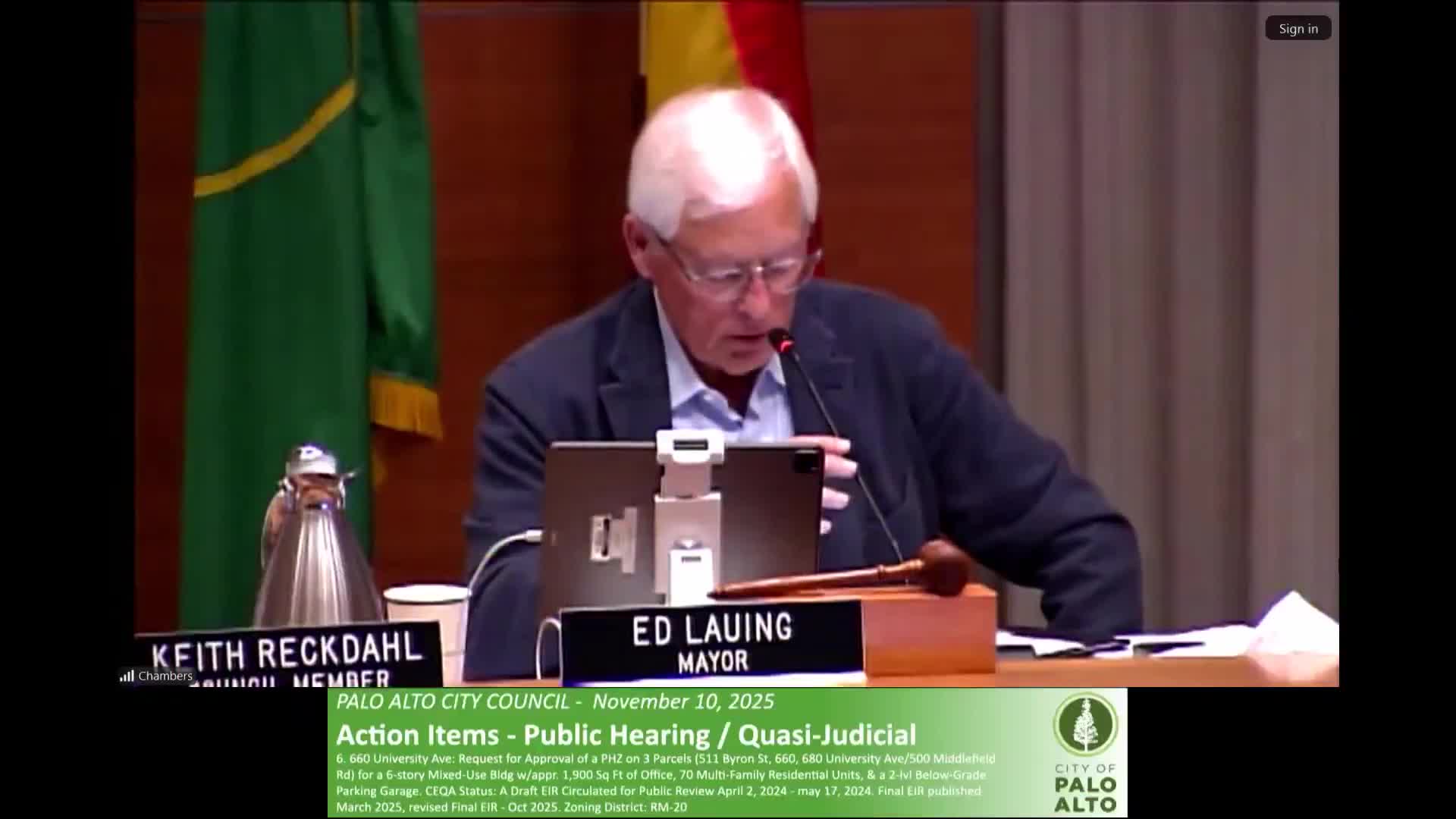
The project team described the history and revisions to the proposal, including a reduction from a previously considered 70‑unit design to 66 units to respond to Planning & Transportation Commission recommendations addressing the canopy of an adjacent coast live oak. Applicant Lund Smith said the team "care[s] a lot about the tree. We wanna save the tree," and emphasized their willingness to work with staff on mitigation and to proceed through city review rather than pursuing a builder's‑remedy path.
Staff planner Emily Callas told the council the proposal would include an 8% parking reduction (78 stalls proposed) supported by a transportation demand management plan that staff estimates could reduce trips by up to 20%. Callas said the application proposes 20% of units as below‑market‑rate (BMR) housing — 13 units under the current unit mix — and described recommended conditions including dedication of a public access easement over a 24‑foot front yard special setback and mitigation monitoring and reporting tied to the project's final approvals.
Neighbors and technical experts focused much of their testimony on two issues: the health and long‑term survival of a mature coast live oak on adjacent property and traffic and parking impacts on narrow nearby streets such as Byron. Multiple neighborhood arborists and residents argued pruning, root loss from below‑grade excavation, and asymmetric canopy trimming could imperil the oak; the city's urban forester, Peter Gollinger, summarized his review of the arborist reports and said the proposal's expected encroachment into the tree protection zone is "about 20%" and that projected pruning (approximately 15%) and root loss fall within the city's usual tolerances but require careful mitigation.
Legal and process questions surfaced around the builder's remedy — a state pathway that can allow denser development if a jurisdiction's housing element is not accepted by state authorities. Several opponents argued the builder's remedy should prevent council approval; staff and the city attorney explained the application is within a tolling agreement and legal review supports council consideration at this time.
Council debate centered on a set of conditions tied to the staff recommendation: the unit count and balconies, BMR distribution among unit sizes, required construction logistics planning, the single on‑street loading stall proposed on Byron, and a staff‑recommended condition requiring the applicant to propose methods to detect and address spillover parking. Council member Liu defended neighborhood access to the Residential Parking Permit (RPP) program and opposed language she said could treat new residents as "spillover" parking. Council member Burt moved to restore the staff‑recommended spillover‑parking mitigations, and that motion carried; the final approval included the restored mitigation language and the project as modified.
What the council approved: the record shows the council adopted the staff resolution to certify the EIR and MMRP, adopt the comprehensive plan amendment, adopt the planned‑community ordinance rezoning the property, and approve the record of land‑use action with findings and conditions as modified by council direction. The final roll call on the motion to approve the project (with the restored parking mitigation condition) was recorded as Yes—Mayor Lowing, Council members Burt, Lythcott Haines and Rechtel; No—Council member Liu.
Next steps and implementation: staff will incorporate the council's modifications into final conditions of approval, and required follow‑up will include a construction logistics plan as part of the building permit process, implementation of the mitigation monitoring and reporting program, and coordination with transportation staff on TDM measures and any necessary traffic or circulation improvements on nearby blocks.
Council members and the applicant emphasized the project's role in meeting the city's housing goals while also flagging the need to protect the oak tree and to manage neighborhood impacts during construction. The council's approval was procedural (an ordinance/action that requires a four‑vote majority when fewer than seven members are present) and sets the project to move into the implementation and permitting phase.
View the Full Meeting & All Its Details
This article offers just a summary. Unlock complete video, transcripts, and insights as a Founder Member.
30-day money-back guarantee
Sponsors
Proudly supported by sponsors who keep California articles free in 2025

