Lansing wins: Rochester Hills’ lobbyists, Rep. Tisdel tout budget wins, earmark transparency and local grants
November 10, 2025 | Rochester Hills City, Oakland County, Michigan
This article was created by AI summarizing key points discussed. AI makes mistakes, so for full details and context, please refer to the video of the full meeting. Please report any errors so we can fix them. Report an error »
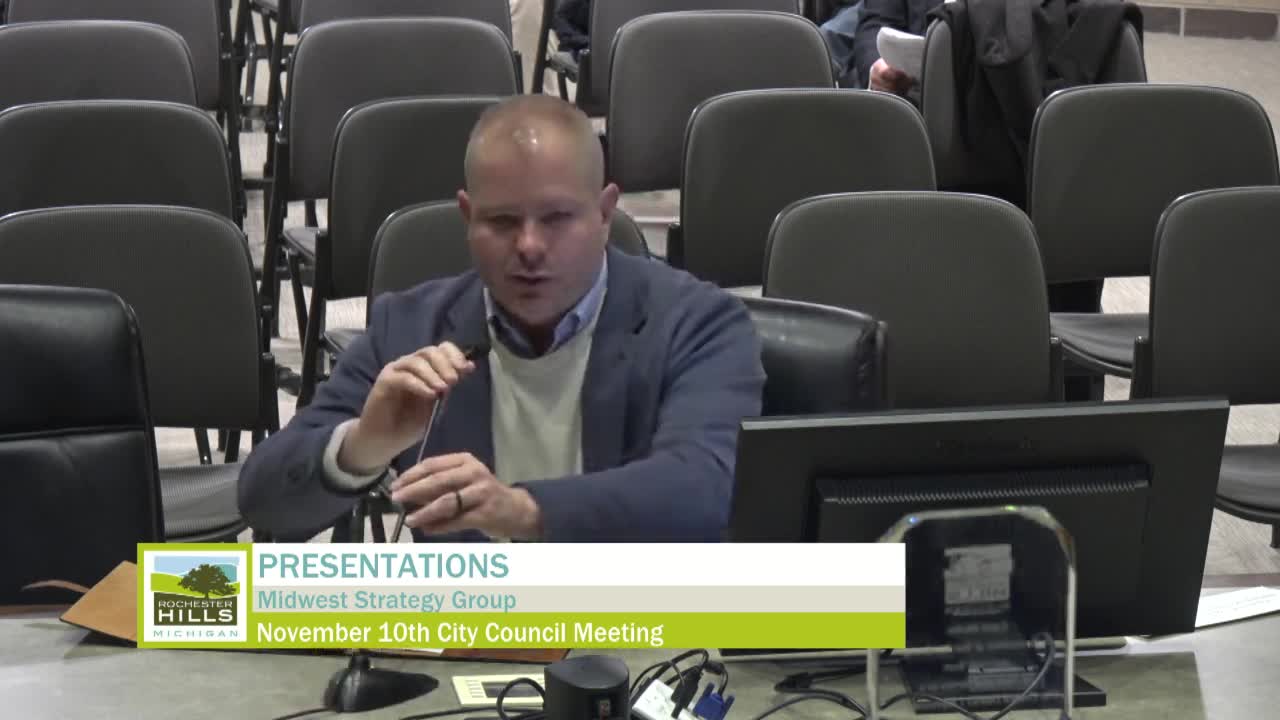
Adam Wright of Midwest Strategy Group summarized the 2025–26 state budget process, saying the Legislature completed an $81 billion spending plan in early October and implemented new transparency measures for earmarks. "They passed the complete $81,000,000,000 state budget for the fiscal year that we're currently in," Wright told council. He told members the budget eliminated many so-called "ghost employees" and reworked road funding by removing the sales-tax on gasoline and increasing the gas tax so pump revenue is dedicated to roads.
Wright highlighted a package of public-safety funding embedded in the budget: $50 million ongoing and $20 million of one-time funds statewide, with restrictions on ineligible uses such as facial recognition technology, pension/OPEB payments, debt service and tactical vehicles. For Rochester Hills he said the city's share of the public-safety allocation will be modest but reflects the city's relative safety profile.
Representative Mark Tisdel (R) detailed additional state-level work and his committee assignments, noting efforts to change how economic-development incentives are awarded. He said lawmakers will pursue a two-bill package on jobs and economic development that would reduce or prohibit some kinds of up-front incentives. "Since the year 2000, the state of Michigan has spent $20,000,000,000 on corporate and business incentives," Tisdel said, arguing the state needs better returns for investments.
Both Wright and Tisdel noted local successes: Wright credited Representative Tisdale and Senator Weber for helping secure $2 million for Nowicki Park; Tisdel separately said his office helped secure $175,000 for a proposed Common Ground resiliency center near Auburn Road, a local priority following recent community incidents. Council members pressed on how changes to state road funding and revenue sharing will affect municipal budgets in the coming fiscal year and asked staff to track pending bills for local preemption and housing reform.
View the Full Meeting & All Its Details
This article offers just a summary. Unlock complete video, transcripts, and insights as a Founder Member.
30-day money-back guarantee
Sponsors
Proudly supported by sponsors who keep Michigan articles free in 2025

