Bethlehem Area SD warns cash could run low, may seek short-term borrowing if state impasse continues
November 10, 2025 | Bethlehem Area SD, School Districts, Pennsylvania
This article was created by AI summarizing key points discussed. AI makes mistakes, so for full details and context, please refer to the video of the full meeting. Please report any errors so we can fix them. Report an error »
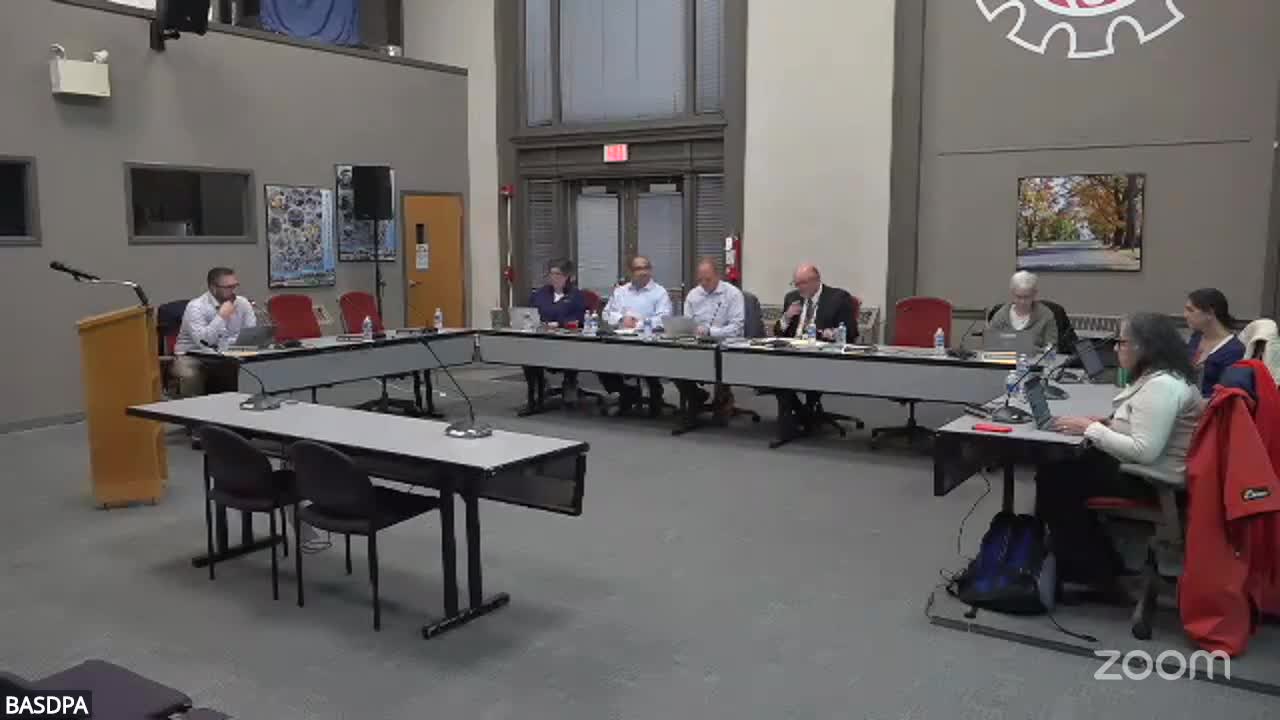
The Bethlehem Area School District’s finance committee heard a budget update on Nov. 10, 2025, that warned a prolonged Pennsylvania state budget impasse could force short-term borrowing and further tighten classroom resources. Harry of the district’s business office told the committee the district has budgeted conservatively for 2026 — including a planned use of $5.7 million of fund balance — but that the lack of a state budget leaves the district’s revenue assumptions hypothetical.
Why it matters: District officials say local revenues have kept operations normal so far but that cash projections show a sharp decline after December. Harry said the district is burning roughly $35–40 million a month; with current assumptions, cash could fall below $30 million in January and near $8 million in February, creating the need for a tax-anticipation note (TRAN) or other short-term financing to bridge the gap.
Harry said the district is relying about 70% on locally raised revenue to operate and that state aid delays already represent roughly $33 million in delayed receipts. “As of today, we still don't have a state budget,” he said during the presentation. “If this thing continues to December and we still don't have a state budget, we would, at that point, have lost out on … potential funding and start putting some real strain on our budget and the ability to operate.”
Board members pressed for specifics about the immediate financial hit. One board member said local taxpayers have already foregone roughly $300,000 in interest that would have been earned locally while state-held funds remain in Harrisburg, adding that figure could approach $500,000 if the impasse lasts into December. Harry confirmed interest earnings are real money that support classrooms and said he would research whether there is a protocol for allocating interest earnings accrued while state funds are delayed.
The presentation reviewed expense drivers — salaries and benefits account for about 65% of the budget, followed by tuition and debt service — leaving less than 10% of funds as discretionary. Harry also reviewed the district’s debt portfolio (about $203 million outstanding as of Sept. 30, 2025), recent refinancing, and a potential new borrowing tied to finishing construction at Fountain Hill Elementary. Using the district’s model, new debt would add roughly $750,000 of interest payments in year one and rise in subsequent years under the assumptions presented.
Administrators stressed the planning assumptions used for projections: a 7% increase in health costs (the district is self-insured), 6.5% growth in charter tuition, flat Title I federal funding and uncertain futures for Titles II–IV. They warned that inflation, slower investment earnings and a potential federal or state funding shift could widen the structural deficit.
Board members called the presentation a “wake-up call” and urged early, multiyear planning to protect classroom services. “We have some levers,” Harry said, noting options such as modest tax-base growth assumptions and careful expense management, but added that decisive planning is required to avoid leaning into a structural deficit.
Next steps: The administration said it will return to the board if short-term financing is needed and will provide follow-up research on lost interest earnings and any applicable allocation protocols. The finance committee will use these projections to inform the district’s multiyear budgeting process.
Why it matters: District officials say local revenues have kept operations normal so far but that cash projections show a sharp decline after December. Harry said the district is burning roughly $35–40 million a month; with current assumptions, cash could fall below $30 million in January and near $8 million in February, creating the need for a tax-anticipation note (TRAN) or other short-term financing to bridge the gap.
Harry said the district is relying about 70% on locally raised revenue to operate and that state aid delays already represent roughly $33 million in delayed receipts. “As of today, we still don't have a state budget,” he said during the presentation. “If this thing continues to December and we still don't have a state budget, we would, at that point, have lost out on … potential funding and start putting some real strain on our budget and the ability to operate.”
Board members pressed for specifics about the immediate financial hit. One board member said local taxpayers have already foregone roughly $300,000 in interest that would have been earned locally while state-held funds remain in Harrisburg, adding that figure could approach $500,000 if the impasse lasts into December. Harry confirmed interest earnings are real money that support classrooms and said he would research whether there is a protocol for allocating interest earnings accrued while state funds are delayed.
The presentation reviewed expense drivers — salaries and benefits account for about 65% of the budget, followed by tuition and debt service — leaving less than 10% of funds as discretionary. Harry also reviewed the district’s debt portfolio (about $203 million outstanding as of Sept. 30, 2025), recent refinancing, and a potential new borrowing tied to finishing construction at Fountain Hill Elementary. Using the district’s model, new debt would add roughly $750,000 of interest payments in year one and rise in subsequent years under the assumptions presented.
Administrators stressed the planning assumptions used for projections: a 7% increase in health costs (the district is self-insured), 6.5% growth in charter tuition, flat Title I federal funding and uncertain futures for Titles II–IV. They warned that inflation, slower investment earnings and a potential federal or state funding shift could widen the structural deficit.
Board members called the presentation a “wake-up call” and urged early, multiyear planning to protect classroom services. “We have some levers,” Harry said, noting options such as modest tax-base growth assumptions and careful expense management, but added that decisive planning is required to avoid leaning into a structural deficit.
Next steps: The administration said it will return to the board if short-term financing is needed and will provide follow-up research on lost interest earnings and any applicable allocation protocols. The finance committee will use these projections to inform the district’s multiyear budgeting process.
View the Full Meeting & All Its Details
This article offers just a summary. Unlock complete video, transcripts, and insights as a Founder Member.
✓
Watch full, unedited meeting videos
✓
Search every word spoken in unlimited transcripts
✓
AI summaries & real-time alerts (all government levels)
✓
Permanent access to expanding government content
30-day money-back guarantee
