North Smithfield council completes first reading of up to $9M bond for public safety complex after budget debate
November 11, 2025 | North Smithfield, Providence County, Rhode Island
This article was created by AI summarizing key points discussed. AI makes mistakes, so for full details and context, please refer to the video of the full meeting. Please report any errors so we can fix them. Report an error »
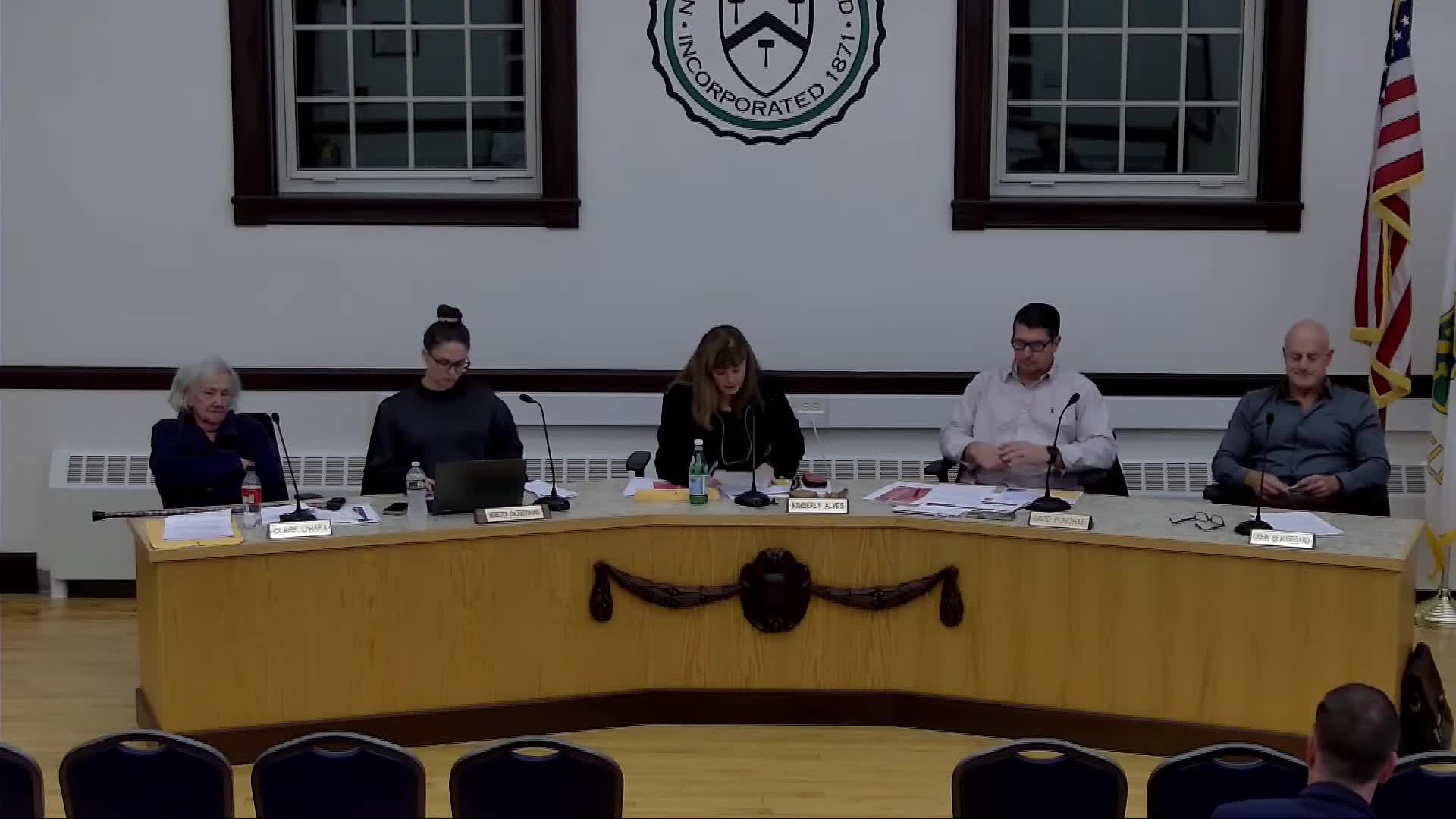
North Smithfield — The Town Council on Nov. 10 completed the first reading of an ordinance authorizing the town to issue general obligation bonds not to exceed $9,000,000 to finance the construction, rehabilitation and improvement of the town’s Public Safety Complex, also described in council materials as the police station.
Consultants from ECC and Signal Works reviewed the project’s budget history, options and cost estimates, and municipal adviser Steve Mastrone gave the council a debt-capacity analysis that framed the central financing choice: how much to draw from the town’s fund balance versus how much to borrow. Mastrone told the council he “never made a recommendation” to take $4,000,000 from reserves and said he would "lean towards issuing more debt than less" given the town’s current low debt burden and the interest-rate environment.
Why it matters: the council must decide between several capital-structure options — using a larger share of unrestricted fund balance, a hybrid of cash plus bonds, or issuing the full amount as bonds — and voters will ultimately approve any bond issuance. Councilors said they want clear, scenario-driven estimates of taxpayer impact before the second reading.
What the consultants presented: ECC and Signal Works re-stated a decision path developed last year in which project options were priced in tiers. The team described a base scope that had been considered at approximately $6,000,000 and an expanded scope and add-alternates that could take the project toward about $9,000,000 if the full set of renovations and additions is authorized. ECC explained the earlier $4,000,000 figure cited in prior meetings represented the suggested cap on unrestricted fund-balance use, and that an additional $2,000,000 in restricted or “use-it-or-lose-it” funding had been contemplated to reach a $6,000,000 baseline.
Procurement and schedule issues: councilors discussed the chosen delivery method — a construction-manager-at-risk (CMAR) approach — and the consequences for pricing and schedule. ECC noted the CMAR proposals were estimates rather than hard GC bids, giving the town more ability to adapt scope but requiring later GMP (guaranteed maximum price) work before award. ECC asked whether the council could authorize a very limited preconstruction notice to proceed (two kickoff meetings) for Parasol, the recommended CM, at an estimated cost of $17,800; procurement staff expressed concern that amount could exceed thresholds that require a signed contract and thus urged caution.
Fund balance and debt conversation: municipal adviser Steve Mastrone gave a longer presentation on debt service, Moody’s scorecard factors and the town’s reserve position. He showed sensitivity runs indicating the town could absorb some use of reserves without an automatic rating penalty but said he would not personally recommend taking $4,000,000 out of fund balance for a capital project. He explained smaller cash contributions (for example, $1 million to $1.5 million) would be "not impactful" to credit metrics and that in the current rate environment borrowing at roughly 4% is a reasonable option if the town prefers to preserve reserves.
Council debate and public comments: councilors and residents pressed two recurring themes: (1) the perception among some voters that the town has already paid for this building via a prior bond and (2) the political risk if a bond question fails at referendum. Resident Paulette Hamilton told the council she is "not in favor of going out for a bond" and warned that a failed bond could make costs rise further. Other residents and councilors argued the town has a small remaining balance of prior bond funds and several grants that can partially offset borrowing, and that a clear, single-purpose bond targeted only to the police station would be more defensible to voters.
The vote: after discussion the councilor who sponsored the ordinance moved to accept the ordinance authorizing up to $9,000,000 in general obligation bonds for the Public Safety Complex. The motion was seconded and passed in a roll-call vote with all recorded members answering "Yes" (Beauregard; Cristavaro; O'Hara; Punchak; Elf). The vote advanced the ordinance to the required second reading and final vote, which the council scheduled for Dec. 1, 2025.
Next steps: staff committed to deliver detailed financing scenarios and taxpayer-impact projections ahead of the second reading, and to circulate the Parasol contract for legal review. ECC and Parasol may begin limited preconstruction engagement only if the council clears procurement and contract-review questions. The council did not adopt final financing decisions at first reading; the vote was a procedural first step to put the bond ordinance before voters if ultimately adopted.
Council comment: Mastrone summarized the trade-offs in his guidance: "anything under 4,000,000 is more advisable from my perspective" while also noting the town’s strong debt metrics and rate environment. Resident speakers urged careful outreach to voters and clarity that any bond would be dedicated to the Public Safety Complex alone.
A second reading of the ordinance and further financing scenario analysis is expected at the council’s Dec. 1 meeting.
Consultants from ECC and Signal Works reviewed the project’s budget history, options and cost estimates, and municipal adviser Steve Mastrone gave the council a debt-capacity analysis that framed the central financing choice: how much to draw from the town’s fund balance versus how much to borrow. Mastrone told the council he “never made a recommendation” to take $4,000,000 from reserves and said he would "lean towards issuing more debt than less" given the town’s current low debt burden and the interest-rate environment.
Why it matters: the council must decide between several capital-structure options — using a larger share of unrestricted fund balance, a hybrid of cash plus bonds, or issuing the full amount as bonds — and voters will ultimately approve any bond issuance. Councilors said they want clear, scenario-driven estimates of taxpayer impact before the second reading.
What the consultants presented: ECC and Signal Works re-stated a decision path developed last year in which project options were priced in tiers. The team described a base scope that had been considered at approximately $6,000,000 and an expanded scope and add-alternates that could take the project toward about $9,000,000 if the full set of renovations and additions is authorized. ECC explained the earlier $4,000,000 figure cited in prior meetings represented the suggested cap on unrestricted fund-balance use, and that an additional $2,000,000 in restricted or “use-it-or-lose-it” funding had been contemplated to reach a $6,000,000 baseline.
Procurement and schedule issues: councilors discussed the chosen delivery method — a construction-manager-at-risk (CMAR) approach — and the consequences for pricing and schedule. ECC noted the CMAR proposals were estimates rather than hard GC bids, giving the town more ability to adapt scope but requiring later GMP (guaranteed maximum price) work before award. ECC asked whether the council could authorize a very limited preconstruction notice to proceed (two kickoff meetings) for Parasol, the recommended CM, at an estimated cost of $17,800; procurement staff expressed concern that amount could exceed thresholds that require a signed contract and thus urged caution.
Fund balance and debt conversation: municipal adviser Steve Mastrone gave a longer presentation on debt service, Moody’s scorecard factors and the town’s reserve position. He showed sensitivity runs indicating the town could absorb some use of reserves without an automatic rating penalty but said he would not personally recommend taking $4,000,000 out of fund balance for a capital project. He explained smaller cash contributions (for example, $1 million to $1.5 million) would be "not impactful" to credit metrics and that in the current rate environment borrowing at roughly 4% is a reasonable option if the town prefers to preserve reserves.
Council debate and public comments: councilors and residents pressed two recurring themes: (1) the perception among some voters that the town has already paid for this building via a prior bond and (2) the political risk if a bond question fails at referendum. Resident Paulette Hamilton told the council she is "not in favor of going out for a bond" and warned that a failed bond could make costs rise further. Other residents and councilors argued the town has a small remaining balance of prior bond funds and several grants that can partially offset borrowing, and that a clear, single-purpose bond targeted only to the police station would be more defensible to voters.
The vote: after discussion the councilor who sponsored the ordinance moved to accept the ordinance authorizing up to $9,000,000 in general obligation bonds for the Public Safety Complex. The motion was seconded and passed in a roll-call vote with all recorded members answering "Yes" (Beauregard; Cristavaro; O'Hara; Punchak; Elf). The vote advanced the ordinance to the required second reading and final vote, which the council scheduled for Dec. 1, 2025.
Next steps: staff committed to deliver detailed financing scenarios and taxpayer-impact projections ahead of the second reading, and to circulate the Parasol contract for legal review. ECC and Parasol may begin limited preconstruction engagement only if the council clears procurement and contract-review questions. The council did not adopt final financing decisions at first reading; the vote was a procedural first step to put the bond ordinance before voters if ultimately adopted.
Council comment: Mastrone summarized the trade-offs in his guidance: "anything under 4,000,000 is more advisable from my perspective" while also noting the town’s strong debt metrics and rate environment. Resident speakers urged careful outreach to voters and clarity that any bond would be dedicated to the Public Safety Complex alone.
A second reading of the ordinance and further financing scenario analysis is expected at the council’s Dec. 1 meeting.
View the Full Meeting & All Its Details
This article offers just a summary. Unlock complete video, transcripts, and insights as a Founder Member.
✓
Watch full, unedited meeting videos
✓
Search every word spoken in unlimited transcripts
✓
AI summaries & real-time alerts (all government levels)
✓
Permanent access to expanding government content
30-day money-back guarantee
