Finance Committee forwards city's 2026 investment policy to full council after extended debate and public testimony urging human-rights screen
November 11, 2025 | Portland, Multnomah County, Oregon
This article was created by AI summarizing key points discussed. AI makes mistakes, so for full details and context, please refer to the video of the full meeting. Please report any errors so we can fix them. Report an error »
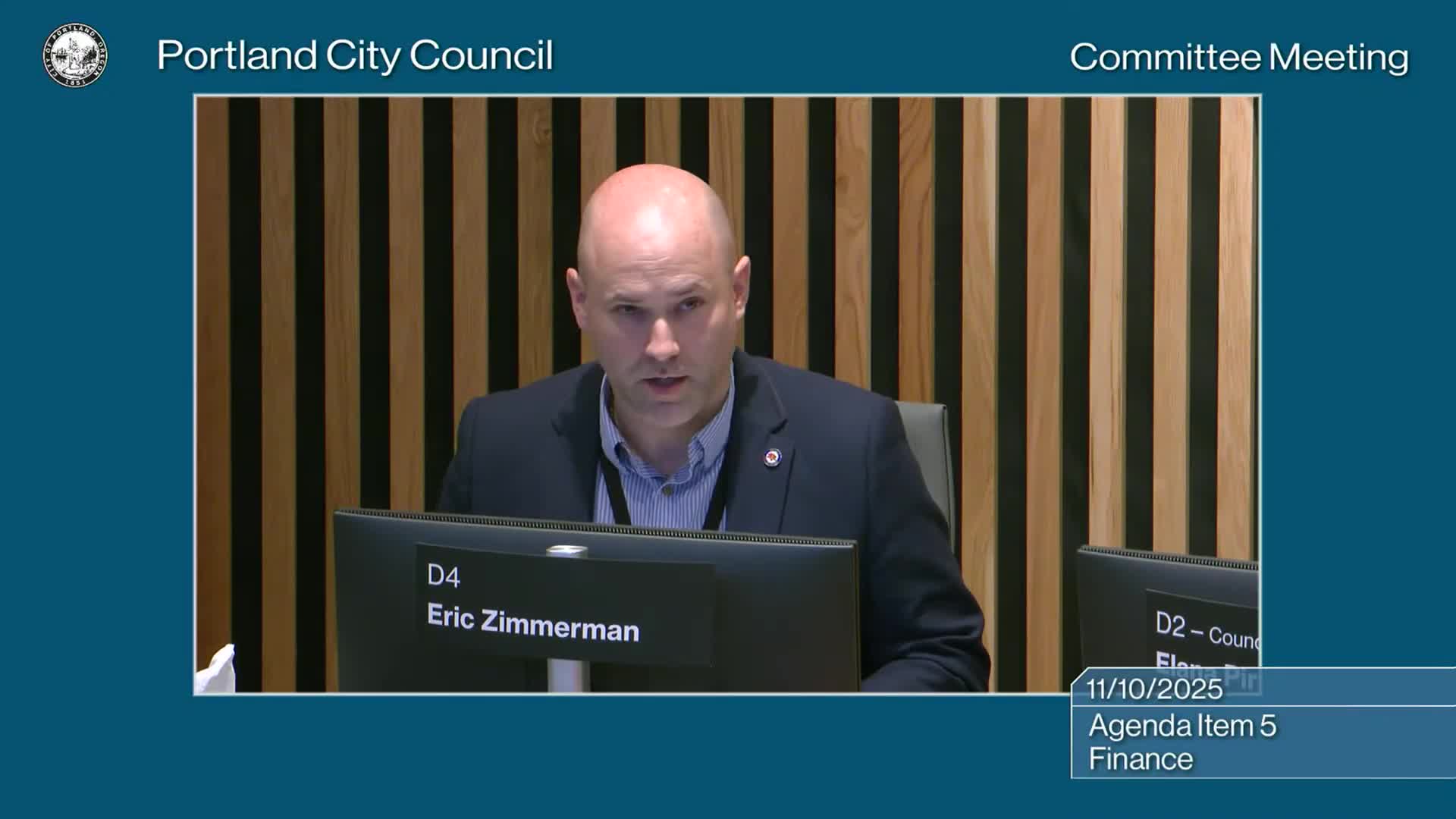
What staff said: CFO Jonas Birri opened the item and City Treasurer Bridget O'Callaghan presented the policy framework and current portfolio statistics. O'Callaghan said the policy contains no material changes for 2026, cited a redline portfolio figure of about $2,800,000,000 and said investment earnings (net of treasury fees) were $115,000,000 in fiscal year 2024–25 and $28,000,000 year‑to‑date through September 2025. She described the policy's objectives — preserve principal, ensure liquidity, and earn a market rate — and explained the city overlays a Bloomberg industry classification filter that currently excludes fossil fuels, arms-related transactions, alcoholic beverages, casinos, correctional facilities and security services.
On corporate bonds and trade-offs: Treasurer O'Callaghan and Investment Officer Michael Montgomery emphasized the city invests primarily in fixed-income securities (bonds), not equities, and that corporate debt in the portfolio is a limited universe that meets the city's high credit-quality requirements. Montgomery estimated the current corporate bucket adds roughly $6,000,000 in return in the current market environment and said there are only about 40 eligible corporate issuers that meet the portfolio's standards; staff cautioned that excluding corporates entirely would reduce diversification and could reduce earnings accordingly.
Public testimony and claims: More than a dozen public commenters urged a human-rights screen or divestment from specific firms. Speakers cited corporate bond holdings the city currently holds (public testimony referenced figures including roughly $68,000,000 in Amazon notes, $26,400,000 in Google, and $30,000,000 in Microsoft) and urged an overlay that would screen companies for ties to military, immigration enforcement or human-rights abuses. Testimony named third-party organizations and index providers (AFSC, MSCI) and urged a dedicated process, external providers, or a multi-year plan for divestment.
Council response: Councilor Novick and others expressed interest in pursuing a more robust ESG/human-rights conversation offline; Councilor Green said she was not prepared to remove the city from bond investments immediately and voted "No" on forwarding the item to full council, citing the need for more work to understand operational impacts and credit-quality limits. Vice Chair Burrell Guinee and others said they welcomed further, deliberate work to define a human-rights screen and how it would be operationalized.
Vote and next steps: Councilor Novick moved and Vice Chair Burrell Guinee seconded that the investment policy resolution be forwarded to the full council for consideration. The committee approved that motion on a 3-1 roll-call vote (three ayes, one no from Councilor Green). Councilors and staff agreed to continue conversations about possible human-rights or expanded ESG screening and noted the treasury publishes the monthly portfolio online for public review.
Why it matters: The investment policy determines how Portland invests funds that support city services; decisions about whether and how to overlay human-rights or ESG screens could alter investment opportunities and returns and have reputational consequences for the city.
View the Full Meeting & All Its Details
This article offers just a summary. Unlock complete video, transcripts, and insights as a Founder Member.
30-day money-back guarantee
Sponsors
Proudly supported by sponsors who keep Oregon articles free in 2025

