Northglenn council hears detailed defense of Flock license-plate readers amid privacy concerns
November 11, 2025 | Northglenn, Adams County, Colorado
This article was created by AI summarizing key points discussed. AI makes mistakes, so for full details and context, please refer to the video of the full meeting. Please report any errors so we can fix them. Report an error »
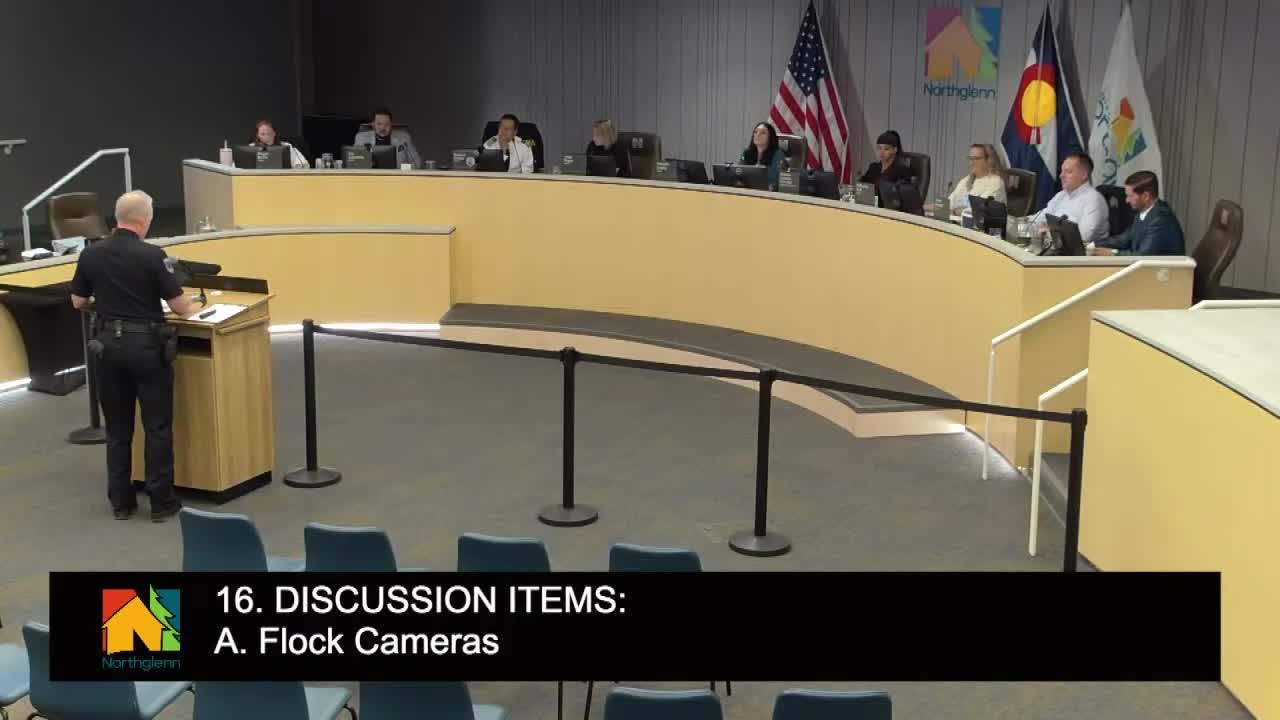
Rice reviewed the system's origins and uses, saying Northglenn began testing Flock in 2022 and used the system to generate investigatory leads in cases including a reported kidnapping and an aggravated motor-vehicle theft that helped recover a car with an infant in the back seat. "This is just an investigatory tool," he said, and added that Flock does not perform facial recognition and that only law enforcement personnel may access the system.
Council members and residents pushed back with privacy and oversight questions. Council member Goff asked how often out-of-state agencies request hits; Rice said such requests occur but that other agencies receive only the location and the camera read triggered and do not have automatic search access to Northglenn's system without a reciprocal "friend" permission. "Not until we give them permission to," Rice said of sharing with other jurisdictions.
Council members sought technical and policy clarifications: how often false positives occur, how stolen vehicle entries are cleared from databases, who approves partner access, and whether filters prevent searches tied to reproductive or immigration enforcement. Rice said Flock implements filters (he said the vendor prevents reproductive- and immigration-related searches in some configurations) and that Northglenn adheres to Colorado law; he also said the department restricts who can approve partner-sharing requests to a small set of administrators and that all access is logged.
Multiple councilors and residents said they wanted more public transparency. Council member Nowicki and others urged a public-facing FAQ and annual reporting; Rice said staff will work with the city's public information officer to publish an explanatory page and that the department will expand training for officers and administrators. "We have fail-safes that we verify before we do that," Rice said, describing internal checklists used before relying on a Flock hit.
Public commenters raised broader worries about network growth and data security. Jonathan Clyburn, a resident, asked how the city ensures promised deletions occur and how many jurisdictions have reciprocal access—Rice said the network can include many agencies and confirmed Northglenn has established reciprocal connections with dozens of partners in the region, and that connection choices are controlled locally.
The council did not vote on policy changes during the meeting but directed staff to increase public communication, conduct additional training, and explore community review options with the Colorado Community Policing Partnership (CCPP). The council then moved to an executive session on a separate personnel matter.
Rice and councilors emphasized that misuse undermines trust and that the department's goal is to use the system as one tool among many in criminal investigations. "It is the investigation piece that's the most important part," Rice said.
View the Full Meeting & All Its Details
This article offers just a summary. Unlock complete video, transcripts, and insights as a Founder Member.
30-day money-back guarantee
Sponsors
Proudly supported by sponsors who keep Colorado articles free in 2025

