Developers pitch 162‑acre solar and storage lease near Waller Mill Reservoir; residents warn of watershed risks
November 10, 2025 | Williamsburg City, James City County, Virginia
This article was created by AI summarizing key points discussed. AI makes mistakes, so for full details and context, please refer to the video of the full meeting. Please report any errors so we can fix them. Report an error »
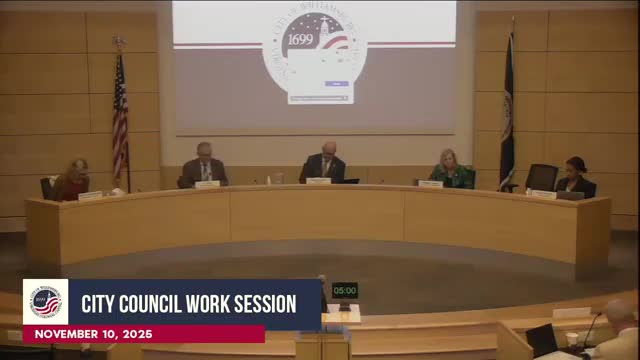
The developer framed the proposal as an opportunity to submit a competitive bid into a Dominion Energy RFP that it said closes in February, but it emphasized that the next contractual step for the city would be a short lease option to allow the company to file an interconnection application with Dominion — not a full, multiyear lease. "Executing the lease option ... just gives us the permission to input an interconnection application with Dominion," a Synergy presenter said (presentation, SEG 1123). The company pointed to available 34 kV distribution lines adjacent to the site and said those lines could shorten the interconnection timeline compared with a transmission‑scale project.
Residents who spoke during public comment urged caution. Kelly Place, a resident who identified herself as a consumer of Williamsburg water, said she was "not overly pleased" about a solar farm proposal that would clear about 162 acres next to the reservoir and urged the city not to "put them in the watershed of a drinking water reservoir" (public comment, SEG 241). Robert Wilson and others warned that clearing forest buffers could increase sedimentation and raise water treatment costs.
Synergy responded to those concerns by describing its due diligence plans: wetland delineations, avoidance of tributaries and required setbacks, and other desktop and on‑the‑ground studies to assess impacts. The presenter said the project would be designed to respect York County's 200‑foot setbacks from tributaries and reservoirs and that developers commonly conduct stormwater and runoff evaluations and secure necessary environmental approvals. The company also said materials used in panels are non‑toxic and that it can include ongoing water and soil testing as part of community monitoring if desired (presentation, SEG 1666–1670; SEG 1666–1674).
On decommissioning, Synergy said it includes a decommissioning plan and that developers typically secure a bond from an investment‑grade provider to cover removal costs if the developer cannot perform at the end of the project term. "We would come out, remove the panels, and return the site to the condition it was prior to construction start," the presenter said (presentation, SEG 1168–1172).
Council members asked several follow‑up questions about lifespan, long‑term operation, and ecological impacts. A council member noted that returning a cleared wooded watershed to its pre‑development condition could be difficult even with replanting; Synergy acknowledged that reestablishing mature forest is not instant but said restoration and bonding are standard mitigants. The vice mayor and other members also asked whether Synergy had examples of similar projects adjacent to watershed land; the developers pointed to municipal airport and other non‑watershed projects and said their standard mitigations and independent technical reviews would be required before the project proceeded (discussion, SEG 1463–1469; SEG 1624–1630).
Next steps: Synergy asked the city to consider a lease option that would allow the developer to file an interconnection application with Dominion and continue site‑specific due diligence; any full lease, land‑use approvals and construction would require additional environmental reviews and city approvals. The council did not vote on the proposal during the work session.
Sources and attribution: Quotes and attributions in this article come from Synergy presenters during the company presentation and from public comments made during the meeting.
Don't Miss a Word: See the Full Meeting!
Go beyond summaries. Unlock every video, transcript, and key insight with a Founder Membership.
30-day money-back guarantee
Sponsors
Proudly supported by sponsors who keep Virginia articles free in 2025

