Pittsboro approves Chatham Park South Village Small Area Plan over public objections
November 11, 2025 | Town of Pittsboro, Chatham County, North Carolina
This article was created by AI summarizing key points discussed. AI makes mistakes, so for full details and context, please refer to the video of the full meeting. Please report any errors so we can fix them. Report an error »
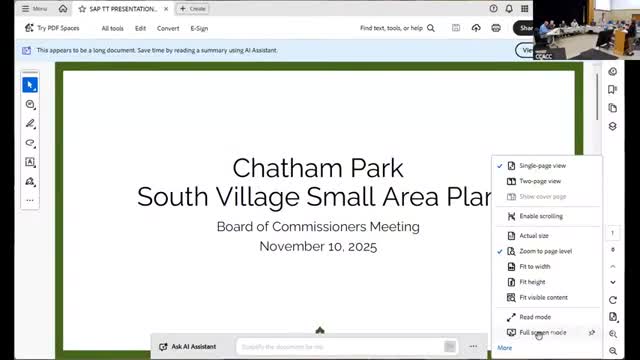
The decision followed a packed public-comment period in which more than 30 residents urged commissioners to reject or delay the SAP, citing concerns about environmental impact, stormwater, traffic, fiscal analysis and loss of future legislative oversight. "This is how out‑of‑town salesmen work," said Mark Barroso, a Pittsboro resident, criticizing what he described as developers’ use of broad approvals to limit local leverage. A petition from Chatham Climate Action Network carrying more than 900 signatures was delivered to the board during public comment (Meredith Dillon, SEG 1148–1155).
Staff and the applicant defended the plan as consistent with earlier entitlements. "Chatham Park is already approved for 22,000 dwelling units completely within the 7,000 acres," Teresa Thompson, assistant planning director, told the board during her presentation. Thompson said the SAP is being presented conceptually for the town and that detailed choices would be made later through Section Design Plans (SDPs). She also said the applicant agreed to early coordination with staff, minimum SDP sizes (40 acres), annual fiscal impact updates and at least 600 acres of park/open space in the South Village.
Planning and legal arguments dominated the board’s discussion. Critics, including several planning‑board members and environmental advocates, argued the SAP effectively transfers routine policy decisions to an administrative SDP stage and risks binding future boards to uncertain commitments. Megan Kimball of the Southern Environmental Law Center asked the board to "take your time" and described legal and practical risks from inserting an administrative layer that could limit legislative review. Thompson and other staff repeatedly responded that SDPs would be reviewed with town involvement and that "the board decision is still legislative" at the SDP stage.
Commissioners also pressed staff and the applicant for more complete fiscal information. Several members said the existing financial impact materials did not give a sufficiently detailed, two‑sided ledger of projected revenues and expenses. "A financial impact analysis would give us both sides of the ledger," Commissioner (speaker 3) said, urging more granular five‑year updates and better specifications for submission. Staff replied that an annual five‑year outlook would be required and updated regularly, which they argued would be more useful than a speculative 30‑year projection.
Motion and vote
After multiple motions and a lengthy debate, commissioner 10 (identified in the record as Mayor Pro Tem Baldwin) moved to approve the SAP "as indicated with the revisions by town staff." Commissioner 7 seconded the motion. The board conducted a voice vote; the record shows Mayor Pro Tem Baldwin and several commissioners voting "aye" and at least two commissioners voting "nay." The chair declared the motion passed (voice vote; SEG 3151–3160; SEG 3236–3247).
What was approved and what comes next
The approved SAP is presented as a conceptual, town‑level framework that staff and the applicant say does not change Chatham Park's existing vested entitlements; instead it provides a coordinated staging of land use, transportation and public facilities for the South Village. Key elements described in the staff presentation include:
- Conceptual footprint: approximately 4,843 acres planned for roughly 15,000 dwelling units and 9,400,000 sq. ft. of non‑residential development.
- Open space: staff cited an average of ~600 acres of open space and ~600 acres of parkland.
- SDP process: the applicant agreed to a SDP step that requires early coordination with staff (at least three months prior to SDP submittal), a two‑week public comment period for each SDP, and a board liaison for the review process.
- Affordable housing: the development agreement and SAP reference an affordable housing element; staff explained that affordable housing obligations are based on a percentage of units built (7.5% was discussed later for Reeves Farm and other projects) and that the absolute number depends on actual units constructed.
Why it matters
Supporters argued the plan provides clarity and early coordination for a very large, multi‑decade development and secures commitments for open space, standards and regular fiscal and transportation updates — items they said reduce long‑term risk. Opponents challenged whether the town should accept a single, sweeping SAP of this size without more explicit fiscal and environmental guarantees and argued the planning board should reexamine the latest draft before a legislative vote.
The board’s approval does not end public scrutiny. By design, the SAP sets the framework for future SDPs and related permitting; those subsequent review stages and the annual updates staff committed to will be the venues where many details (traffic mitigation projects, stormwater studies, exact locations of parks and affordable‑housing unit types) are tested.
Provenance
This article is based on the town meeting presentation and debate beginning at SEG 1778 (staff presentation) and continuing through the board vote recorded at SEG 3247.
View the Full Meeting & All Its Details
This article offers just a summary. Unlock complete video, transcripts, and insights as a Founder Member.
30-day money-back guarantee
Sponsors
Proudly supported by sponsors who keep North Carolina articles free in 2025

