Anderson City Council adopts tiered tax-assessment freeze for historic rehabs
November 11, 2025 | Anderson City, Anderson County, South Carolina
This article was created by AI summarizing key points discussed. AI makes mistakes, so for full details and context, please refer to the video of the full meeting. Please report any errors so we can fix them. Report an error »
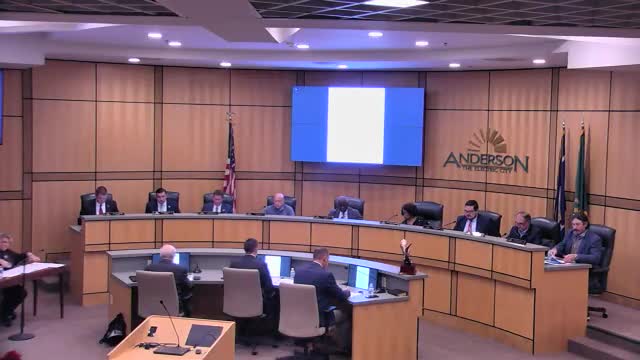
The Anderson City Council on second and final reading unanimously adopted an ordinance to create a special tax assessment for rehabilitated historic properties under state statute commonly called the 'Bailey bill.' Staff said the measure aims to stabilize cash flow for owners and spur investment while limiting the city's exposure to public funds.
City attorney/staff counsel Mr. McKeown told the council the ordinance uses a tiered approach tied to the size of the private investment: projects under $2,000,000 would receive a seven-year assessment freeze; projects between $2,000,000 and $5,000,000 would receive a 12-year freeze; and projects over $5,000,000 would receive a 17-year freeze. "Essentially what that does is, it would freeze the assessed value of a project for a period...based on the level of investment," McKeown said.
McKeown and other staff described the local process: council would provide preliminary acknowledgment by resolution, then the Board of Architectural Review (BAR) would issue preliminary certification — the point at which the statute sets the property's value and the freeze clock begins. Final certification after construction would confirm actual expenditures; BAR would verify spending and could decertify a project and trigger clawback of foregone taxes if reported costs were not substantiated.
Council members pressed staff on timing, arguing the freeze's effective benefit depends on when the clock starts. "If the statute is written where we could just assess it when the project was completed, then I agree that would probably be the better method to do it," Councilwoman Martinez said; staff and counsel responded that the statute frames preliminary certification as the start date and that the ordinance adds two years to earlier tiers to account for construction time.
Supporters framed the ordinance as a cautious, calibrated incentive. "We really don't want to over-incentivize a project...we're dealing with taxpayer money," McKeown said. Councilman Steele moved to pass the ordinance with the amendments; the motion was seconded and the council voted unanimously to adopt the ordinance on second and final reading.
The ordinance text, as presented to the council, included the tier thresholds noted above and the administrative steps involving council resolution and BAR certification. The council did not record a roll-call vote in the transcript; the clerk announced the measure passed unanimously.
Next steps: the ordinance takes effect as the city's second and final reading was completed; staff will implement the application portal and the BAR will begin preliminary certifications for eligible projects.
City attorney/staff counsel Mr. McKeown told the council the ordinance uses a tiered approach tied to the size of the private investment: projects under $2,000,000 would receive a seven-year assessment freeze; projects between $2,000,000 and $5,000,000 would receive a 12-year freeze; and projects over $5,000,000 would receive a 17-year freeze. "Essentially what that does is, it would freeze the assessed value of a project for a period...based on the level of investment," McKeown said.
McKeown and other staff described the local process: council would provide preliminary acknowledgment by resolution, then the Board of Architectural Review (BAR) would issue preliminary certification — the point at which the statute sets the property's value and the freeze clock begins. Final certification after construction would confirm actual expenditures; BAR would verify spending and could decertify a project and trigger clawback of foregone taxes if reported costs were not substantiated.
Council members pressed staff on timing, arguing the freeze's effective benefit depends on when the clock starts. "If the statute is written where we could just assess it when the project was completed, then I agree that would probably be the better method to do it," Councilwoman Martinez said; staff and counsel responded that the statute frames preliminary certification as the start date and that the ordinance adds two years to earlier tiers to account for construction time.
Supporters framed the ordinance as a cautious, calibrated incentive. "We really don't want to over-incentivize a project...we're dealing with taxpayer money," McKeown said. Councilman Steele moved to pass the ordinance with the amendments; the motion was seconded and the council voted unanimously to adopt the ordinance on second and final reading.
The ordinance text, as presented to the council, included the tier thresholds noted above and the administrative steps involving council resolution and BAR certification. The council did not record a roll-call vote in the transcript; the clerk announced the measure passed unanimously.
Next steps: the ordinance takes effect as the city's second and final reading was completed; staff will implement the application portal and the BAR will begin preliminary certifications for eligible projects.
View the Full Meeting & All Its Details
This article offers just a summary. Unlock complete video, transcripts, and insights as a Founder Member.
✓
Watch full, unedited meeting videos
✓
Search every word spoken in unlimited transcripts
✓
AI summaries & real-time alerts (all government levels)
✓
Permanent access to expanding government content
30-day money-back guarantee
