Columbus council holds second hearing on Title 39 changes to diversity office, officials cite legal risk and data study
November 11, 2025 | Columbus City Council, Columbus, Franklin County, Ohio
This article was created by AI summarizing key points discussed. AI makes mistakes, so for full details and context, please refer to the video of the full meeting. Please report any errors so we can fix them. Report an error »
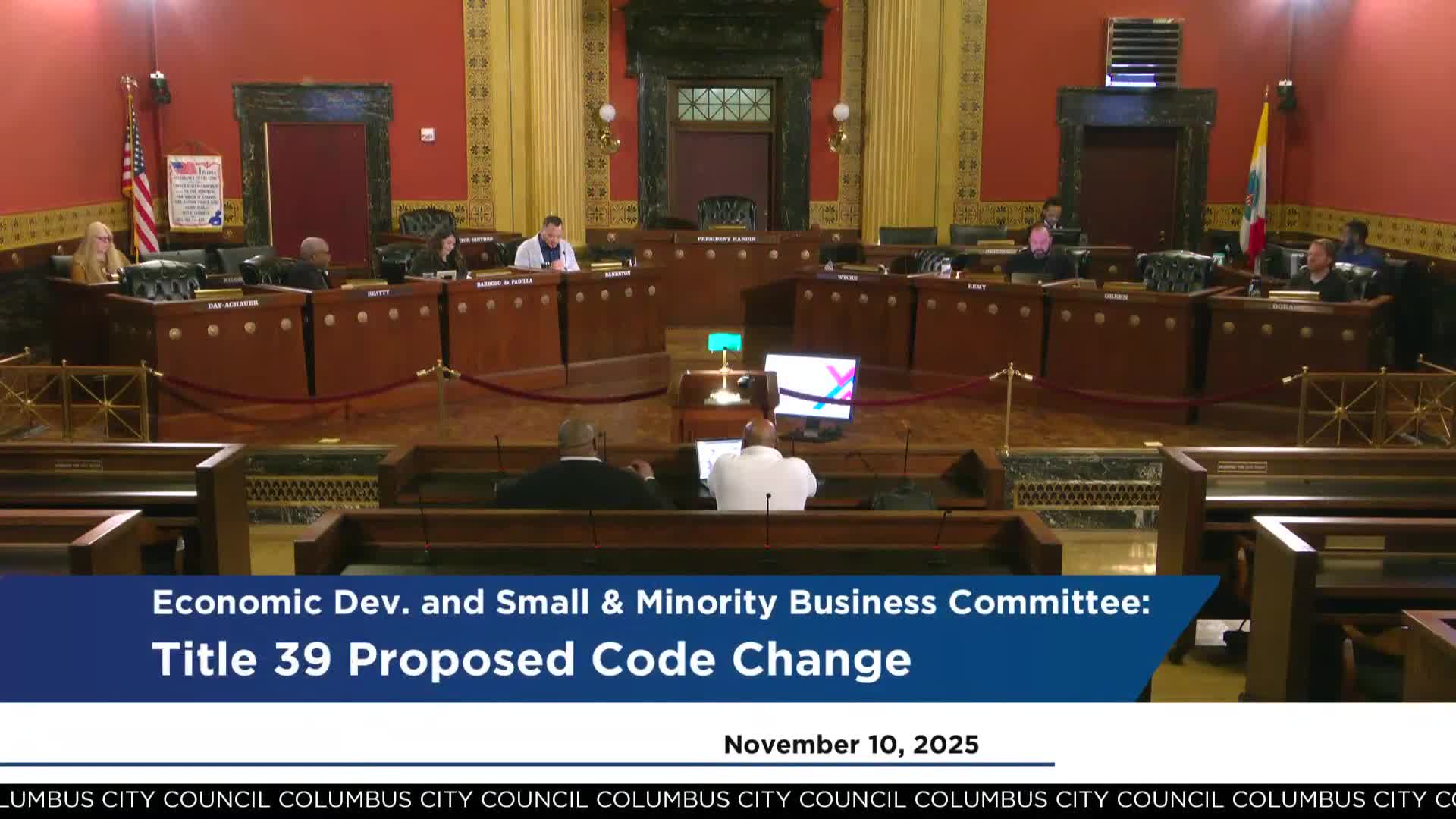
The Office of Diversity and Inclusion presented three primary changes being proposed: retain workforce diversity language as a guiding principle while clarifying operational responsibility, treat the new regional business enterprise (RBE) as a verification rather than a certification, and replace specific acronyms (MBE/WBE/SRBE) with a broader “program member” definition that would encompass certified entities when council-authorized programs are activated. "We are retaining references in this language to workforce diversity," AJ Powell, supplier development specialist in the Office of Diversity and Inclusion, said during the presentation. "We decided to right size that as many cities that have done around the country because it's a national standard."
Deputy City Attorney and Chief Legal Counsel Laura Baker Morris told the council that "program member" is intended to be inclusive of all certified entities within any program that council authorizes. She said enabling legislation would be used to turn particular programs on or off and to specify benefits such as bid discounts or incentive credits for program members.
Officials cited recent federal enforcement actions and guidance as a driver for the revisions. Director Jenkins told council members the city has received feedback from the U.S. Department of Justice letters sent to other cities and described national shifts away from race- or gender-based certification frameworks, noting that the city needs to adjust to remain compliant and to protect itself from litigation. "We have not brought that online yet, and we needed to make these revisions to bring that certification online," Jenkins said about the move toward small-business (SBE) approaches.
City staff described the city’s near-term data and outreach work: two requests for proposals (RFPs) are open—one to collect availability data (owner demographics, commodity codes, revenue and employee counts) and another for community engagement—and officials expect to run a shelter market in 2026 and to publish a disparity study toward the end of 2026 that would inform future program decisions. Powell outlined the local formula staff will use to determine SBE eligibility: use SBA commodity codes but "right‑size" the thresholds to Columbus by applying 25% of the SBA revenue standard or 50% of the employee standard.
Council members pressed officials on outreach and on whether benefits would be diminished. Vice Chair Barrosa de Padilla asked how changes would be communicated; Jenkins said certified businesses will receive notices and the city will run a robust rollout in 2026. Jenkins also said the city "stacks" certifications so existing minority- and women-owned certified firms could add an SBE designation without additional paperwork. He told members that about 96% of currently certified firms would meet the proposed small-business thresholds.
A public commenter, Jayary Frost (referred to during remarks as "Avery"), urged caution and said the proposed changes would "dilute the market" and broaden eligibility in a way that could make it harder for historically disenfranchised firms to secure city contracts. "When you concede ground, it is hard to regain it," Frost said. Council members asked Frost to specify the harms she anticipated; she replied she believed fewer underrepresented firms would receive city business under the new structure.
Council members and officials responded by emphasizing legal exposure and the need to protect the city while pursuing long-term remedies. Chair Bankston said the revisions were a necessary step to mitigate risk and to preserve the ability of the city to continue diversity work: "In order to proceed with the necessary work of the Office of Diversity and Inclusion and to protect the city from future liability, the proposed changes that we see today must be adopted," Bankston said.
Next procedural steps: Chair Bankston said the administration plans to place the Title 39 legislation on the Columbus City Council agenda for the Nov. 17 council meeting for formal consideration and invited residents to submit feedback to the director's office via the provided staff contacts.
View the Full Meeting & All Its Details
This article offers just a summary. Unlock complete video, transcripts, and insights as a Founder Member.
30-day money-back guarantee
Sponsors
Proudly supported by sponsors who keep Ohio articles free in 2025

