TAMC outlines plan to extend passenger rail to Salinas; officials point to $86 million budget and 2027–2028 service targets
November 10, 2025 | Salinas, Monterey County, California
This article was created by AI summarizing key points discussed. AI makes mistakes, so for full details and context, please refer to the video of the full meeting. Please report any errors so we can fix them. Report an error »
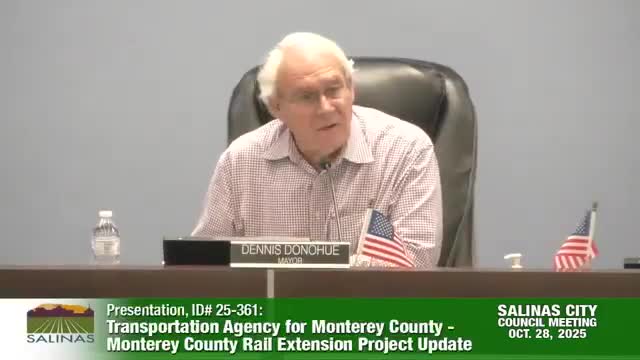
Todd Mook, TAMC executive director, said the agency is coordinating with Caltrain, the Capital Corridor, Caltrans and Union Pacific and that the effort has been ongoing for more than two decades. Christina Watson, TAMC director of planning, said the plan would extend existing passenger service down Union Pacific-owned tracks for an approximately 38-mile connection and initially operate two weekday round trips on Caltrain equipment, with the longer-term goal of additional Capital Corridor and Coast Starlight service.
Watson said the total project budget is about $86,000,000, which includes preconstruction work and initial capital improvements. The near-term scope includes reconfiguring the Salinas station area (the Lincoln Avenue extension to improve access), building a train layover facility west of the downtown platform and adding track connections at Gilroy to enable through service. The layover facility is designed for up to six tracks in a full build-out scenario; near-term service would require fewer tracks.
TAMC staff said they recently completed a 25% design submittal with Union Pacific, which counts as a major milestone in the railroad's review process. Watson said Union Pacific's design review milestones typically move from 25% to 30% then to 90% and 100%; the agency expects to put bid documents out for construction as early as winter 2026 if Union Pacific and others permit the schedule. Watson projected that Capital Corridor service extensions could begin sooner (with a 2027 target in the best-case scenario) and that Caltrain extension operations could be possible by 2028 if remaining hurdles are cleared.
Councilmembers asked about funding and risk. Mook and Watson said the grant funding supporting the Salinas layover and Gilroy track work comes from state infrastructure awards and other transport-specific pots of money; additional gaps will be addressed with competitive grants as design and construction plans advance. Watson warned the timeline remains contingent on cooperation with Union Pacific, completion of required engineering reviews and separate operator agreements with Caltrain and Capital Corridor.
Councilmembers also raised safety and operations questions tied to nearby homeless encampments after a recent death on the tracks. Watson said mitigation of encampments and operational safety is primarily an operator and Union Pacific responsibility, but added that activating regular passenger service brings additional "eyes on the corridor" and that TAMC can advocate and coordinate with the city and the railroad. She recommended that operational safety and outreach be addressed explicitly in later agreements.
Next steps listed by the agency included a Gilroy site visit after Union Pacific review, initiation of negotiations over track use and encroachment, and development of maintenance and operations agreements with Union Pacific and the chosen operator.
View the Full Meeting & All Its Details
This article offers just a summary. Unlock complete video, transcripts, and insights as a Founder Member.
30-day money-back guarantee
Sponsors
Proudly supported by sponsors who keep California articles free in 2025

