Appropriations subcommittee hears agency budget needs as federal shutdown, data centers and disaster recovery shape requests
November 11, 2025 | Appropriations, HOUSE OF REPRESENTATIVES, Committees, Legislative, Georgia
This article was created by AI summarizing key points discussed. AI makes mistakes, so for full details and context, please refer to the video of the full meeting. Please report any errors so we can fix them. Report an error »
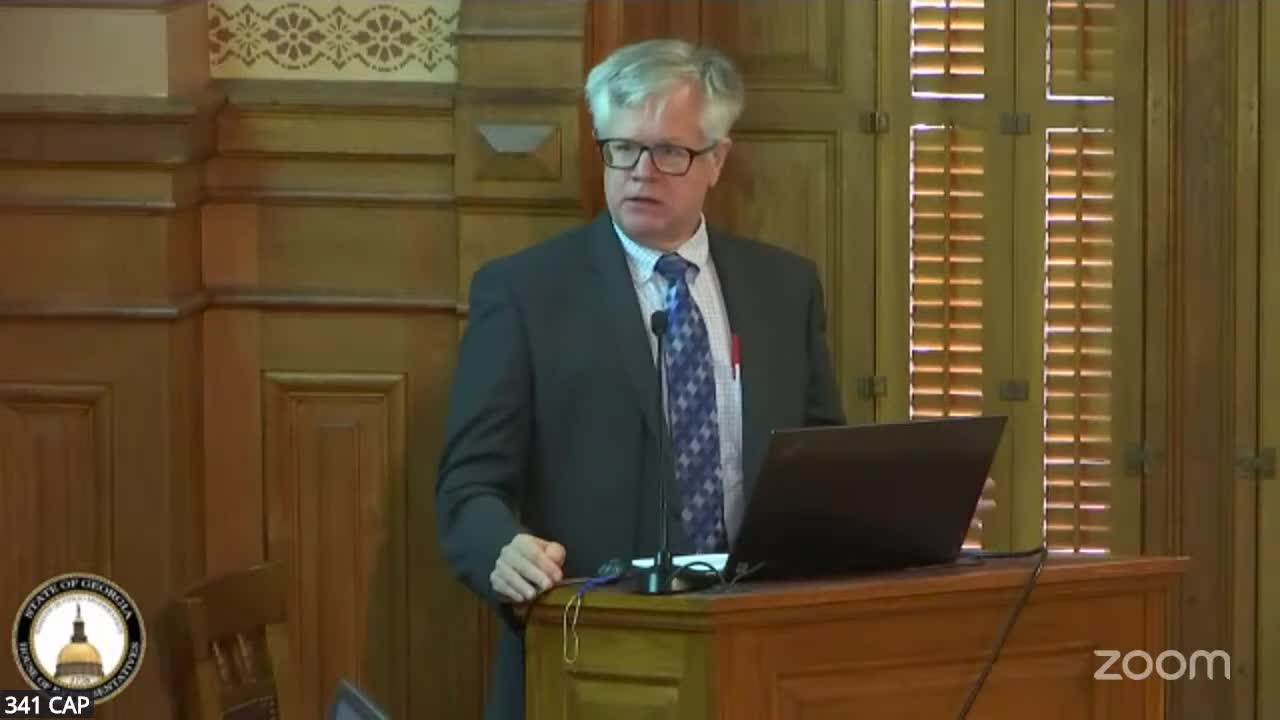
Commissioner Tyler Harper, Department of Agriculture, told the committee that the Rural Center will formally join the Department of Agriculture in January, moving staff currently housed on the ABAC campus into department laboratory space in Tipton and transitioning employees from the university system to state employment. “All the employees will officially become employees of the Department of Agriculture … effective basically in January,” Harper said.
Harper gave a detailed account of the hemp program, saying Georgia has about 7,200 licensed hemp entities across growers, processors, manufacturers, wholesalers and retailers, with roughly 13 active grower licenses and roughly 1,200 retail/wholesale inspections completed by the department this year. He said the division issued more than 900 cease-and-desist or notice-of-violation letters and opened 31 criminal investigations, with three administrative cases pending.
Harper also reviewed the state response to highly pathogenic avian influenza (HPAI), calling it an ongoing national issue and noting Georgia has recorded eight detections since February 2022 and about 345,000 birds impacted in the state compared with about 182 million nationally. He said the department has added an emergency-management specialist to lead HPAI planning, training and coordination starting Dec. 1, and urged discussion about increasing emergency staffing so personnel are not fatigued during protracted incidents.
On funding, Harper said the department has absorbed roughly $1.12 million in federal funding cuts that have forced the agency to use state dollars to cover critical programs such as meat inspection and food safety. He said understaffing has led to license denials for meat processing facilities — noting 22 denials in the past eight months — and warned these gaps reduce rural economic development and job creation.
Representatives of the Georgia Expo Authority reported a record fair with about 612,000 attendees and preliminary revenue up 8% year over year, while expenses rose 10%. The authority outlined capital needs including HVAC and boiler work, roof repairs and a long-range $21.46 million barn-and-arena project tied to youth livestock programming; it emphasized that an ongoing $900,000 annual appropriation covers roughly two-thirds of operations.
John Moffitt of the Department of Economic Development highlighted film- and tourism-related revenue — the department reported roughly $2.3 billion in state revenue tied to the film industry and said tourism supports about 470,000 jobs — and noted investments and programs to boost small-business growth and site development for industry recruitment.
Christopher Nunn of the Department of Community Affairs (DCA) briefed members on housing programs and disaster recovery. Nunn said DCA has helped create or preserve roughly 29,000 senior and workforce housing units over five years, launched competitive rounds of accountable-housing pilot grants and used state trust-fund dollars to leverage federal funding; he also updated the committee on CDBG-DR efforts for Hurricane Helene recovery and a pending pipeline of awards for home repair and rental rehab in 44 eligible counties.
The Georgia Forestry Commission described an uptick in wildfire activity in recent years and detailed equipment acquisitions funded in FY25 (including 29 heavy tractors and lowboy trailers), an incoming helicopter expected before the new year and a proposed FY27 budget that would fund tractors, facilities and a $2-per-hour on-call pay rate to compensate rangers for significant uncompensated on-call time.
Judy Adler, GEFA director of water resources, reviewed a regional coastal water-supply project that includes a new raw-water intake for Effingham County, expansions to Savannah’s treatment capacity and transmission infrastructure to Bryan County. Adler also described a new roughly $500 million ARPA-funded resilience program for Hurricane Helene recovery that prioritizes projects designed to make water and sewer systems more resilient to future storms.
Reese McAllister and Tom Bond of the Public Service Commission (PSC) outlined recent appropriations — including funding for pipeline-safety equipment and an additional inspector — and warned the committee about unprecedented new energy demand tied to data centers. Bond said Georgia Power’s forecasts have shifted dramatically in recent filings, from a projected need of roughly 400 megawatts several years ago to as much as 9,900 megawatts in recent filings, a figure that would require roughly $20 billion of new generation and an additional ~$10 billion in transmission investment if fully certified and built. “These are routinely over 100 megawatts, and some are over a thousand megawatts,” Bond said of typical new data-center customers.
What’s next: most updates were informational; agencies requested that the legislature consider targeted appropriations and recurring line items (for vehicles, ongoing replacement funding, emergency-staffing capacity, electrical infrastructure planning at the World Congress Center and additional PSC resources should large generation builds be certified). Several agencies flagged delays or uncertainty from the recent federal government shutdown that temporarily delayed final sign-off on block-grant formulas and related federal reimbursements.
The subcommittee adjourned after members thanked agency leaders for their reports and for the work done on Hurricane Helene recovery, rural economic development and emergency responses.
Don't Miss a Word: See the Full Meeting!
Go beyond summaries. Unlock every video, transcript, and key insight with a Founder Membership.
30-day money-back guarantee
Sponsors
Proudly supported by sponsors who keep Georgia articles free in 2025

