State Alt Ed survey: fewer students overall but longer stays for K� 65; transition planning is top technical-assistance need
November 10, 2025 | Energy Efficient Schools Initiative, Deparments in Office of the Governor, Organizations, Executive, Tennessee
This article was created by AI summarizing key points discussed. AI makes mistakes, so for full details and context, please refer to the video of the full meeting. Please report any errors so we can fix them. Report an error »
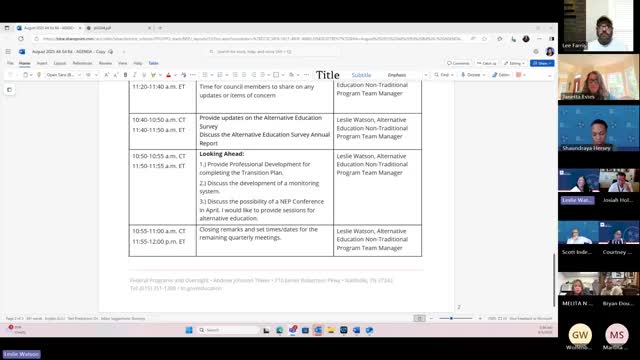
"We got a 100% completion," Leslie Watson said, and the survey yielded 24 schools and 152 programs. Watson said the average length of stay increased across grade bands: K-5 rose from 22 to 44 days; grades 6-8 from 48 to 57 days; and grades 9-12 from 57 to 61 days.
Total students served declined 2%, from 16,439 to 16,122. Watson characterized the drop as modest and noted that this was the first decrease in enrollment since the early COVID period. Placement reasons remained consistent: violations of school rules was the leading reason (58%, up from 54%), zero-tolerance issues stayed at 29%, and placement for alternative-education strategy fell to 13%.
Asked about the survey instrument, Watson said the team had added fields to capture school numbers to improve accuracy and that next yearthe survey will request a completed transition plan rather than a blank template to better assess whether transition planning is being implemented. She also noted one operational gap discovered after distribution: some grant opportunities (for SROs) referenced physical school locations and did not include alternate programs the way the team had defined them; she intends to include physical-location fields in the next survey iteration.
Council members identified professional development priorities tied to the survey findings: training on transition planning, exemplary practices, and virtual/digital learning. Watson said the annual report has been drafted and submitted to communications for clearance and will be shared once approved.
The council asked for more granular data over the year and agreed to revisit evaluation metrics at the end of the year after the proposed PD sessions and next survey cycle.
View the Full Meeting & All Its Details
This article offers just a summary. Unlock complete video, transcripts, and insights as a Founder Member.
30-day money-back guarantee
Sponsors
Proudly supported by sponsors who keep Tennessee articles free in 2025

