TDOE advisory council proposes tighter Alt Ed survey to clarify SRO eligibility and require completed transition plans
November 10, 2025 | Energy Efficient Schools Initiative, Deparments in Office of the Governor, Organizations, Executive, Tennessee
This article was created by AI summarizing key points discussed. AI makes mistakes, so for full details and context, please refer to the video of the full meeting. Please report any errors so we can fix them. Report an error »
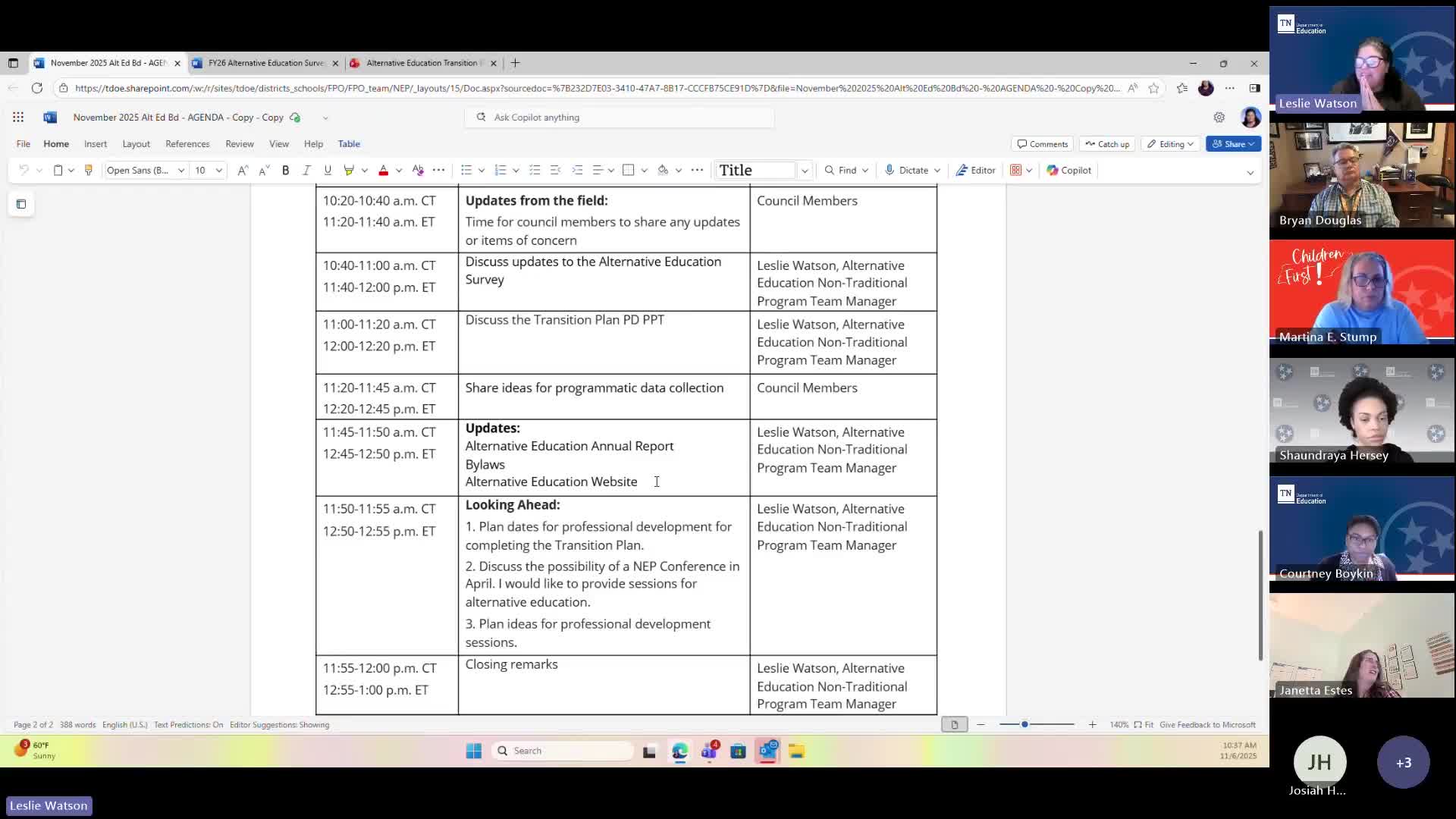
Leslie Watson, executive chairperson of the council, led the presentation, saying she wants the survey window moved earlier "to close that on June 15." The change would narrow the current May 1–June 30 window to help keep reporting on schedule, Watson said.
Why it matters: Council members said inconsistencies in how districts report programs — for example, listing a program as a school when it is actually a virtual or hybrid program — led to some alternative programs not receiving SRO grant funding. "So I really wanna make a drop down there so that if they report they're a school and this SRO grant provides an SRO to an alternative school, but it won't provide it to, like, a virtual school," Watson said.
Key proposals discussed:
- Move the survey close date from June 30 to June 15 to reduce late submissions and give staff time to analyze results. Watson: "I'd really like to close that on June 15."
- Add grade-level fields for each alternative school and program so large systems with multiple sites can report enrollment by site.
- Collect a physical address and a checkbox for whether a program is located on a school campus or at a separate location, to determine SRO eligibility tied to site location.
- Require at least one completed transition plan be uploaded (not just a sample) so reviewers can verify that transition planning is occurring when students move to and from alternative placement.
- Add a dropdown to distinguish alternative schools from hybrid/nontraditional/virtual/technical programs so program counts and grant eligibility are accurate.
- Create optional narrative fields to capture community partners and promising practices, and to gather programmatic information on modalities of instruction (online, hybrid, traditional) and supports.
Council members generally supported the changes. Josiah (speaker 8) and Mamadou Keda advocated for adding program‑level details that show whether a program uses restorative practices and trauma‑informed approaches, and for collecting data on how long students stay in placements. Martina Stupp, director of education for the Department of Children’s Services, noted that the transition plan is required by statute and rule and that DCS could help clarify transportation responsibilities under ESSA at a later presentation.
Process and next steps: Watson said she will meet with the team that builds the survey and bring concrete draft changes to the council at the next meeting. The council approved the prior meeting minutes by consensus (no roll call or tally was recorded). The proposed survey edits will be finalized and presented for implementation after the TDOE survey team incorporates the changes.
Details not specified in the meeting: the exact effective date for the new survey timeline, whether the SRO grant program rules will be changed to reflect survey refinements, and whether districts will receive technical assistance or funding to support one-time uploads of completed transition plans.
The council’s next steps include a technical meeting with the survey team and, if approved, presenting the survey changes to alternative education directors and teachers at the planned NEP conference or via virtual sessions.
View the Full Meeting & All Its Details
This article offers just a summary. Unlock complete video, transcripts, and insights as a Founder Member.
30-day money-back guarantee
Sponsors
Proudly supported by sponsors who keep Tennessee articles free in 2025

