Mount Vernon considers studies for lime slakers, a southern water tower and changing disinfection chemistry
November 10, 2025 | Mount Vernon, Knox County, Ohio
This article was created by AI summarizing key points discussed. AI makes mistakes, so for full details and context, please refer to the video of the full meeting. Please report any errors so we can fix them. Report an error »
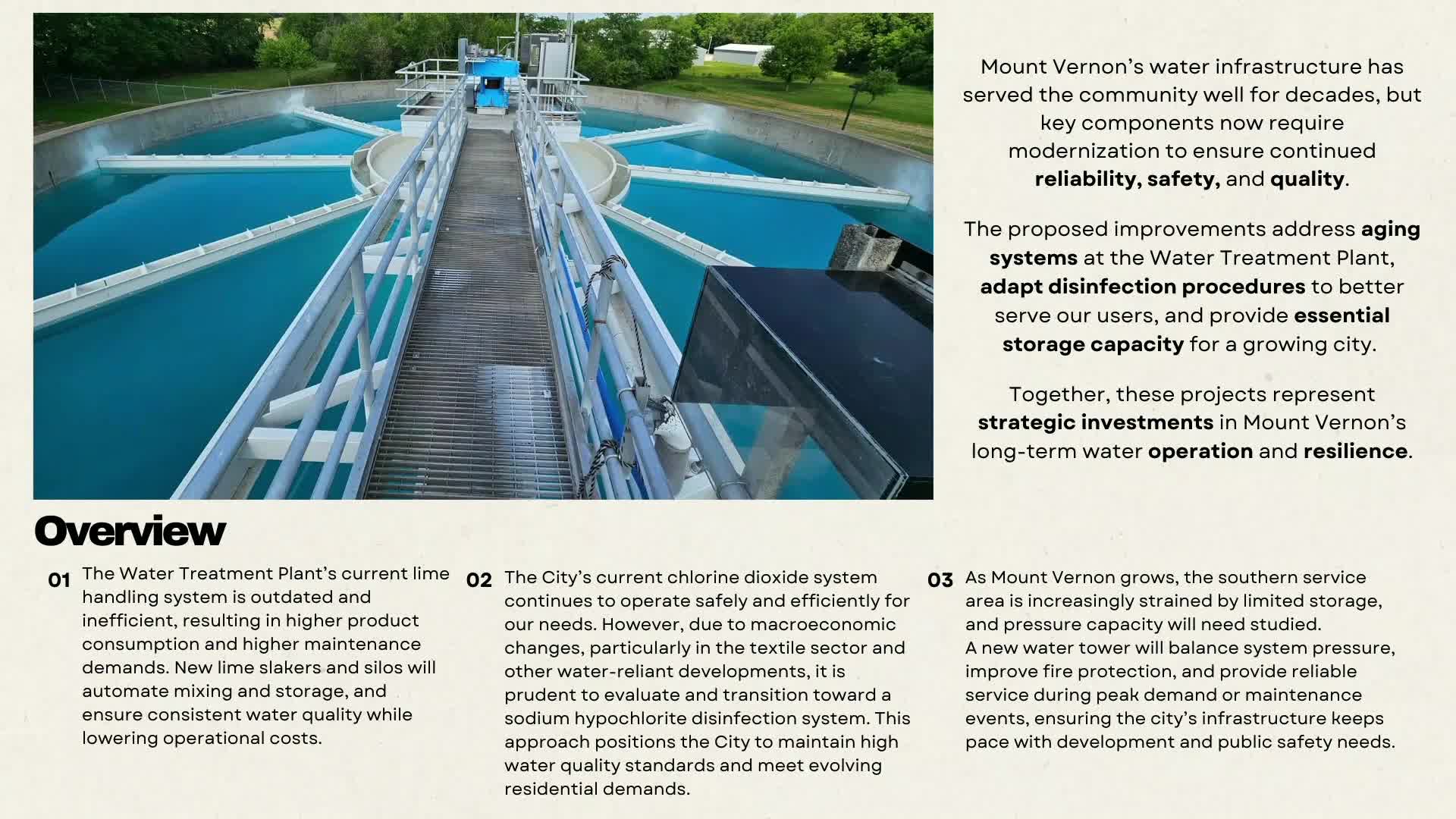
Director Sawyers said the lime handling equipment is aging, undersized and driving higher maintenance and chemical usage. The proposed design study would evaluate installing two modern lime slakers, dual lime silos, and an enclosed system for dust control and operator safety; design work would also look at converting current pump feed to a gravitational feed. Sawyers said these items are study and design only; construction would require future council approvals.
On distribution, staff proposed studying an elevated storage tank (roughly up to a 1‑million gallon capacity) near either the Newark Road industrial park or the Twin Oak property to support southern service area pressure, ensure redundancy during high demand or maintenance events, and improve fire protection. The study would integrate modern SCADA monitoring and model new pressure zone options.
Regarding disinfection, Sawyers noted Mount Vernon uses a chlorine dioxide system—one of only two public water systems in Ohio to do so. While the current system provides consistent disinfection, staff cited external factors (textile dye quality and occasional 'washout' reports) and long‑term material compatibility concerns; Mount Vernon has experienced higher oxidative stress requirements that influence pipe material choices. Staff said shifting to sodium hypochlorite could allow wider use of plastic pipe materials (PVC/C900) for new construction and lower long‑term material and replacement costs, but also cautioned about safe storage and proper handling of liquid hypochlorite and the need to evaluate corrosion risk in older pipes.
Resident Jennifer Showman asked during public comment whether the conversion analysis would specifically evaluate impacts on Mount Vernon's aging distribution pipes and the feasibility of switching city‑wide materials. Sawyers and staff confirmed the RFQ and upcoming design work will evaluate alternatives and that council will have multiple approval opportunities before any construction or chemical conversion occurs.
Legislative note: Resolution 2025‑109 (release RFQ for slakers/silos, sodium hypochlorite system, and southern water tower) received its second reading at this meeting; staff expects to return with engineered cost estimates and alternatives during the design phase so council may make informed decisions on whether to proceed to construction.
Don't Miss a Word: See the Full Meeting!
Go beyond summaries. Unlock every video, transcript, and key insight with a Founder Membership.
30-day money-back guarantee
Sponsors
Proudly supported by sponsors who keep Ohio articles free in 2025

