Atlanta grants chief: city has awarded FY25 HUD allocations but grantee agreements delayed by federal shutdown
November 10, 2025 | Atlanta, Fulton County, Georgia
This article was created by AI summarizing key points discussed. AI makes mistakes, so for full details and context, please refer to the video of the full meeting. Please report any errors so we can fix them. Report an error »
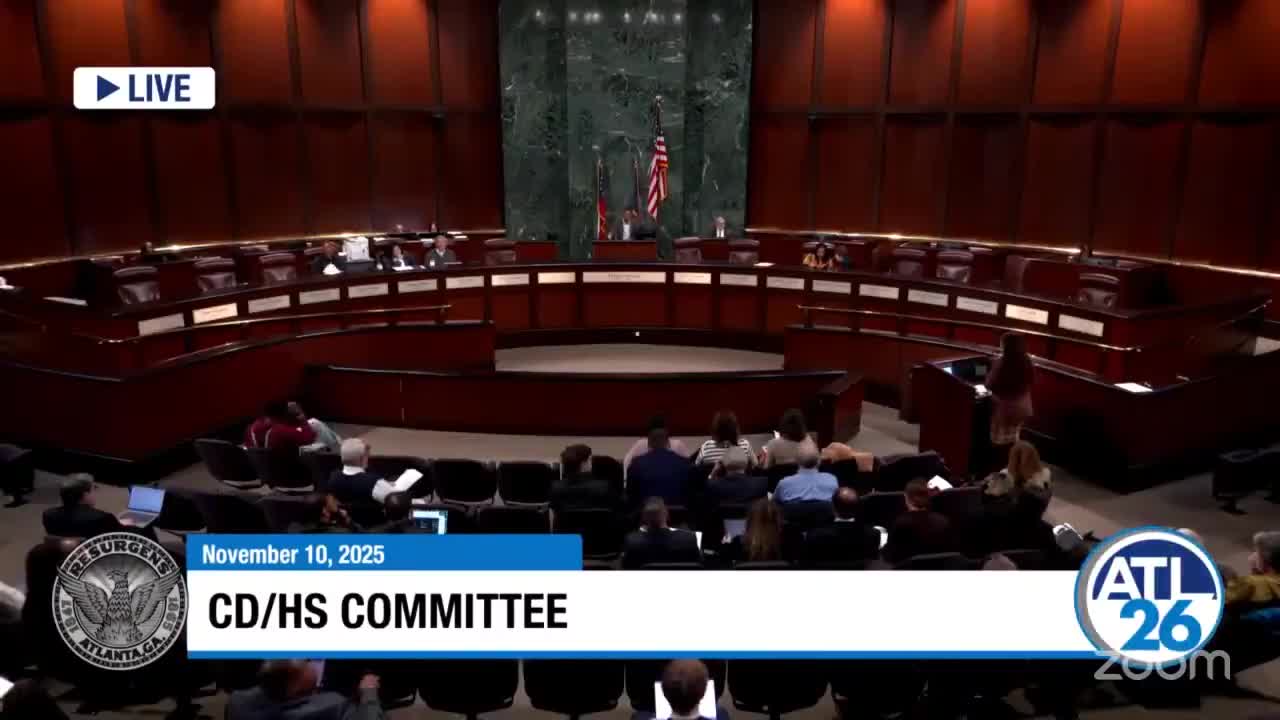
Commissioner Deborah Lunning summarized entitlement programs the department administers — Community Development Block Grants (CDBG), HOME, Emergency Solutions Grants (ESG) and HOPWA — and said the department had reimbursed or expanded roughly $25,830,000 through Oct. 31 for a mix of entitlement and competitive funds. She listed FY25 allotments the committee could expect once grantee agreements are executed: CDBG $6,602,001.30; HOME $2,031,804.29; ESG $598,006.23; HOPWA $15,000,003.99.
Lunning warned that the department has not yet received executed FY25 grantee agreements from the federal government because of the federal shutdown. "We have not received the grantee agreement," she said. "So not only have we not executed these funds... we have not, in fact, received that grantee agreement." As a result, some FY25 awards remain under contingency pending environmental reviews and final federal execution.
The commissioner outlined two competitive grants: Healthy Homes (a city award of $1,753,802 with eligibility for additional supplemental funding) and a Lead Hazard Reduction Capacity Building grant for which the city has applied. On Healthy Homes the department received a 100% score on its mandatory quarterly federal reporting, Lunning said, which indicates compliance with reporting and program requirements.
Committee members pressed for details about unspent balances and timeliness. Lunning explained that entitlement funds carry expiration windows (CDBG typically seven years, HOME eight years, ESG 24 months, HOPWA three years) and that large balances from prior fiscal years are generally already awarded and awaiting reimbursement through the federal IDIS system. She said HUD calculates a timeliness ratio annually; the city was not on HUD's timeliness watch list this year.
Council members asked for clearer timelines and for the department to publish expected processing steps for applicants; Council member Dozier asked the department to provide public timelines explaining key benchmarks and procurement steps for Healthy Homes applicants. Lunning agreed to share the applicant timelines publicly and with council offices.
Next steps: the department will continue to monitor the federal shutdown and provide the committee with follow-up information as grantee agreements are received. Committee members said they expect more frequent back-and-forth as those FY25 agreements are executed and funds become fully available for reimbursement and contracting.
Provenance: Commissioner Lunning's remarks and ensuing Q&A appear in the committee transcript beginning at SEG 256 and continuing through SEG 533 and later question threads at SEG 624–995.
Don't Miss a Word: See the Full Meeting!
Go beyond summaries. Unlock every video, transcript, and key insight with a Founder Membership.
30-day money-back guarantee
Sponsors
Proudly supported by sponsors who keep Georgia articles free in 2025

