Board recommends city council adopt Fleet Electrification Master Plan; study shows large upfront cost and reliance on exemptions
November 07, 2025 | Santa Rosa City, Sonoma County, California
This article was created by AI summarizing key points discussed. AI makes mistakes, so for full details and context, please refer to the video of the full meeting. Please report any errors so we can fix them. Report an error »
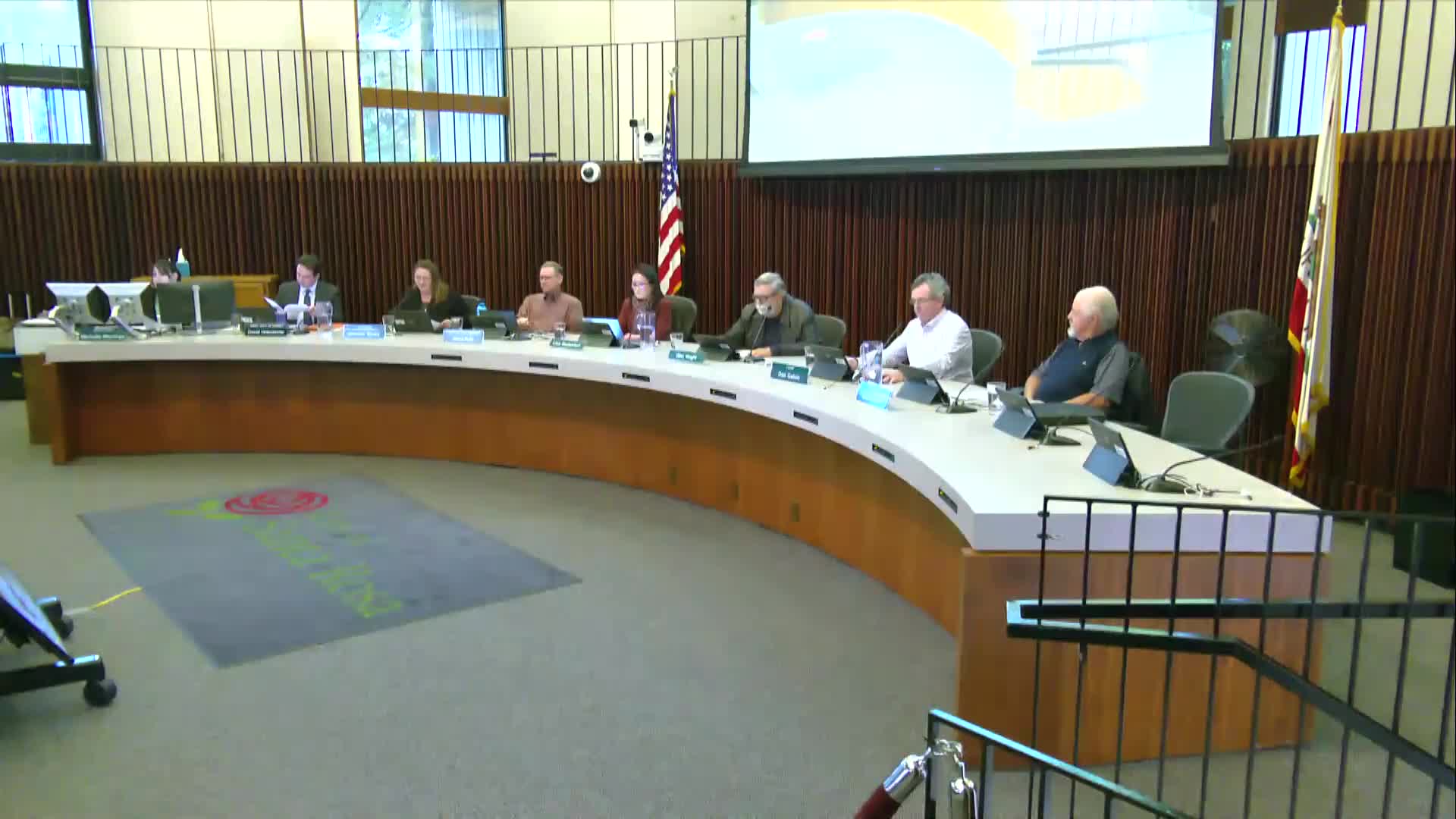
Presenters from Santa Rosa Water and consultant NV5 described a two‑year effort funded in part by a $210,000 federal Energy Efficiency and Conservation Block Grant and led by the water department. The plan models fleet replacements on end‑of‑life schedules, sets a $10 million annual cap on incremental electrification spending, and projects that 100% of the included vehicle classes could be electric by 2040 (excluding first‑responders and transit buses, which are handled separately).
Key model outputs presented to the board include a projected reduction of about 12.5 million kilograms of CO2e over 15 years, a 63% reduction in energy consumption and an estimated 53% reduction in annual fuel cost by 2040. However, consultants said the modeled program yields a nominal $38 million increase in lifecycle fleet costs over the study period (about a 32% increase). Consultants noted that vehicle and infrastructure incentives (some under negotiation with PG&E) could reduce that figure but were excluded from base modeling when not secured.
The plan reviewed three charger‑deployment phases tied to fleet transition timing, recommended standardizing on a single charge‑management platform, and proposed concept designs at eight municipal sites. The consultants modeled resiliency options for six priority locations and found conventional generators the most cost‑effective resiliency option (capital ~$2.6 million; 25‑year NPV ~$3.4 million). A solar + battery + generator approach reduced lifecycle greenhouse‑gas emissions but raised capital costs (capital ~$14.6 million; 25‑year NPV ~$11.8 million) and did not pay back over the modeled life without additional funding.
Consultants also summarized recent regulatory changes affecting compliance: the California Air Resources Board’s move to repeal ACF for private fleets, AB 1594 (appearing in the transcript as “AB 15 94”) that provides flexible exemptions for municipal fleets, and a CARB proposal to move the 50% EV purchase requirement to 2030—giving public fleets additional time. Presenters recommended aggressively pursuing exemptions where appropriate, advocating with CARB for utility‑specific flexibilities, and seeking incentives to offset capital costs.
Board members posed several operational questions. Board member Wright raised concerns about emergency operations and charging time; consultants said backup charging was sized to meet modeled duty‑cycle needs during 1‑day and 7‑day outage scenarios but acknowledged charging time remains a limitation and that additional modeling would be needed for microgrid designs. Consultants confirmed construction and heavy equipment (excavator, tractor, forklifts) were included in the fleet inventory and that replacements for categories without current market EV equivalents were deferred until viable electric models are projected by the Center for Transportation and Environment.
During discussion, staff emphasized that water and wastewater operations have unique duty cycles and that expected CARB exemptions for utilities could preserve critical operational flexibility.
A board member moved and a second was given to recommend city council accept the final draft of the Fleet Electrification Master Plan. The board voted by roll call and the motion passed unanimously with board members Mullen, DeWitt and Bartholow absent.
Don't Miss a Word: See the Full Meeting!
Go beyond summaries. Unlock every video, transcript, and key insight with a Founder Membership.
30-day money-back guarantee
Sponsors
Proudly supported by sponsors who keep California articles free in 2025

