Lancaster County staff present preliminary fire-rescue funding plan; estimates show substantial per-home impacts if city withdraws
November 07, 2025 | Lancaster County, South Carolina
This article was created by AI summarizing key points discussed. AI makes mistakes, so for full details and context, please refer to the video of the full meeting. Please report any errors so we can fix them. Report an error »
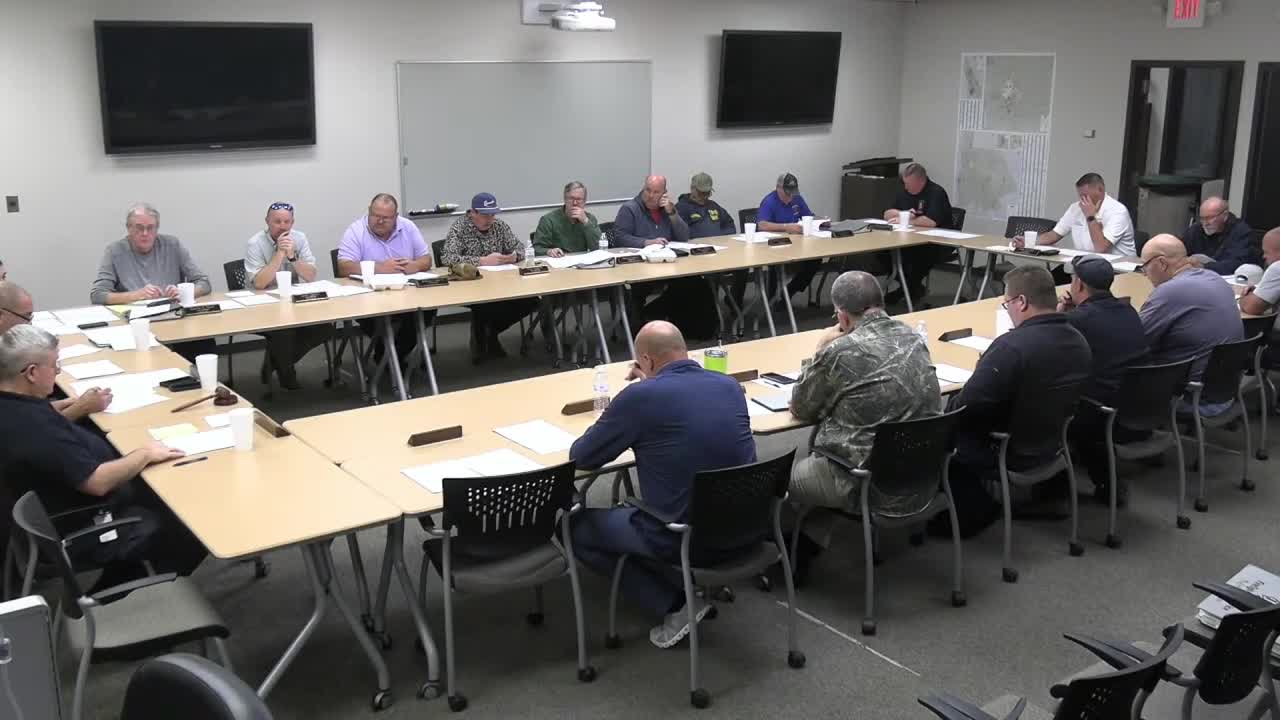
Darren, speaking for fire service staff, presented preliminary cost estimates and a multi-year staffing plan as the commission considered funding options for expanding the county career fire service.
Darren said the department modeled a 24‑hour, three‑person‑per‑shift approach for each new station and included salary, county retirement contributions, workers' compensation, FICA, benefits (including full‑family insurance where applicable), overtime and holiday pay in the totals. "When you see total benefits, that's what it costs to pay an employee $76,300 a year," he said, noting figures were based on current salaries and are preliminary.
He said the county aggregates fire spending across three budgets (the fire commission budget, the career fire service budget and a contract budget component) and that, as discussed in the meeting, the combined fire budgets amount to $55,818,771 in the current accounting, which he equated to about 9.7 mills at the then-current rate.
Darren presented examples of household impact using an assumed 4% owner‑occupied assessment baseline (he acknowledged this is a simplifying assumption). Under that assumption, he gave sample annual contributions for homes at $100,000, $200,000 and $300,000 market values and said those amounts would increase substantially if the city were to withdraw from the shared county funding arrangement. He said Indian Land and Van Wyck represent about 68.54% of assessed value in his calculations and that the city represents about 6.5%; removing the city from the tax base would leave roughly 25% of assessed value to fund the county’s portion and would raise the per‑household burden in the remaining area.
Commissioners asked whether the McDonald Green station could be staffed by existing career personnel; Darren said a captain position has been funded in the budget but hiring, qualifications and staff willingness to transfer are variables. He emphasized the numbers he presented reflected operations only (salaries and benefits) and did not include capital costs such as apparatus purchases or building construction.
Darren outlined a phased, multi‑year approach: begin with smaller staffing levels, then incrementally add personnel over time to reach four‑person engine companies and expand rescue staffing as resources allow. He described the presented estimates as conservative and said the figures exclude vehicle valuations, certain personal property and variable assessment classes that would refine the tax-rate modeling.
No final funding decision was taken; commissioners directed staff to continue refining estimates and return with updated figures and options at a future meeting.
Darren said the department modeled a 24‑hour, three‑person‑per‑shift approach for each new station and included salary, county retirement contributions, workers' compensation, FICA, benefits (including full‑family insurance where applicable), overtime and holiday pay in the totals. "When you see total benefits, that's what it costs to pay an employee $76,300 a year," he said, noting figures were based on current salaries and are preliminary.
He said the county aggregates fire spending across three budgets (the fire commission budget, the career fire service budget and a contract budget component) and that, as discussed in the meeting, the combined fire budgets amount to $55,818,771 in the current accounting, which he equated to about 9.7 mills at the then-current rate.
Darren presented examples of household impact using an assumed 4% owner‑occupied assessment baseline (he acknowledged this is a simplifying assumption). Under that assumption, he gave sample annual contributions for homes at $100,000, $200,000 and $300,000 market values and said those amounts would increase substantially if the city were to withdraw from the shared county funding arrangement. He said Indian Land and Van Wyck represent about 68.54% of assessed value in his calculations and that the city represents about 6.5%; removing the city from the tax base would leave roughly 25% of assessed value to fund the county’s portion and would raise the per‑household burden in the remaining area.
Commissioners asked whether the McDonald Green station could be staffed by existing career personnel; Darren said a captain position has been funded in the budget but hiring, qualifications and staff willingness to transfer are variables. He emphasized the numbers he presented reflected operations only (salaries and benefits) and did not include capital costs such as apparatus purchases or building construction.
Darren outlined a phased, multi‑year approach: begin with smaller staffing levels, then incrementally add personnel over time to reach four‑person engine companies and expand rescue staffing as resources allow. He described the presented estimates as conservative and said the figures exclude vehicle valuations, certain personal property and variable assessment classes that would refine the tax-rate modeling.
No final funding decision was taken; commissioners directed staff to continue refining estimates and return with updated figures and options at a future meeting.
Don't Miss a Word: See the Full Meeting!
Go beyond summaries. Unlock every video, transcript, and key insight with a Founder Membership.
✓
Get instant access to full meeting videos
✓
Search and clip any phrase from complete transcripts
✓
Receive AI-powered summaries & custom alerts
✓
Enjoy lifetime, unrestricted access to government data
30-day money-back guarantee
