Acton‑Boxborough faces rising facilities backlog; rooftop HVAC project eyed as high priority
November 07, 2025 | Town of Acton, Middlesex County, Massachusetts
This article was created by AI summarizing key points discussed. AI makes mistakes, so for full details and context, please refer to the video of the full meeting. Please report any errors so we can fix them. Report an error »
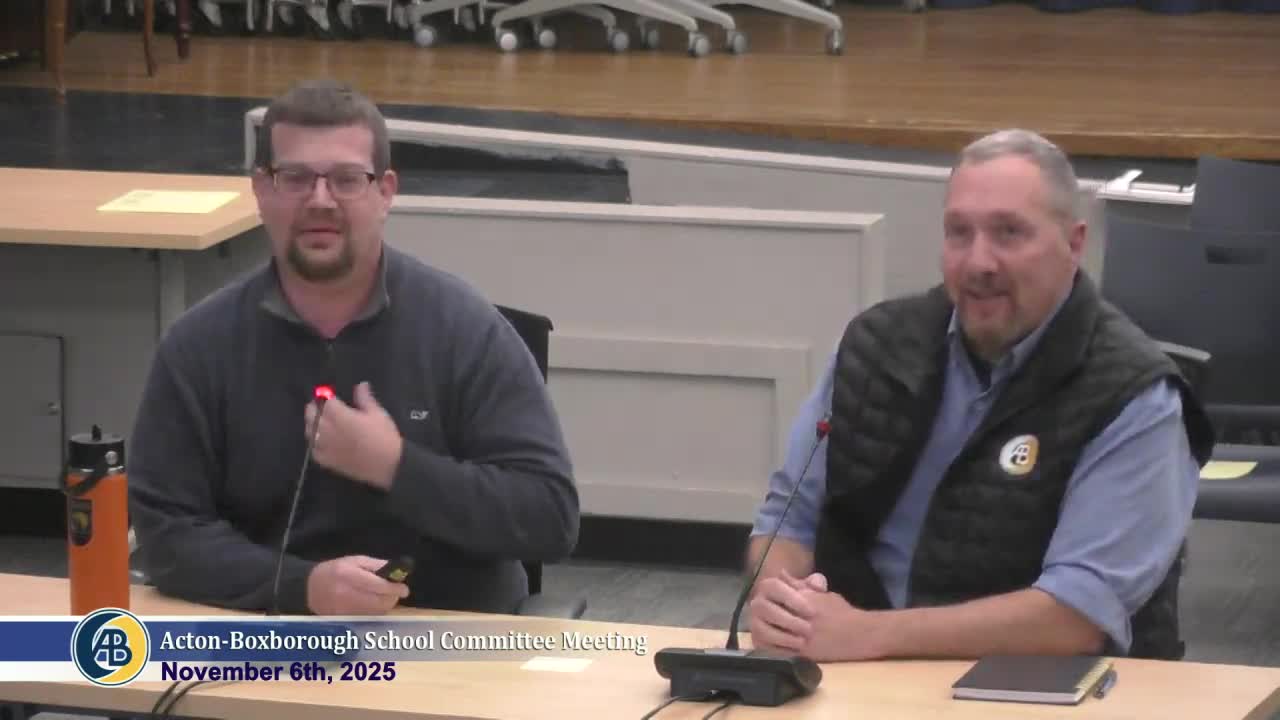
Capital projects manager Brenton Hurn and facilities coordinator Mark Hamill said a facilities condition assessment prompted a multi‑year capital list that now exceeds available annual pay‑as‑you‑go funding. Hurn said the district is using a mix of limited general‑fund allocations, revolving funds and available incentive/grant programs to manage near‑term needs, but that the total program outstrips the current funding stream.
The high priority for FY26–27 is partial replacement of aging rooftop HVAC units at the high school, a project early‑priced at about $4.4 million. "We were awarded a grant through DOER's Green Communities program of a half‑million dollars toward that project," Hurn said; he added that incentive programs and Mass Save rebates improve the life‑cycle case for air‑source heat pump options. The district expects to fund design and early construction phases out of a combination of revolving funds and the small FY26 general‑fund capital allocation, but leaders cautioned that the second phase of rooftop replacements and other major projects will push the district toward borrowing or other larger funding mechanisms in FY28 and beyond.
Other priorities on the FY27 list include major resurfacing at Blanchard’s rear lot/play area, further investigation of high‑school gym bleacher condition, and developing a single bus depot (currently the fleet is split between district property and leased space). Hurn noted smaller items — elevator and wheelchair‑lift replacements, paging upgrades, accessibility door operators and camera upgrades — add up quickly across the district.
Why it matters: Facilities costs are rising broadly across public construction, affecting the timing and scale of needed work. Hurn said that many of the district’s school systems have expected lifespans of 30–50 years, placing a wave of replacements now. Trustees and committee members asked that the capital subcommittee engage town finance committees earlier to plan for larger funding measures such as bonding if needed.
District next steps: Leaders will continue to pursue grant and rebate funding where possible (DOER, Mass Save, IRA incentives, MSBA ARP where applicable), complete engineering and owner's‑project‑manager procurement for the high‑school rooftop effort, and present options to the capital subcommittee on funding scenarios that may include a bond vote or other multi‑year financing plan.
Bottom line: Facilities staff outlined a plausible near‑term program but warned that the aggregate cost of needed projects substantially exceeds the modest annual capital allocation, meaning the district will likely need to consider larger‑scale funding options in the coming fiscal years.
Don't Miss a Word: See the Full Meeting!
Go beyond summaries. Unlock every video, transcript, and key insight with a Founder Membership.
30-day money-back guarantee
Sponsors
Proudly supported by sponsors who keep Massachusetts articles free in 2025

