Norwalk council tables subdivision ordinance after developers warn of costs, bonding concerns
November 07, 2025 | Norwalk City, Warren County, Iowa
This article was created by AI summarizing key points discussed. AI makes mistakes, so for full details and context, please refer to the video of the full meeting. Please report any errors so we can fix them. Report an error »
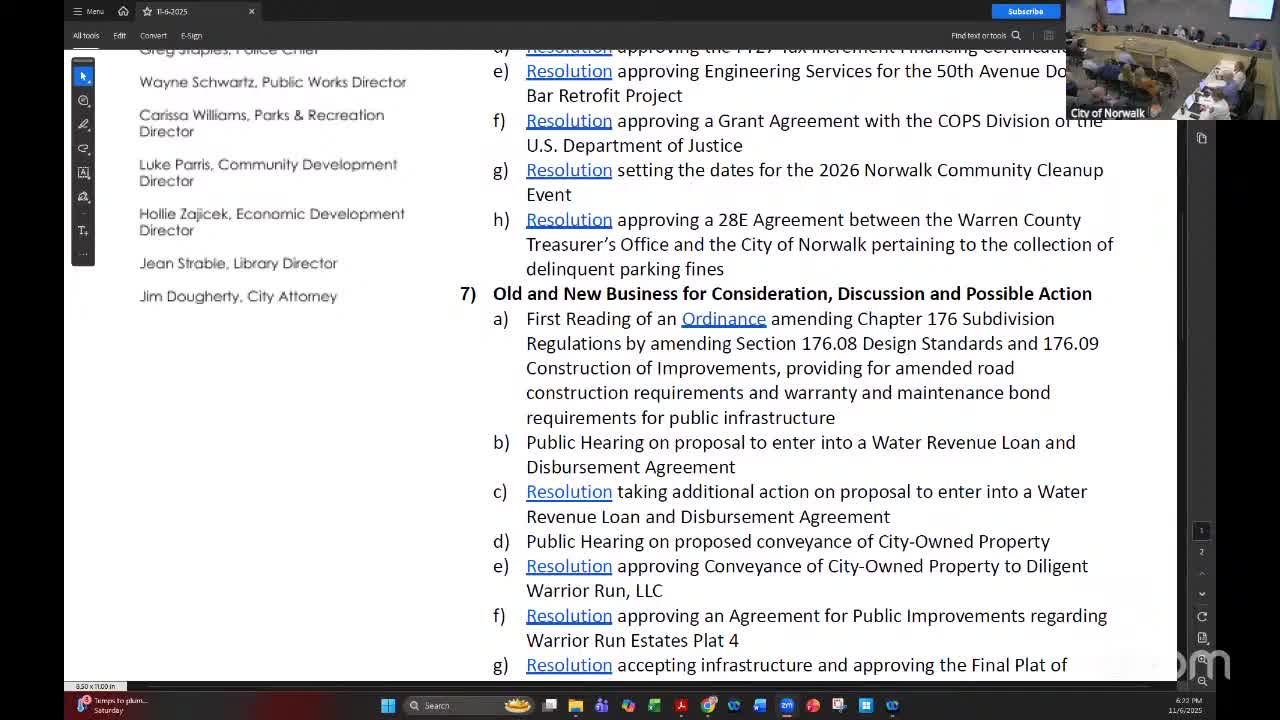
The ordinance, presented at first reading on Nov. 6, would require granular subbase and subsurface subdrains on new streets and revise warranty and maintenance bond language so developers bear clearer responsibility for repairs, staff said. City engineers and public works staff told council they have seen relatively new streets require significant maintenance and said stronger minimum construction standards and clearer developer liability would extend pavement life.
Why it matters: Council members said the change is intended to reduce future taxpayer expense for early street reconstruction and to improve the longevity of newly constructed roadways. Developers and the Home Builders Association argued the proposal, as originally drafted, would substantially increase lot costs, could be impractical to bond, and might shrink the city’s pool of builders if not refined.
What was proposed and why: Wayne (Public Works) told council that the city’s own projects include granular subbase and subdrains and that several other Iowa cities require similar measures. Staff estimated added costs per lot could be roughly $2,000–$4,000 depending on subdivision geometry; developers presented higher contractor estimates of about $4,000–$5,000 per lot for representative plats and warned that some conditions could push costs higher.
Industry response: Developers and builders — including representatives from the Home Builders Association, Vista Real Estate and Hubbell Realty — urged more time for stakeholder review, asked for a phased implementation, and disputed bonding language that they said could require developers to warrant design errors or accept unconstrained consequential liability. Dave Harmier (Vista Real Estate) and Caleb Smith (Hubbell Realty) said they want the city’s objectives met but requested time to craft workable bond language and to identify whether some costs could be shared or offset by the city in targeted circumstances.
Council action: After public comment and a detailed staff/developer discussion, council voted to table the ordinance and directed staff to work with the development community on revised bonding language and an implementation timeline. Council also asked staff to evaluate phasing so preliminary plats submitted under existing standards are not unfairly disrupted.
What comes next: Staff will return with revised bonding language, options for phased implementation, and recommended thresholds for when subdrains/subbase are required or when geotechnical reports should drive design. The council indicated it may pause new preliminary plat approvals until the matter is resolved.
Quote attributable to a meeting participant: "We want the repairs done without having to be the mediators and the decision makers," Jim (city staff) said, summarizing staff’s aim to clarify developer responsibility.
Ending: Council members and local builders agreed to continue negotiations; the ordinance will return only after staff and the industry provide more detailed, mutually acceptable language. The tabling preserves time for the city and developers to narrow technical, cost and legal differences before any change becomes binding.
View the Full Meeting & All Its Details
This article offers just a summary. Unlock complete video, transcripts, and insights as a Founder Member.
30-day money-back guarantee
Sponsors
Proudly supported by sponsors who keep Iowa articles free in 2025

