Providence council approves phased ban on gas-powered leaf blowers
November 07, 2025 | Providence City, Providence County, Rhode Island
This article was created by AI summarizing key points discussed. AI makes mistakes, so for full details and context, please refer to the video of the full meeting. Please report any errors so we can fix them. Report an error »
The Providence City Council voted on Nov. 6 to approve an ordinance that phases out gas-powered leaf blowers, with the city beginning an initial phase-out in the fall and a broader seasonal phase-out beginning in 2030.
Councilwoman Anderbrock said the amendment before the council adjusted several dates, moved enforcement and clarified expectations for education before fines. “We're proving and showing to residents and businesses that the city is willing to go first and show that this is something that's possible,” she said, adding the ordinance directs that there will be "a number of instances of education before enforcement so that folks aren't surprised or given a fine that they aren't expecting." The implementation responsibility was shifted to the Department of Public Works from the department previously named in the draft.
Supporters framed the ordinance as a public health and quality-of-life measure. Councilman Gansaoffs said the rule would protect air quality and workers who inhale exhaust and fine particulates, and he cited a statistic during his remarks: “Using a gas powered leaf blower for an hour is equivalent to 1,100, miles in a gas powered vehicle.” He added the ban advances protections for workers and residents.
Opponents warned of economic consequences for low-income residents who earn income operating blowers and questioned the readiness of battery-powered alternatives. Councilman Oscar Vargas pressed the council on equity concerns, saying the measure could "take the food out of the table" for people who rely on this work and noting battery tools' weight and charging logistics as obstacles for some operators.
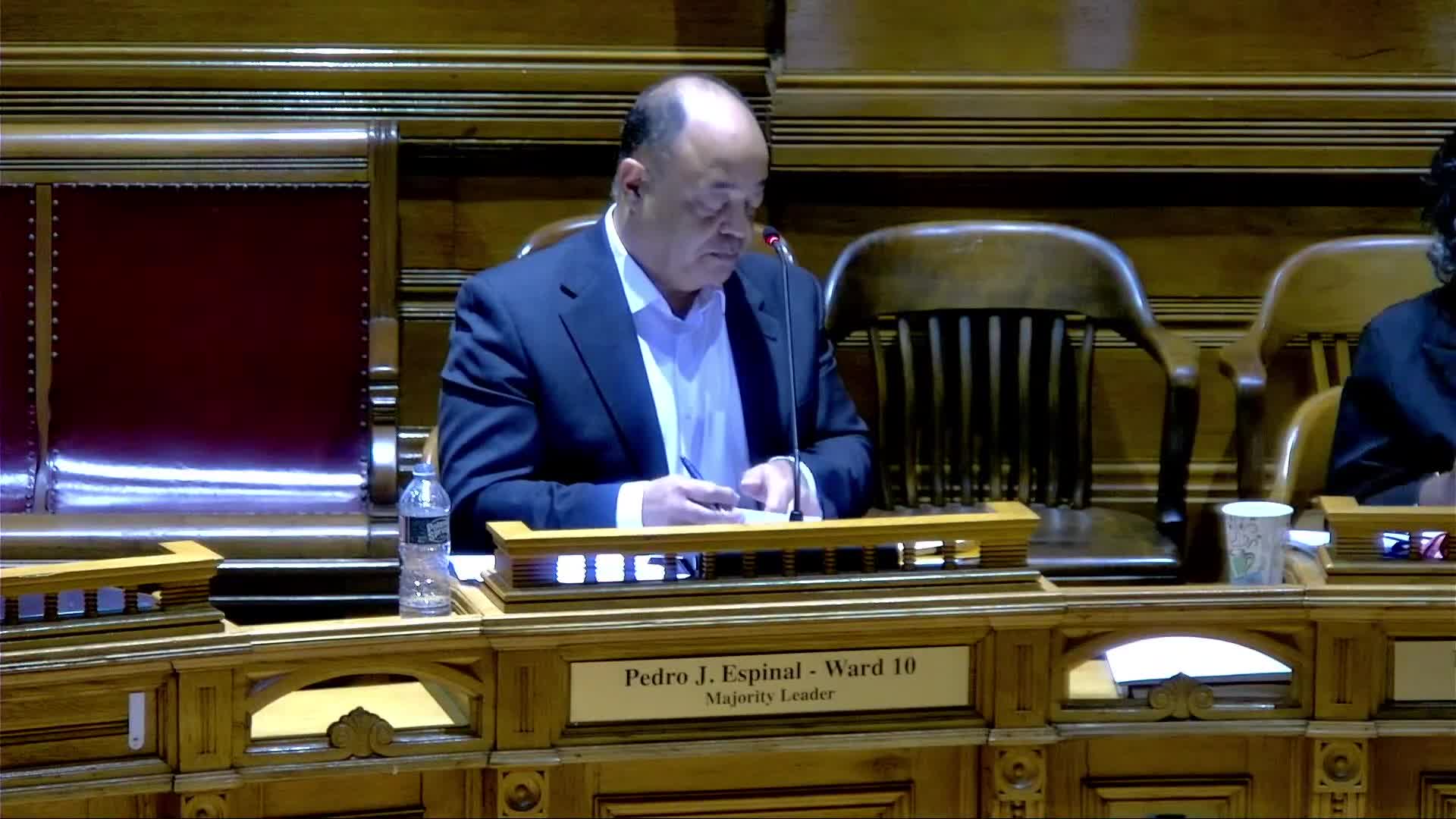
The motion to waive the reader, substitute and pass the ordinance for a second time as amended was made by Majority Leader Espinal and carried in a roll-call vote recorded by the clerk. The clerk announced a final tally of 9 ayes, 3 nays, 1 abstention and 1 absent; the motion passed and the matter was recorded as passed on second reading as amended.
The ordinance as approved phases implementation, prioritizes education before enforcement, and assigns primary administration to Public Works. The council did not specify in the meeting the exact enforcement schedule beyond the dates referenced in the amendment, and the ordinance language in the clerk's reading will govern the official implementation timeline.
Council members who spoke in favor said the ordinance protects public health and workers; those opposed said the council should consider additional measures to prevent harm to workers who would be affected by the change.
Councilwoman Anderbrock said the amendment before the council adjusted several dates, moved enforcement and clarified expectations for education before fines. “We're proving and showing to residents and businesses that the city is willing to go first and show that this is something that's possible,” she said, adding the ordinance directs that there will be "a number of instances of education before enforcement so that folks aren't surprised or given a fine that they aren't expecting." The implementation responsibility was shifted to the Department of Public Works from the department previously named in the draft.
Supporters framed the ordinance as a public health and quality-of-life measure. Councilman Gansaoffs said the rule would protect air quality and workers who inhale exhaust and fine particulates, and he cited a statistic during his remarks: “Using a gas powered leaf blower for an hour is equivalent to 1,100, miles in a gas powered vehicle.” He added the ban advances protections for workers and residents.
Opponents warned of economic consequences for low-income residents who earn income operating blowers and questioned the readiness of battery-powered alternatives. Councilman Oscar Vargas pressed the council on equity concerns, saying the measure could "take the food out of the table" for people who rely on this work and noting battery tools' weight and charging logistics as obstacles for some operators.
The motion to waive the reader, substitute and pass the ordinance for a second time as amended was made by Majority Leader Espinal and carried in a roll-call vote recorded by the clerk. The clerk announced a final tally of 9 ayes, 3 nays, 1 abstention and 1 absent; the motion passed and the matter was recorded as passed on second reading as amended.
The ordinance as approved phases implementation, prioritizes education before enforcement, and assigns primary administration to Public Works. The council did not specify in the meeting the exact enforcement schedule beyond the dates referenced in the amendment, and the ordinance language in the clerk's reading will govern the official implementation timeline.
Council members who spoke in favor said the ordinance protects public health and workers; those opposed said the council should consider additional measures to prevent harm to workers who would be affected by the change.
View the Full Meeting & All Its Details
This article offers just a summary. Unlock complete video, transcripts, and insights as a Founder Member.
✓
Watch full, unedited meeting videos
✓
Search every word spoken in unlimited transcripts
✓
AI summaries & real-time alerts (all government levels)
✓
Permanent access to expanding government content
30-day money-back guarantee
