Trophy Club ZBA’s motion to deny homeowner’s fence variance fails; no final action recorded
November 07, 2025 | Trophy Club, Denton County, Texas
This article was created by AI summarizing key points discussed. AI makes mistakes, so for full details and context, please refer to the video of the full meeting. Please report any errors so we can fix them. Report an error »
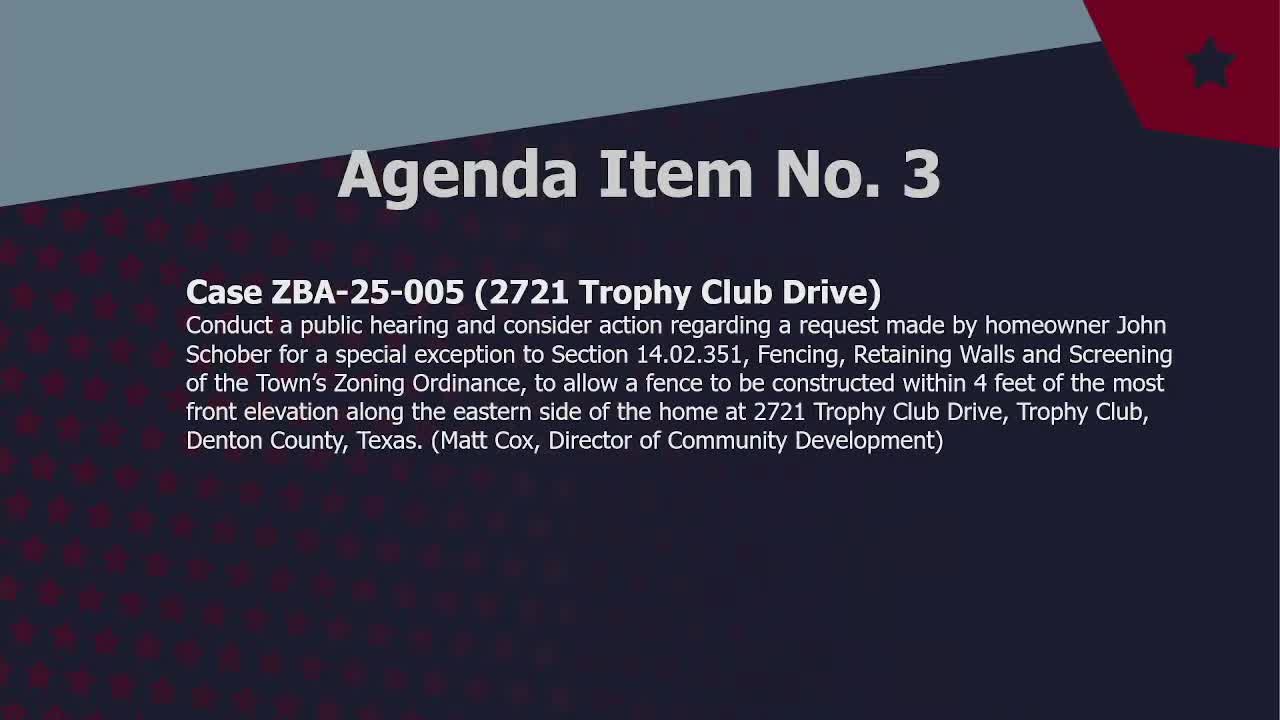
Matt Cox, the town’s director of community development, told the board the application was denied at staff level because the ordinance requires a 10-foot setback and that the board’s authority is limited to granting a specific, case-by-case special exception. “Staff recommends zoning board of adjustment conduct a public hearing and move to deny the request made by homeowner John Schrober,” Cox said during his presentation of the staff report. Cox also described the notification process for the hearing, including mailed notice to properties within 200 feet and a newspaper notice.
Homeowner John Schrober testified that the requested placement (shown to the board as position A on submitted photos) would put a fence post where he plans to install a side-office window when he replaces the house’s windows in about a year to 18 months. Schrober said the change would improve the yard’s balance, better accommodate his working dog’s exercise area and that immediate neighbors had been notified and expressed support. “It puts a fence post right in the middle where we wanna put our window,” Schrober said, explaining why he requested the exception.
Schrober also disputed claims in a neighbor’s letter that were cited during discussion, described investments he has made in the property — including custom trees and a stone-coated metal roof — and said the proposed wrought-iron fence is a custom installation intended to be more attractive than the existing wooden fence.
Board members questioned whether the asserted hardship (a future window) was sufficiently concrete and noted the ZBA’s procedural limit: a special exception applies only to the specific address and does not amend or change the underlying ordinance. One board member said he was reluctant to base a decision on a project that has not yet been completed.
A motion to deny the variance was made and seconded. During a voice vote several members said “aye” and others said “nay”; a member counted “2 nays” and reminded the board that decisions require a supermajority (75 percent of members present). The board chair later announced, “Motion fails is not approved.” The transcript does not record any subsequent motion to approve the variance or any final approval of the applicant’s request.
What the board did record: the staff recommendation to deny, the applicant’s testimony and evidence submitted, the board’s deliberations emphasizing that the ordinance’s 10-foot setback remains in force, and that board decisions are addressed on a case-by-case basis.
Because the transcript ends with the statement that the denial motion failed and contains no follow-up motion or vote to grant the special exception, the record in the meeting transcript does not show a formal approval of the variance.
View the Full Meeting & All Its Details
This article offers just a summary. Unlock complete video, transcripts, and insights as a Founder Member.
30-day money-back guarantee
Sponsors
Proudly supported by sponsors who keep Texas articles free in 2025

