Santa Ana staff outlines Chapter 30 revisions to strengthen review, disclosure and demolition-by-neglect enforcement
This article was created by AI summarizing key points discussed. AI makes mistakes, so for full details and context, please refer to the video of the full meeting. Please report any errors so we can fix them. Report an error »
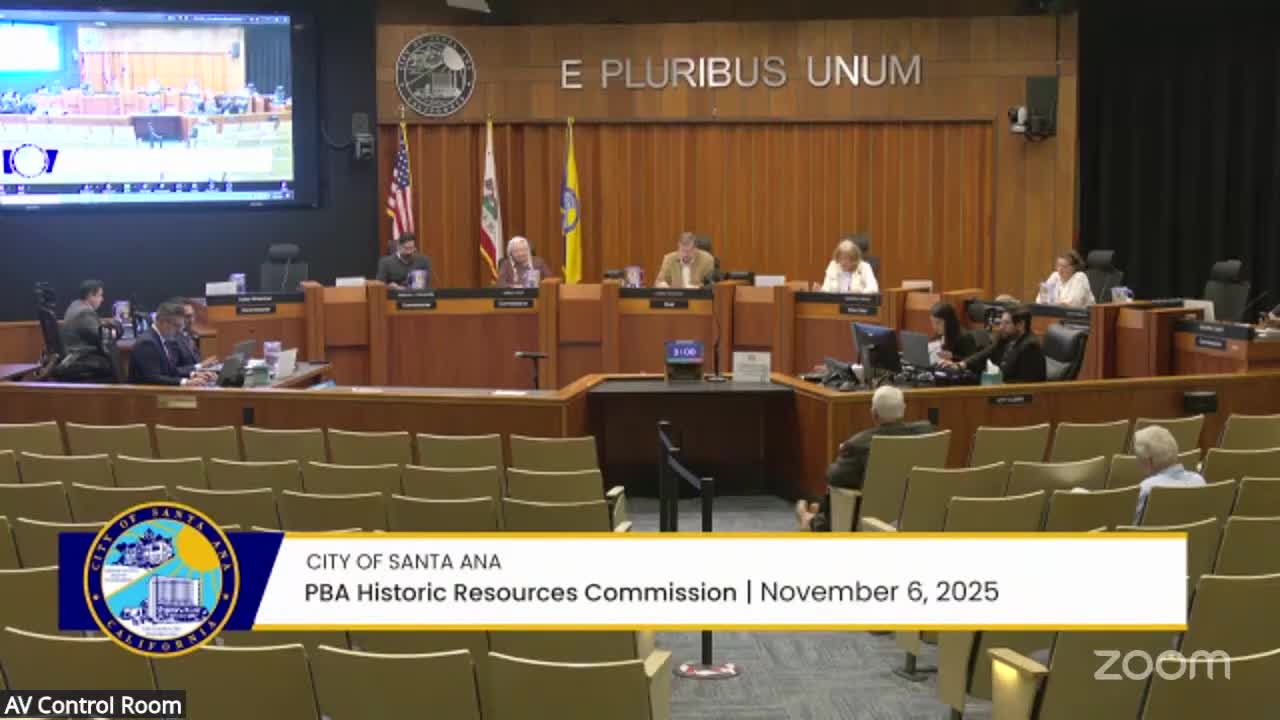
Planning staff presented a work-study summary of proposed revisions to Chapter 30 (historic resources) at the Nov. 20 meeting of the Santa Ana Historic Resources Commission, describing a set of changes intended to modernize definitions, clarify when site work (landscaping, hardscaping, detached accessory structures) triggers historic review, and strengthen protections against demolition by neglect.
James Williams told the commission the draft ordinance amendments grew from three years of ad hoc committee and commission discussion. Proposed changes include new and clarified terms (for example, character-defining feature, internal setting, demolition by neglect, hardscaping, and routine maintenance); a redrafted Section 30-6 that distinguishes major modifications (which would require commission approval) from minor modifications (subject to an administrative certificate of appropriateness issued by planning staff); and explicit language to treat parts of a designated historic property located outside the primary building footprint as potentially subject to review.
To curb demolition by neglect, staff proposed new minimum maintenance standards (draft Section 30-8), a list of deterioration conditions that could constitute violations, procedures for abatement, and penalties. The draft would also institute a 5-year construction and planning moratorium for properties found to have been illegally demolished or effectively demolished by neglect; the moratorium would bar acceptance of new planning applications for the property during that period and require fencing, site maintenance and a salvage/documentation plan to preserve remaining historic fabric prior to removal.
Staff also proposed a new Section 30-11 requiring sellers of properties listed as historic resources (local, state, or national registers) to use a city-provided disclosure form notifying buyers of the property's status and any regulatory implications. Planning staff said the disclosure is intended to reduce surprises in real estate transactions and to support enforcement and maintenance by ensuring buyers are informed upfront.
The revisions are intended to align the municipal code more closely with the Secretary of the Interior's Standards and contemporary preservation practice, while improving administrative efficiency by categorizing work as major or minor and providing clearer, objective thresholds for when work must come to the commission.
The draft package adds an appeals path for staff determinations about character-defining features and leaves in place the existing appeal route to city council for commission decisions. Staff recommended the Historic Resources Commission hold a public hearing on the draft in March 2026, with a city council hearing anticipated in April 2026.
Tim Rush spoke during public comment in support of the proposed site-review changes, saying stronger code language might have changed past controversial cases. Commissioners asked staff clarifying questions about plaques, existing disclosure, and how the Henninger Park specific-development (SD 40) guidelines interact with the proposed Chapter 30 changes. Planning staff confirmed SD 40 is codified and that the Henninger Park guidelines are applied where properties fall under the SD 40 zoning; properties not listed on the register are reviewed under citywide guidelines that provide more material flexibility, which is one reason staff and commissioners distinguished awards recognizing the 'spirit of preservation' from taking formal designation actions.
The commission provided high-level direction, asked staff to continue outreach to neighborhood groups, and accepted the draft for return as a formal hearing item in 2026.
James Williams told the commission the draft ordinance amendments grew from three years of ad hoc committee and commission discussion. Proposed changes include new and clarified terms (for example, character-defining feature, internal setting, demolition by neglect, hardscaping, and routine maintenance); a redrafted Section 30-6 that distinguishes major modifications (which would require commission approval) from minor modifications (subject to an administrative certificate of appropriateness issued by planning staff); and explicit language to treat parts of a designated historic property located outside the primary building footprint as potentially subject to review.
To curb demolition by neglect, staff proposed new minimum maintenance standards (draft Section 30-8), a list of deterioration conditions that could constitute violations, procedures for abatement, and penalties. The draft would also institute a 5-year construction and planning moratorium for properties found to have been illegally demolished or effectively demolished by neglect; the moratorium would bar acceptance of new planning applications for the property during that period and require fencing, site maintenance and a salvage/documentation plan to preserve remaining historic fabric prior to removal.
Staff also proposed a new Section 30-11 requiring sellers of properties listed as historic resources (local, state, or national registers) to use a city-provided disclosure form notifying buyers of the property's status and any regulatory implications. Planning staff said the disclosure is intended to reduce surprises in real estate transactions and to support enforcement and maintenance by ensuring buyers are informed upfront.
The revisions are intended to align the municipal code more closely with the Secretary of the Interior's Standards and contemporary preservation practice, while improving administrative efficiency by categorizing work as major or minor and providing clearer, objective thresholds for when work must come to the commission.
The draft package adds an appeals path for staff determinations about character-defining features and leaves in place the existing appeal route to city council for commission decisions. Staff recommended the Historic Resources Commission hold a public hearing on the draft in March 2026, with a city council hearing anticipated in April 2026.
Tim Rush spoke during public comment in support of the proposed site-review changes, saying stronger code language might have changed past controversial cases. Commissioners asked staff clarifying questions about plaques, existing disclosure, and how the Henninger Park specific-development (SD 40) guidelines interact with the proposed Chapter 30 changes. Planning staff confirmed SD 40 is codified and that the Henninger Park guidelines are applied where properties fall under the SD 40 zoning; properties not listed on the register are reviewed under citywide guidelines that provide more material flexibility, which is one reason staff and commissioners distinguished awards recognizing the 'spirit of preservation' from taking formal designation actions.
The commission provided high-level direction, asked staff to continue outreach to neighborhood groups, and accepted the draft for return as a formal hearing item in 2026.
Don't Miss a Word: See the Full Meeting!
Go beyond summaries. Unlock every video, transcript, and key insight with a Founder Membership.
✓
Get instant access to full meeting videos
✓
Search and clip any phrase from complete transcripts
✓
Receive AI-powered summaries & custom alerts
✓
Enjoy lifetime, unrestricted access to government data
30-day money-back guarantee
