Council reviews renewed liquor-store permit request at Avenue M in Temple Heights amid safety concerns
November 07, 2025 | Temple, Bell County, Texas
This article was created by AI summarizing key points discussed. AI makes mistakes, so for full details and context, please refer to the video of the full meeting. Please report any errors so we can fix them. Report an error »
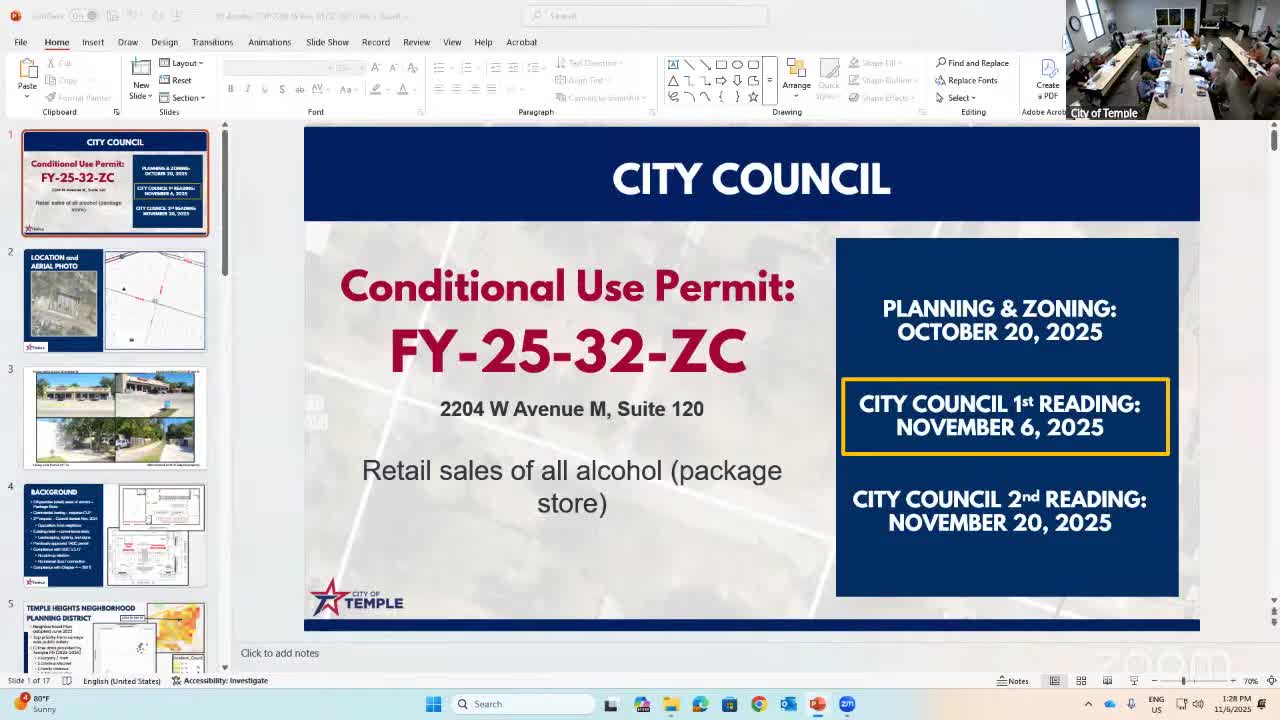
The liquor-store suite would occupy the smaller left-hand unit of a building that also houses a convenience store; staff said the two uses would be physically separated by a solid wall. Staff told the council the site sits about 950 feet from a church and more than 1,000 feet from Scott Elementary, placing it outside the city's 300-foot protected distance from the school. Staff also said it had not yet received a current Texas Alcoholic Beverage Commission certificate for any renewed application.
Staff provided updated outreach results and a three-year crime analysis focused on a 300-foot radius around the address. The packet showed 21 offenses in that window, including burglary, theft, public intoxication and possession of controlled substances. Staff said that, taken together with residents' complaints about vandalism and alley problems, the higher-than-average property-crime rate in that small radius had informed the staff recommendation.
Council members cautioned that the data as presented does not prove causation and asked staff for more granular incident-level detail (for example, whether multiple charges arose from single incidents). Staff agreed the map and the earlier presentation covered different date ranges and said the current map reflects recent months while earlier maps covered a prior period. Staff also said the convenience-store use had been open for only about four months during the period reviewed.
Operational details presented to the council: the liquor-store side was described as not having a drive-through window, store hours were listed as 10 a.m. to 9 p.m., and state law allows beer and wine sales in convenience stores in the commercial zone but the store's plan would keep distilled-spirit sales confined to the separate liquor-suite side.
Neighbors submitted mailed notes, phone calls and a written petition; staff said additional responses arrived after the packet was published and that the owner supplied a handwritten list of supporters that staff had not independently verified. Staff told the council it had conducted door-knocking and outreach to adjacent residents and had received both written and phone responses.
There was extensive discussion about interpreting the crime data, and the mayor and several councilmembers urged caution about using correlation as proof that a liquor license would cause increased crime. No formal motion or vote on the application appears in the public transcript of the item. The council proceeded to the next agenda item after the staff presentation; staff did not report a final council decision in the recorded discussion.
Next steps: staff will continue processing any outstanding permitting steps, including verification of any new Texas Alcoholic Beverage Commission paperwork, and the application will return to the council if a formal action or additional required approvals are needed.
Don't Miss a Word: See the Full Meeting!
Go beyond summaries. Unlock every video, transcript, and key insight with a Founder Membership.
30-day money-back guarantee
Sponsors
Proudly supported by sponsors who keep Texas articles free in 2025

