County committees review OLO report and press for faster data sharing, phone upgrades and more MCOT capacity
November 07, 2025 | Montgomery County, Maryland
This article was created by AI summarizing key points discussed. AI makes mistakes, so for full details and context, please refer to the video of the full meeting. Please report any errors so we can fix them. Report an error »
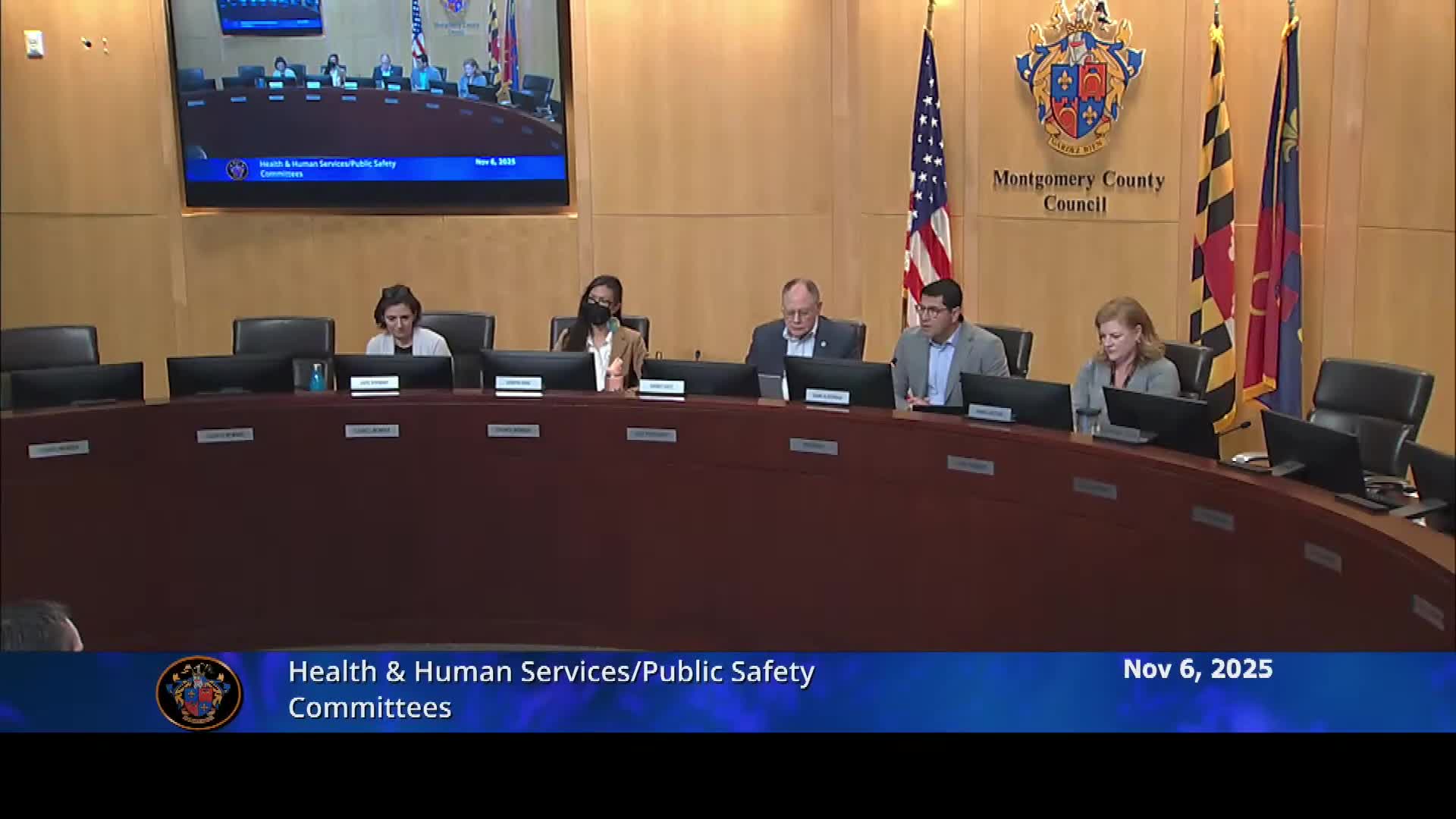
OLO staff told the joint Public Safety and Health & Human Services committees that the county’s community crisis system includes five call‑taking entities: the county crisis center (operated by the Department of Health and Human Services), EveryMind’s 988 center, the longstanding Montgomery County crisis hotline, the Emergency Communications Center (911/ECC), and 311. The report compared definitions of imminent risk, routing practices, backup arrangements, and the availability of text/chat options.
Why it matters: OLO found wide differences in how calls are routed and resolved. For example, 988 resolved 98.1 percent of contacts by phone in 2024, while nearly 98.8 percent of ECC’s mental‑health calls resulted in an in‑person police response. OLO recommended increasing the crisis center’s call‑taking capacity, creating formal interoperable transfer protocols (including direct transfer lines), and improving disaggregated demographic data collection to identify racial inequities and service gaps.
OLO presentation and key findings
Gabriela Reynolds of OLO summarized the work and said the report examines how entities treat imminent and non‑imminent risk and how they handle surges. OLO defined imminent risk as active suicidal intent, access to means, or an immediate threat to others, and noted that in imminent‑risk situations 988, the crisis hotline and 311 transfer calls to 911 for police dispatch. The crisis center’s protocol for imminent risk triggers a level‑2 response in which the county’s Mobile Crisis Outreach Team (MCOT) may be dispatched and may request police support if there is a weapon or clear threat.
OLO presented 2024 and early FY25 data: the crisis center logged the largest number of mental‑health calls (41,610), the county hotline recorded 18,308 contacts, and 988 reported a notable increase in texts. OLO also reported that MCOT dispatches rose from 858 in FY24 to 2,466 in FY25 and that the crisis center expanded peak‑hour MCOT capacity from five to seven teams.
Stakeholder responses and operational changes
Monica Martin, chief of behavioral health and crisis services at DHHS, told council members the crisis center has already implemented the first phase of a phone‑system upgrade (completed in July) that creates a triage hierarchy for incoming calls and establishes a direct line for Montgomery County Police Department partners. "We do have up to seven mobile crisis and outreach teams available during peak hours," Martin said, describing capacity gains since 2023.
Dornay Hill, senior administrator for crisis intake and trauma services, said the July phone upgrade allows the center to prioritize first‑responder calls and imminent behavioral‑health crises and that the next phase — a cloud‑based system for improved data capture — requires building rewiring now scheduled to finish in March. Ariel Gordon, director of EveryMind’s hotline program, described 988’s backup arrangements: "If counselors are unavailable at 988, the call is first transferred to Prince George’s County and then to the national 988 backup network." Gordon and LBHA director Sarah Rose also noted text/chat routing operates at the state level and is currently routed by phone‑number origin rather than caller location, with an 18‑month plan under state and federal work to move to location‑based routing.
911 policy and dispatching criteria
Jen Reedy, director of the Montgomery County 911 Center, said ECC policy (updated in 2023) allows conference transfers to the crisis center when calls lack violence, weapons or criminal activity. Reedy described ECC quality assurance reviews using international standards and said ECC does not routinely collect caller demographic data as part of its call‑handling protocols.
Council questions and next steps
Council members repeatedly pressed for timely MOUs, data sharing and staffing actions. Chairs asked whether the MOUs will include data sharing; panelists confirmed that data sharing is intended to be part of forthcoming memoranda of understanding. Committee members also pressed DHHS about administrative personnel actions that would allow the crisis center to recruit additional peer specialists and community service aid positions; DHHS said several positions are awaiting a county reclassification process and OMB review.
Several council members urged sustained funding and asked staff to return with implementation timelines. Chair Gabriel Bornos thanked OLO and stakeholders and said the committees will follow up on reclassifications, MOUs and ongoing data work.
Ending note
OLO and county staff emphasized the report is part of an ongoing effort: OLO staff recommended the council consider community engagement to define preferred crisis responses, and county agencies described both recent operational improvements and remaining gaps in interoperability and demographic data. "There’s always somebody to talk to 24/7," Sarah Rose said of expanded crisis options, and county officials promised additional updates as the phone upgrades, MOUs and data‑sharing efforts proceed.
View the Full Meeting & All Its Details
This article offers just a summary. Unlock complete video, transcripts, and insights as a Founder Member.
30-day money-back guarantee
Sponsors
Proudly supported by sponsors who keep Maryland articles free in 2025

