Marion board launches North End rezoning push, forms advisory committee and weighs new Spar‑Anthony school
November 07, 2025 | Marion, School Districts, Florida
This article was created by AI summarizing key points discussed. AI makes mistakes, so for full details and context, please refer to the video of the full meeting. Please report any errors so we can fix them. Report an error »
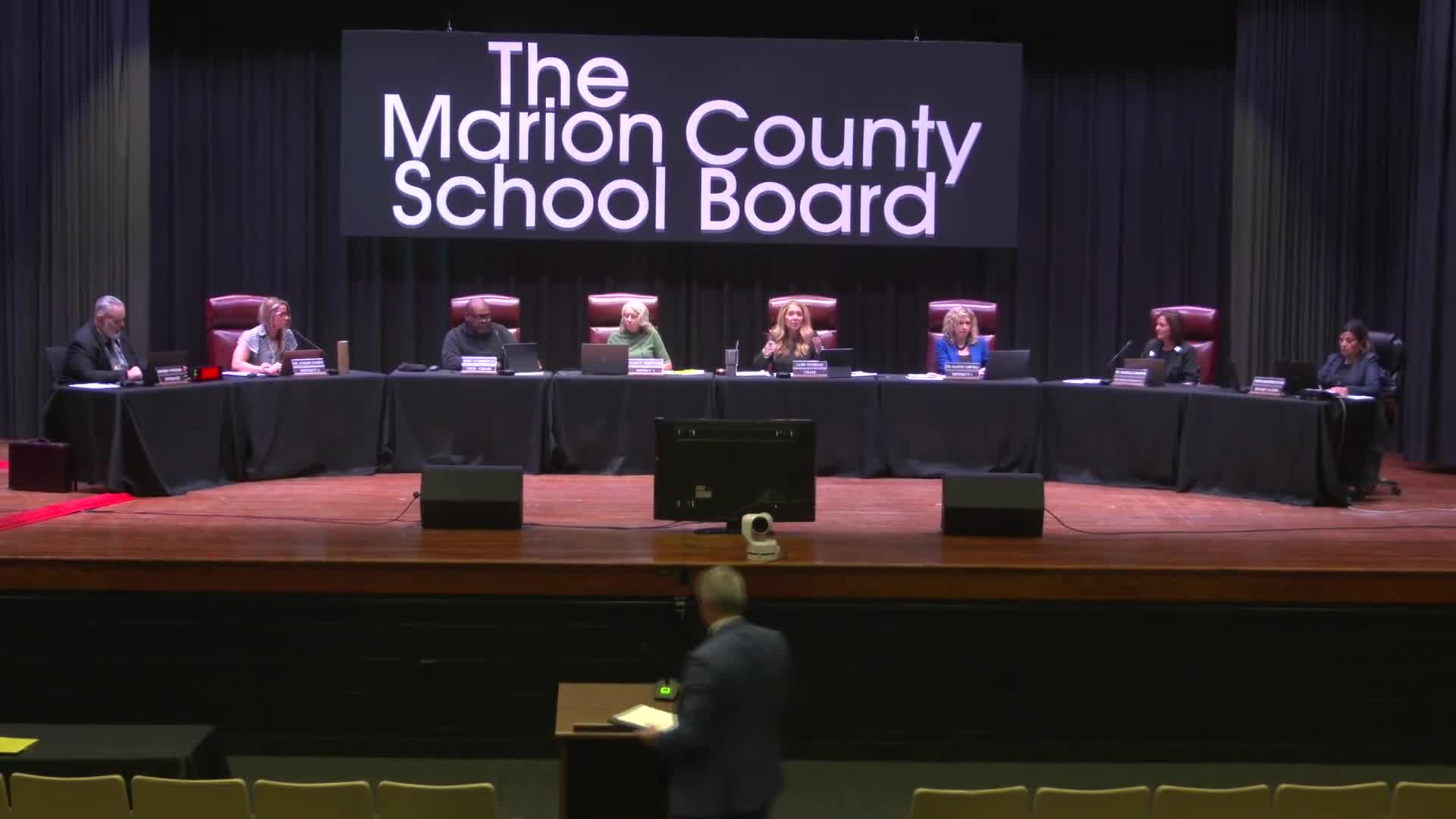
Mr. Whitehouse told the board the district's conservative growth forecast is roughly 600 students per year (about 6,000 over 10 years), concentrated in two corridors. Staff identified Anthony, Fessenden, Oakcrest, Ocala Springs, Reddick Collier and Sparr elementary schools for focused review. "If you take all of those elementary schools and combine the total number of seats and the total number of students enrolled across all those schools, we're at 82% utilization for that group," he said, arguing that redistricting could get the cluster to roughly 80–82% utilization while allowing room for future enrollment growth.
To carry out community engagement and technical work, staff proposed an Attendance Boundary Advisory Committee (ABAC) whose resolution appears on the Nov. 11 board agenda. The committee would include board nominees, a superintendent nominee, and representatives from the Public Education Foundation, CEP, NAACP, ESE director, Hispanic Business Council, the land development industry and a county commissioner. The proposed timeline calls for committee meetings in November–December, a work session in December or January, community meetings in January–March, rule development in March–April and parent notification by May if any changes are adopted.
Board discussion covered several connected proposals: moving the Fiddler Springs diagnostic/learning resource program into Building 10 at Reddick Collier (staff recommended against it, citing small restrooms, insufficient adult training space and lost square footage); combining Sparr and Anthony into a new elementary on the Sparr site (staff outlined options to reallocate existing capital funds and delay other projects to produce roughly $55 million toward a new school); and potential uses for vacated sites and buildings (for example, using surplus Bellevue buildings to save $13 million on a future campus design). Board members pressed for detailed cost breakdowns, operating‑cost splits for Fiddler Springs, and options to preserve community traditions and access.
Several board members emphasized process and transparency. Members asked staff to prepare virtual tours of two newly built elementary schools for an upcoming town hall, to detail how rezoning would affect ESE students and auxiliary (Evergreen) zones, and to provide a clear timeline that distinguishes what decisions are needed for the 2026–27 school year versus longer‑term capital projects. The board directed staff to move forward with the ABAC and to return with the meeting schedule and names, and asked for follow‑up work on Bridgeway placement, vacated site proposals and potential capital reallocation scenarios.
Ending: The board agreed to proceed with the advisory committee and rezoning process as the immediate next step; staff will bring data, virtual tours and meeting schedules to upcoming public forums and to the Nov. 11 agenda for the ABAC resolution.
View the Full Meeting & All Its Details
This article offers just a summary. Unlock complete video, transcripts, and insights as a Founder Member.
30-day money-back guarantee
Sponsors
Proudly supported by sponsors who keep Florida articles free in 2025

